
Lieferung heute & morgen

Qualitätsgarantie

Willkommens-Angebote freischalten: KOSTENLOSE Lieferung | Bis zu 80 % RABATT | Kostenlose 30-Tage-JoyPlus-Testphase
App herunterladen
A 1-litre French press coffee maker is ideal for households with several coffee drinkers, the office or weekend guests. Brewing requires neither paper filters nor coffee capsules and works without electricity. However, models differ considerably in terms of materials, filters, cleaning and safety.
If you only pay attention to the colour or brand name, you may overlook important details. Three common buying misconceptions are particularly relevant:
A French press labelled as 8 cups with a capacity of 1.0 litre is designed for several people. However, the cup designation is not based on a uniform German standard. Always check the capacity in millilitres rather than relying solely on the advertised number of cups.
For one or two people, a 350- or 500-millilitre model may be sufficient. For families, offices and guests, a 1-litre French press coffee maker offers more flexibility. The pot should not be filled right to the brim after pouring in the water, so that the filter can be moved safely and the coffee poured cleanly.
In a high-quality model, the pot is often made from heat-resistant borosilicate glass. The material is non-porous and, according to BODUM’s product information, does not absorb odours. A frame made from stainless steel or chrome-plated steel can provide the glass with additional protection during everyday use, but it does not replace careful handling.
When choosing a coffee maker with a filter, look for:
According to the product description, the Bialetti Preziosa is made from 18/10 stainless steel, glass and plastic. This model has a specified maximum temperature of 120 °C. This limit should be observed.
Coffee residue and oils build up in the filter and on the walls of the pot. A detachable filter makes thorough cleaning easier. Even with a dishwasher-safe coffee maker, you should follow the care instructions provided by the relevant manufacturer. Plastic parts and chrome-plated surfaces may show more visible signs of wear after frequent dishwasher cycles.
It is also important to check whether replacement filter parts are available separately. A manual coffee maker can be used for a long time with careful handling, but the glass, seals or filter may need replacing if damaged.
Coarsely ground coffee is generally used for a French press coffee maker. Finely ground coffee can pass through the filter or make the pressing process more difficult.
A simple guide:
A coffee press like this can also be used for coffee and tea. However, tea may leave flavours in the filter. If the pot is used for both drinks, thorough cleaning after each use is recommended.
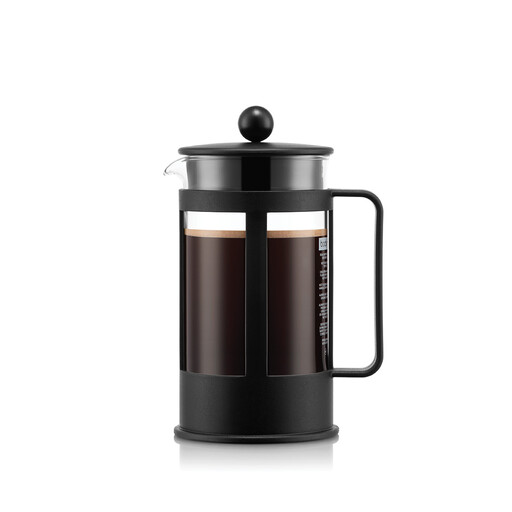
Why this product suits this profile: The 1-litre model is aimed at shoppers looking for an uncomplicated 8-cup French press for home or the office. The black polypropylene frame and ergonomic handle are designed to make pouring easy.
The product information specifies a capacity of 1 litre, heat-resistant borosilicate glass and a three-part stainless steel filter system. This makes the key technical details easy to check before buying.
1-litre capacity, a visible brewing process through the glass and a reusable stainless steel filter.
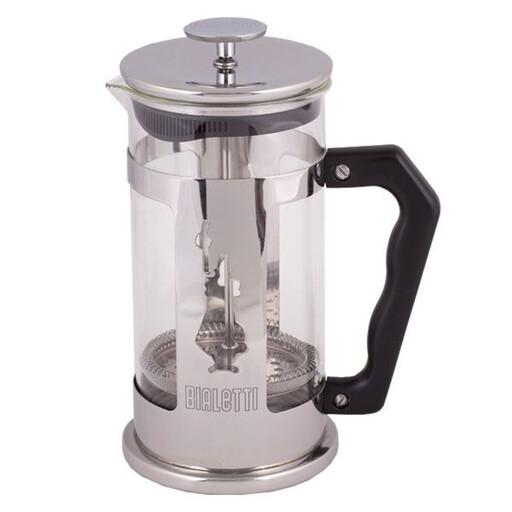
Why this product suits this profile: The combination of a stainless steel casing and borosilicate glass is ideal for households that value a protected pot and easy care. According to the product description, this model is dishwasher-safe.
The manufacturer’s information lists the materials, capacity, dimensions, dishwasher suitability and a maximum temperature of 120 °C. Shoppers can compare these details with their everyday needs.
18/10 stainless steel casing, 1-litre capacity and stated dishwasher-safe cleaning.
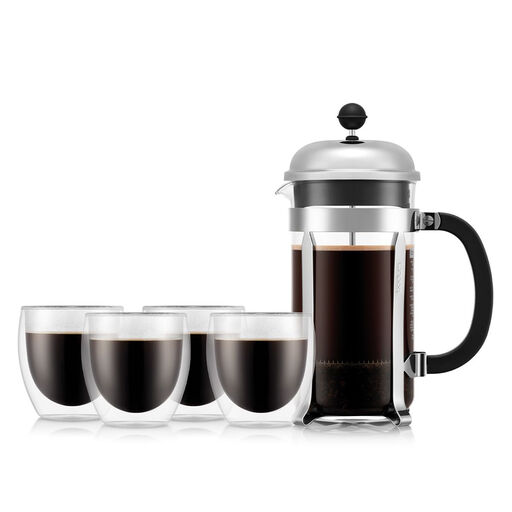
Why this product suits this profile: This set combines a 1-litre coffee maker with four 250-millilitre glasses. It is therefore suitable for hosts or households that want to serve coffee in ready-portioned servings.
The product description specifically states the pot’s capacity, the three-part stainless steel filter system and the included glasses. This makes it easier to understand exactly what is included before ordering.
1-litre pot plus four 250-millilitre glasses and a safety lid, according to the product information.
We have put together a complete, regularly updated list of products that fully meet these strict selection criteria and the safety regulations applicable in the EU.
As a starting point, you can use around 60 grams of coarsely ground coffee per litre of water. The exact amount depends on the coffee, grind size and personal taste. Using scales helps you achieve a consistent ratio every time.
The service life depends mainly on how the glass is handled, cleaning and the quality of the filter. Stainless steel parts can remain usable for a long time with normal care. The glass pot should not be placed on sharp edges or exposed to sudden changes in temperature. Before each use, it is advisable to check it visually for cracks or damage.
To prepare coffee, you only need coffee beans or ground coffee and water. As no paper filter or coffee capsule is required, these consumables are not an additional expense. A coarse grind, the right amount of water and regular cleaning can help prevent unnecessary coffee waste.