
Lieferung heute & morgen

Qualitätsgarantie

Willkommens-Angebote freischalten: KOSTENLOSE Lieferung | Bis zu 80 % RABATT | Kostenlose 30-Tage-JoyPlus-Testphase
App herunterladen
A 1-litre glass bottle is suitable for water, homemade lemonade, iced tea and juice. However, choosing one does not always lead to the right product. Buyers often base their decision solely on appearance or the stated capacity. In everyday use, potential weaknesses tend to show up elsewhere: in the closure, during cleaning or in the bottle’s suitability for particular drinks.
This buying guide from the Joybuy Product Recommendation Officer provides an objective overview of the most important criteria and explains which 1-litre bottle suits which type of use.
A specification such as “1 litre” does not always describe the practical fill level up to the closure. Some bottles have a small amount of space left at the top due to their design. Product names and technical specifications can also occasionally differ. Buyers should therefore check whether the product is actually listed as 1.0 litres, a nominal volume or a different capacity.
For everyday use at the table, a 1-litre lemonade bottle is usually sufficient. If you want to serve several people, you could also consider a jug or a set with glasses.
A stopper or lid can protect drinks from dust and make serving easier. When transporting the bottle, for example to a picnic, it is more important to know how securely the closure fits. For a drinks bottle with a closure, check the product description for information about secure closing and the intended use.
A closure with a drinking opening or straw is a different solution from a traditional serving stopper. A sports bottle with a straw is more suitable for exercise and use on the go, while a glass bottle with a stopper may be more practical on the dining table.
The glass body of a glass bottle may be dishwasher-safe, while the lid, seals or decorative surfaces should be cleaned separately. Before buying, it is worth checking the complete care instructions. Narrow bottle openings can also make manual cleaning more difficult, even when the material is generally easy to care for.
A glass water bottle generally does not take on typical plastic flavours when used for cold drinks, and its transparent surface lets you see the contents directly. However, glass is sensitive to impact and can break if dropped.
Products intended for contact with food should include the relevant manufacturer’s information. The “Lemonade Bottle Line 1.0 L Transparent Glass” is stated to be suitable for food contact and to comply with EU Regulation (EC) No 1935/2004. This information applies to the specific product and should not automatically be assumed to apply to every glass bottle.
A tall, slim bottle takes up less space, but may be impractical in low refrigerator compartments or door shelves. For example, the Lemonade Bottle Line measures approximately 8.4 cm in diameter and 31 cm in height. This shape makes pouring easier, but you should check it against your available storage space beforehand.
For a 1-litre glass jug, a stable base, an easy-to-reach spout and a sufficiently wide neck are also important. Grooves or textured surfaces can affect grip, but may sometimes make cleaning more time-consuming.
Many 1-litre glass bottles are intended for cold or room-temperature drinks. The product information should clearly state whether hot liquids are excluded. For the Lemonade Bottle model described here, the instructions state: do not fill with boiling liquids and avoid sudden changes in temperature. So-called thermal shock can damage the glass or cause it to break.
Microwave suitability should not be assumed either. Use of the Lemonade Bottle Line in a microwave is expressly excluded. For water, lemonade, iced tea and juice, this is generally not an issue in everyday use, provided the drinks are poured in cold or at most at room temperature.
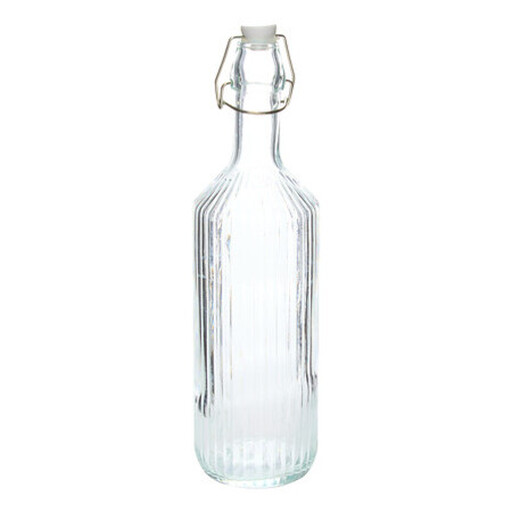
Why this product suits this profile: This transparent 1-litre glass bottle is designed for water, lemonade, juice and other cold drinks at home. Its slim shape makes it well suited to serving at the table.
The 1.0-litre capacity, dimensions and care instructions are clearly specified. The closure should be kept firmly closed when storing or carrying the bottle.
Transparent glass, a 1.0-litre capacity and dishwasher-safe according to the product information. Intended for cold and room-temperature drinks.
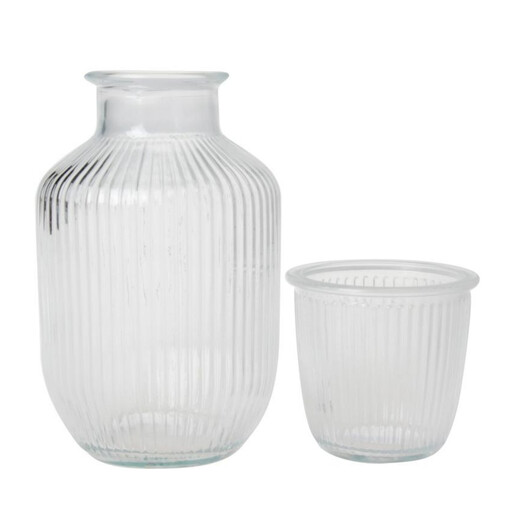
Why this product suits this profile: This set combines a 1,000-ml jug with two 270-ml glasses, making it suitable for families, guests, brunch or serving cold drinks.
The product description specifies the material, volume, set contents and cleaning instructions. The ribbed surface and textured base are clearly described, but they do not replace careful handling of glass.
Lead-free, transparent glass according to the product information, a 1,000-ml jug and two matching 270-ml glasses. Suitable for cold drinks and dishwasher-safe according to the description.
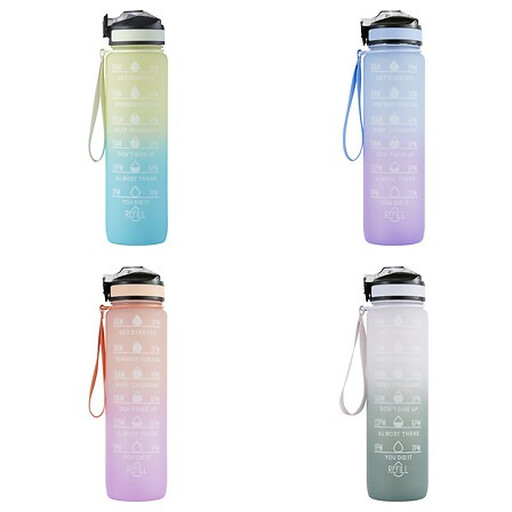
Why this product suits this profile: If you want to drink while out and about, exercising or working in the office, this 1-litre PETG and PP bottle features an integrated silicone straw, carry strap and one-handed opening.
This bottle is not made of glass, making it suitable for users who want to avoid the risk of breakage during transport. The removable silicone straw can be cleaned separately.
PETG/PP construction, 1.0-litre capacity, carry strap and one-handed opening according to the product description. Graduations and time markings make it easier to keep track of your drinking.
We have put together a complete, regularly updated list of products that fully meet these strict selection criteria and the safety regulations applicable in the EU.
To ensure that a glass bottle can be used for a long time, a few simple routines are essential:
For catering businesses and hosts, stackable glasses, a stable base and an easy-to-reach opening are also important. A jug for cold drinks may be more practical for larger gatherings than several individual bottles. A water jug with glasses provides a coordinated serving set.
That depends on the specific design and the manufacturer’s information. A traditional lemonade bottle with a simple stopper should not automatically be used for highly carbonated drinks. Before buying, check whether the closure and container are expressly designed for this purpose.
If the product is labelled as dishwasher-safe, the glass body can be cleaned accordingly. Closures, seals and straws should be treated in line with their respective care instructions. For hand-washing, warm water, mild washing-up liquid and a suitable bottle brush are helpful.
There is no standard lifespan that applies in every case. It depends on the material, how frequently the bottle is used and how it is handled. Glass can be used for a long time provided there are no cracks, chips or other damage. The bottle should be replaced if any visible damage occurs.