
Lieferung heute & morgen

Qualitätsgarantie

Willkommens-Angebote freischalten: KOSTENLOSE Lieferung | Bis zu 80 % RABATT | Kostenlose 30-Tage-JoyPlus-Testphase
App herunterladen
A 1-litre thermos flask is useful in many everyday situations: it can provide hot water for the household, sit in the office ready for several cups of tea, or accompany you on a picnic or camping trip. At first glance, choosing one seems straightforward. However, unclear information about heat retention, closures and cleaning often leads to unsuitable purchases.
If you are looking for a 1-litre insulated flask, you should therefore consider more than just the colour and advertising claims. The key factors are the inner material, how easy it is to use in practice and whether it is suitable for the drinks you intend to carry.
Phrases such as “keeps drinks warm for a long time” often state neither a time period nor the conditions behind the claim. Heat retention depends, among other things, on how full the flask is, how often it is opened and whether it was preheated before filling.
A thermos flask with high heat retention should therefore have a clearly explained insulation design. Many models use a double-wall construction with a vacuum or a glass inner flask. By contrast, a general number of hours without further explanation is only of limited use when comparing products.
A thermos flask with a glass inner flask can be suitable for tea, coffee and hot water. However, glass is more vulnerable to impacts than stainless steel. Drops, hard knocks or vigorous shaking can damage the inner flask, even if the outer casing appears sturdy.
If you plan to carry the flask in a rucksack or transport it frequently, you should therefore consider how carefully it can be handled. For use at a desk or in the kitchen, or for careful transport, a glass inner flask can be a suitable choice.
Not every insulated flask is dishwasher-safe. With delicate surfaces or a glass inner flask, hand washing with mild washing-up liquid may be required. Carbonated drinks and dry ice are also unsuitable for many sealed containers, as pressure can build up.
Before buying, check the care instructions and the drinks the flask is approved for. This is especially important if the thermos flask for hot drinks will be used every day for coffee or tea.
A stated capacity of 1 litre is roughly equivalent to four to eight cups, depending on the size of the cup. This may be sufficient for a working day or a household with several people. For one person travelling only short distances, a smaller insulated flask may be easier to handle.
Also pay attention to the opening size and closure. A wide opening makes filling and cleaning easier, while a suitable pouring mechanism helps you portion out coffee or tea. The flask should not be filled right to the brim, so that nothing spills over when it is closed.
With a glass-inner-flask thermos, the most delicate part is the inner container. A sturdy outer casing can protect the inner flask, but it cannot replace careful handling. Stainless-steel models are often more practical for outdoor activities when a low risk of breakage and resistance to transport are priorities.
The product details for the COOKER KING Warmth Series state that it has a glass inner flask, a robust outer casing and is designed for hot drinks. The model has a capacity of 1 l and is available in Warm Apricot. According to the product description, it should be washed by hand using a mild cleaning product and a soft cloth.
For a more consistent temperature, rinse the flask with hot water before filling it. Empty the water, then add your actual drink. Regular cleaning is recommended for tea and coffee, as residue can affect the smell and taste.
A glass inner flask requires additional precautions:
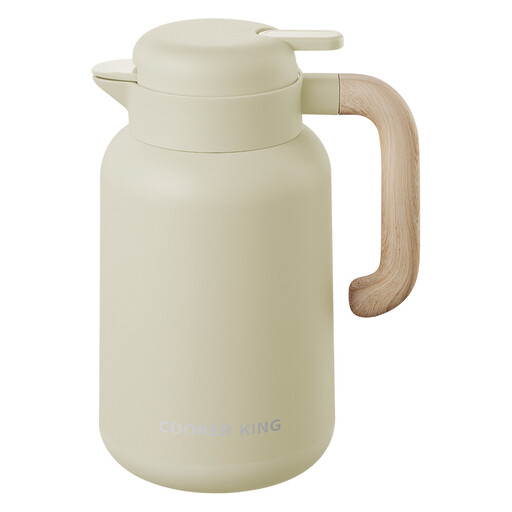
Why this product suits this profile: The 1-litre format covers typical quantities for the home, office and short trips. The subtle Warm Apricot colour offers a specific design option without relying on decorative extras for its functionality.
The product details specify the capacity, inner material and care instructions. This means you can check before buying whether hand washing and careful handling fit your everyday routine.
1 l capacity, glass inner flask, robust outer casing and, according to the product description, high heat retention for hot drinks.

Why this product suits this profile: This model is aimed at users who prioritise low weight and a leak-proof closure over an exact 1 l capacity. It is suitable for commuting, walks and sporting activities.
The details clearly state the 0.75 l capacity. This makes it clear that it is not a 1-litre insulated flask, but a more compact alternative.
Double-walled stainless steel, Safe-Flow lid with safety lock and, according to the product details, up to 10 hours of heat retention.

Why this product suits this profile: The 1.2-litre tumbler is designed for users who prefer a larger drinking capacity and mobile use in everyday life. The handle, lid and reusable straw are designed for transport and frequent drinking.
The actual 1.2 l capacity is clearly stated. Buyers can therefore decide whether they specifically need the extra capacity or would prefer to stick to a 1-litre thermos flask.
1.2 l capacity, handle, lid and reusable straw; according to the product description, suitable for hot and cold drinks.
We have put together a complete, regularly updated list of products that fully meet these strict selection criteria and the safety regulations applicable in the EU.
A few simple steps are recommended for hot drinks:
A thermos flask should not be placed in the microwave or on a hob. With models featuring a glass inner flask, protection against knocks is particularly important.
There is no single time period that applies to every model. It depends on the insulation principle, fill level, starting temperature and how often the flask is opened. Product specifications should therefore be viewed as a guide under specific conditions, not as a guarantee for every use.
Yes, provided the manufacturer specifies that these drinks are suitable. The flask should be cleaned promptly after use, as coffee and tea residue can leave behind odours. Careful handling is essential during transport because of the risk of breakage.
For camping, hiking and picnics, weight, closure, leak resistance and impact resistance are particularly important. A lighter stainless-steel model may be more practical when you are out and about. A 1-litre flask with a glass inner flask is better suited to situations where it can be protected and transported carefully.