
Lieferung heute & morgen

Qualitätsgarantie

Willkommens-Angebote freischalten: KOSTENLOSE Lieferung | Bis zu 80 % RABATT | Kostenlose 30-Tage-JoyPlus-Testphase
App herunterladen
A 1-litre thermos flask is ideal for the breakfast table, office, family home or longer outings. Depending on cup size, its capacity provides approximately six to eight servings. However, a wide selection does not automatically guarantee the right choice: some models are designed only for cold drinks, others feature delicate glass liners or cannot be transported safely when travelling.
This buying guide from the Joybuy Product Recommendation Officer explains the most important product specifications and highlights what you should consider before purchasing a 1-litre insulated carafe.
The claim thermos flask keeps drinks hot for 12 hours generally refers to a maximum value measured under specific conditions. Factors such as the starting temperature, fill level, ambient temperature and frequency of opening all play a role. A flask that is only half full will usually lose heat faster than a completely filled model.
According to the respective product specifications, the Emsa Soft Grip models keep hot drinks warm for up to 12 hours and cold drinks chilled for up to 24 hours. This should be understood as a guideline rather than a guaranteed temperature performance in every usage scenario.
A sports bottle with a straw can be practical for carrying water on the go, but it is not automatically an insulated carafe for coffee and tea. The “Sports Bottle with Straw 1.0 L PETG Assorted” included in the range is made of PETG and PP and features a silicone straw and one-handed closure. According to the product description, it is designed for active use and cold drinks. For hot liquids, you should follow only the instructions explicitly approved by the manufacturer.
Calling a thermos flask leakproof is not sufficient as a buying criterion. Check whether the product description specifies a particular seal or a closure design explicitly described as leakproof. It is equally important to determine whether the lid must be fully locked and whether the flask is suitable for transport in a horizontal position.
A stainless-steel thermos flask with double-wall vacuum insulation is generally more resistant to knocks in everyday situations than a model with a glass liner. Stainless-steel models are therefore often well suited to offices, picnics, travel and outdoor activities.
Vacuum flasks with glass liners can be a classic choice for coffee and tea. However, the glass insert requires careful handling. Drops, hard impacts and sudden temperature changes can damage it. With glass-lined models, the care and safety instructions should be followed particularly closely.
A one-handed closure is useful when the flask is being used at a desk, while serving or when your other hand is occupied. According to the respective product specifications, Quick-Tip and Quick-Press systems can be operated with one finger. Even so, make sure the closure is completely sealed before lifting or transporting the flask.
When it comes to pouring, the following features also matter:
A 1-litre thermos flask is compact enough for everyday household use while still providing several servings. The actual number depends on cup size. A model with a wide opening is easier to rinse and clean with a suitable brush.
Follow the care instructions carefully: some flasks may only be cleaned by hand using a mild detergent. With glass liners, do not use metal spoons and avoid exposing the flask to sudden temperature changes. Thoroughly rinsing the flask before first use is recommended.
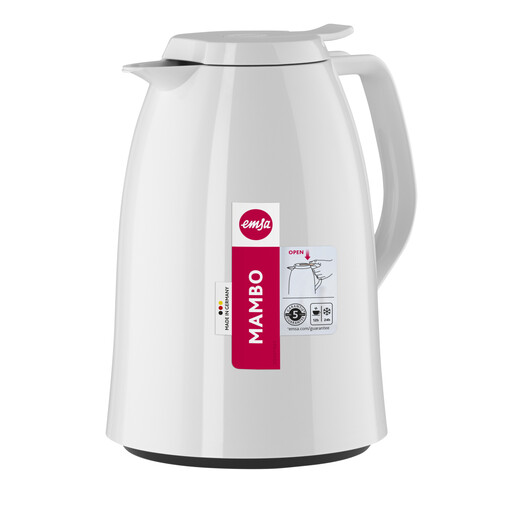
Why does it suit this profile? Its classic design is ideal for coffee breaks at home, in the office and for serving guests.
The product specifications state that it features a Quick-Press closure, a wide opening and a lid described as 100% leakproof.
According to the product specifications, keeps drinks hot for up to 12 hours and cold for up to 24 hours; one-handed operation and an easily accessible opening.
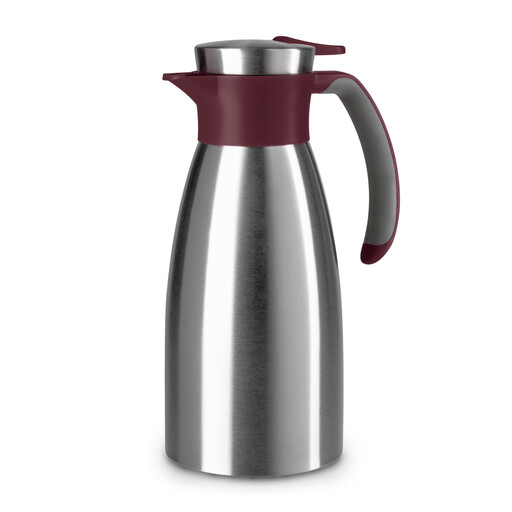
Why does it suit this profile? This model combines double-wall stainless steel with a soft-grip handle and a streamlined design for the home and office.
The material, closure and leak resistance are clearly specified in the product data rather than being described only through general insulation claims.
Double-wall stainless steel, Quick-Tip closure, soft-grip handle and, according to the product specifications, up to 12 hours of heat retention and 24 hours of cold retention.
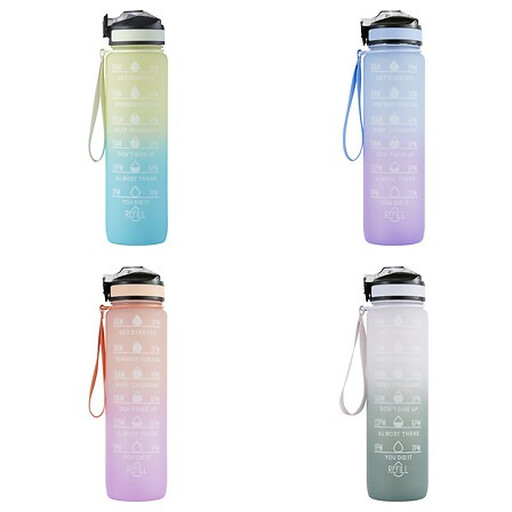
Why does it suit this profile? For sports, walks and outdoor activities, it offers a carry loop, volume markings and one-handed opening.
It is not classified as a traditional thermal carafe: according to the product data, it is a sports bottle with a straw. Before buying, make sure it matches the type of drink you plan to carry.
PETG/PP construction, removable silicone straw, 1-litre capacity and carry strap according to the product description.
We have put together a current selection of products to suit different requirements for capacity, closure and insulation.
Before filling, a vacuum flask can be preheated with hot water or pre-chilled with cold water. This reduces the initial temperature difference between the drink and the inner wall. Then fill the flask as fully as possible and close the lid immediately.
For hot drinks:
For cold drinks: glass-lined models must not be used with ice without first consulting the manufacturer’s instructions. Carbonated drinks and dry ice should never be placed in an ordinary insulated flask, as pressure may build up.
Depending on cup size, approximately six to eight cups can be served. The Emsa Soft Grip product specifications state that a 1-litre capacity provides around eight cups. With larger mugs, the actual number will be correspondingly lower.
According to the manufacturer’s specifications, this may be possible for up to 12 hours with certain models. Actual performance depends on factors including fill level, starting temperature, preheating and ambient conditions. The stated duration should therefore be regarded as a guideline, not an independently verified guarantee of continuous performance.
For regular transport, a tightly closing lid, sturdy construction and secure handle are important. A double-wall stainless-steel flask is generally less vulnerable to impact than a model with a glass liner. Before packing it away, make sure the lid is fully closed; suitability for horizontal transport should be confirmed in the manufacturer’s specifications.