
Lieferung heute & morgen

Qualitätsgarantie

Willkommens-Angebote freischalten: KOSTENLOSE Lieferung | Bis zu 80 % RABATT | Kostenlose 30-Tage-JoyPlus-Testphase
App herunterladen
By Joybuy Product Recommendation Officer, July 14, 2026
A reliable power supply is crucial, whether you're camping, in an RV, working outdoors, or as a safeguard against a power outage at home. A 1000Wh power station offers a balanced compromise between performance and portability. It's powerful enough to run most everyday and even some high-draw devices, yet still compact enough for mobile use.
This article provides a practical guide to choosing a suitable portable power station. We will highlight the most important technical features and present a selection of models that, based on their specifications, are well-suited for various applications.
The decision for a specific model should be based on objective criteria that match your individual needs. Here are three key points to consider.
The choice of battery is fundamental to the longevity and safety of a power station. Modern devices increasingly rely on Lithium Iron Phosphate (LiFePO4) batteries. Compared to conventional lithium-ion batteries (NCM/NCA), LiFePO4 cells offer a significantly higher cycle life. This means they can be fully charged and discharged much more often before their capacity noticeably degrades. Manufacturers often state 3,000 to 4,000 charge cycles until the capacity drops to 80%, which can correspond to a lifespan of up to 10 years with regular use. They are also considered more thermally stable and therefore safer. A mobile power storage unit with LiFePO4 is thus a future-proof investment.
The output power, measured in watts (W), determines which devices you can operate. Pay attention to two values:
A power station for camping should have a variety of ports: at least two 230V AC outlets, multiple USB-A and high-power USB-C ports (e.g., with 100W Power Delivery), and a 12V car socket.
Charging flexibility is a key practical advantage. Most models can be recharged via a wall outlet, the 12V socket in a car, or with solar panels. The latter transforms the power station into a self-sufficient solar generator. Charging time is another criterion; some devices can reach a near-full charge in under an hour thanks to fast-charging technology.
For emergency power at home, an uninterruptible power supply (UPS) function is relevant. Devices with a switchover time of less than 20 milliseconds can keep sensitive electronics like computers or servers running without interruption during a power outage. Quiet operation is also a plus, especially if the unit will be used in living spaces or as a quiet power generator in a tent at night.
Based on the criteria mentioned, we have selected three models from our range that showcase different strengths.
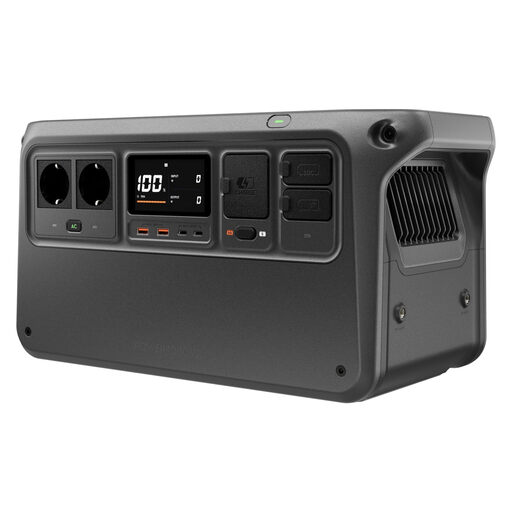
What sets it apart: The DJI Power 1000 V2 is designed for high performance and speed. With a very high AC output and extremely fast charging times, it targets users who need to run power-intensive devices and get back up and running quickly. A special feature is the SDC fast-charging function for specific DJI drone batteries.
Pros:
Who is it for? Professional users like photographers, videographers (especially DJI drone pilots), and tradespeople who require very high output for tools and rapid charging cycles. It's also an option for demanding emergency power at home due to its high performance and fast UPS function.
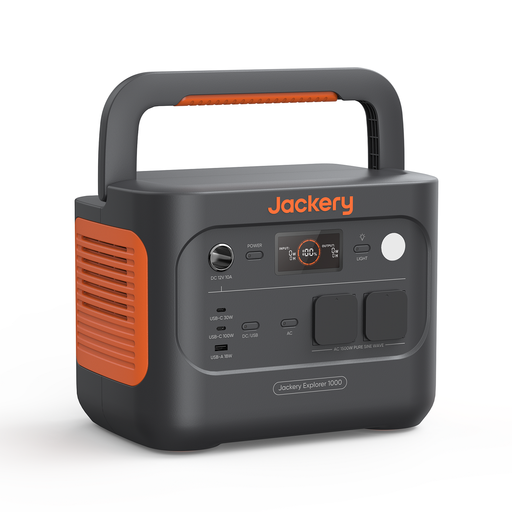
What sets it apart: The Jackery Explorer 1000 V2 focuses on a balance of compactness, durability, and user-friendliness. According to the manufacturer, it is lighter and smaller than comparable models and offers a very long lifespan with 4000 charge cycles. Its extremely quiet operation makes it ideal for use in quiet environments.
Pros:
Who is it for? Ideal for outdoor enthusiasts and campers looking for a lightweight, durable, and especially quiet power station for camping. Its compact dimensions and lower weight make it a great choice for transport in a car or RV.
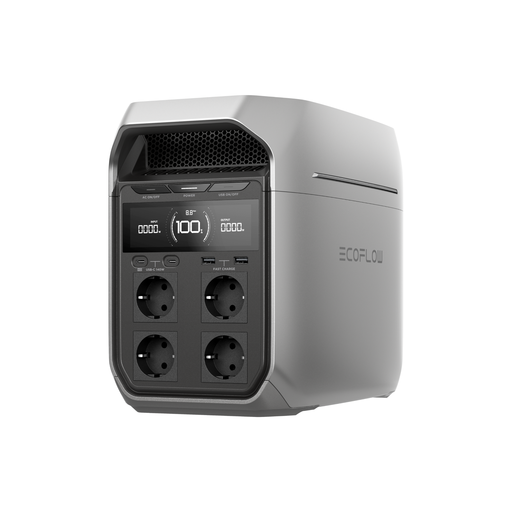
What sets it apart: The EcoFlow Delta 3 Plus stands out with its flexibility and smart energy management. It offers very fast recharging, a high output with X-Boost technology for demanding appliances, and the ability to expand its capacity up to 5 kWh with extra batteries.
Pros:
Who is it for? Users looking for a flexible and expandable solution. It is suitable for both emergency power at home—where capacity can be increased as needed—and for demanding camping trips where many devices need to be powered at once.
If these models don't meet your specific requirements, or if you are considering a different power class, you can find a wider selection of mobile power solutions in our Emergency Power category.
A power station with 1000 watt-hours (Wh) can power a wide range of devices. For reference: it can run a laptop (approx. 50W) for about 16-18 hours, a portable electric cooler (approx. 45W) for over 20 hours, or charge a smartphone (approx. 10Wh per charge) over 80 times. Short-term use of kitchen appliances like a small kettle or a coffee maker (up to the device's maximum power output) is also possible. Always check the power consumption (in watts) of your device.
The lifespan of a LiFePO4 battery is measured in charge cycles. Models in this class often offer 3,000 to 4,000 cycles before the battery capacity drops to about 80% of its original value. With daily full discharge and recharge, this would correspond to a lifespan of over 8 years. With typical, occasional use (e.g., on weekends or during holidays), such a battery can remain functional for well over 10 years.
Yes, many modern power stations offer a UPS function. Models with a switchover time of less than 20 milliseconds (ms) are suitable for seamlessly maintaining power to sensitive devices like computers, Wi-Fi routers, or servers during a power outage. This protects against data loss and work interruptions. However, the capacity of a 1000Wh station is limited for powering an entire house; it primarily serves to back up selected, essential appliances.