
Lieferung heute & morgen

Qualitätsgarantie

Willkommens-Angebote freischalten: KOSTENLOSE Lieferung | Bis zu 80 % RABATT | Kostenlose 30-Tage-JoyPlus-Testphase
App herunterladen
A playpen provides a protected space where your child can safely play and explore the world, giving you a brief moment with your hands free. However, the market can be overwhelming, and not every model delivers on its promise. A 100x100 cm playpen is a popular choice due to its generous, square shape. Before you make a decision, it's crucial to understand the common weaknesses that can severely limit its everyday usability.
As a Joybuy Product Recommendation Officer, I'll help you identify the essential features and distinguish marketing hype from genuine signs of quality.
Many playpens look appealing at first glance but reveal their flaws only through daily use. Pay close attention to these three points to avoid a poor investment:
To ensure you get a durable and, most importantly, safe product, you should carefully examine three technical parameters. These form the basis for an informed purchasing decision.
This code is your most important indicator. A playpen manufactured according to the DIN EN 12227:2010-12 standard meets strict European safety requirements. These include, among others:
A 100x100 wooden playpen is often an excellent choice. Solid or laminated wood offers high stability and durability. Look for a smooth, clean finish with no splinters. A white baby playpen is a classic that fits well into many home interiors. Here, the quality of the paint is crucial: it must be explicitly declared as food-safe or child-safe.
A good square play yard should make daily life easier. An indispensable feature is a base that is adjustable to at least three height levels.
A playpen with a mat and casters further enhances convenience. Lockable casters make the playpen mobile, allowing it to be moved flexibly from the living room to the bedroom. A padded, washable mat provides a cosy and hygienic play surface.
To illustrate the criteria mentioned above, let's look at a specific example that meets the requirements for safety and functionality.
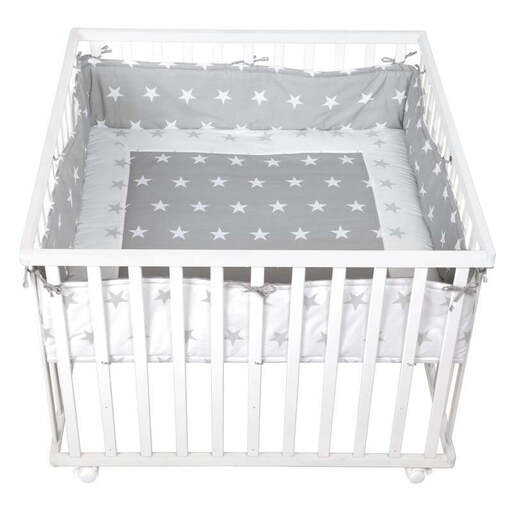
Why This Fits Their Persona: This roba playpen combines a classic white design with crucial safety and functional features. It is ideal for parents looking for a durable, certified solution that blends harmoniously into their living space and grows with their child.
It is designed according to the DIN EN 12227:2010-12 safety standard, features a sturdy laminated wood frame, and has a 3-level height adjustment, which avoids the typical pitfalls of unstable or impractical models.
The combination of a 3-level adjustable base, lockable casters for mobility, and a washable fabric mat offers a well-designed complete package. According to the manufacturer, the paint is food-safe and skin-friendly.
We have compiled a complete, up-to-date list of products that fully meet these strict selection criteria and German safety regulations.
A playpen can be used from birth. In its highest position, it serves as a safe bassinet substitute. It becomes most useful once your baby is more mobile, around 4 to 6 months of age. It remains a helpful companion until the child is about 24 months old or begins to actively climb out.
The wooden surfaces should only be wiped with a slightly damp cloth. Do not use harsh cleaning agents, as they could damage the paint. On most quality models, the fabric mat is removable and machine-washable (please follow the manufacturer's care instructions).
Yes, as long as they are lockable casters. These locking casters ensure that the playpen stands securely in place while your child is playing in it. The brakes should always be locked when the child is in the playpen. To move the empty playpen, the brakes can be easily released.