
Lieferung heute & morgen

Qualitätsgarantie

Willkommens-Angebote freischalten: KOSTENLOSE Lieferung | Bis zu 80 % RABATT | Kostenlose 30-Tage-JoyPlus-Testphase
App herunterladen
A 10-in-1 food processor blender is designed to replace several individual appliances: smoothie blender, ice crusher, blender with chopper, dough mixer, blender with grinder and vegetable slicer. On paper, that sounds space-saving and practical. In the kitchen, however, it only becomes clear whether the accessories, motor power and cleaning requirements suit your everyday needs.
That is why it is worth taking a close look at the technical specifications before buying. Many product descriptions list numerous functions but do not explain clearly enough which quantities, foods and operating times the appliance is designed for.
A 1,300-watt blender may specify a high maximum power consumption. This does not automatically mean that the motor will run every application continuously at that power. Short operating intervals and breaks are important when crushing ice, processing nuts or mixing firm dough.
So check whether the manufacturer provides information about maximum quantities, operating times and cooling periods. For example, the HoninJoy FP12 specifies a two-minute cooling period after cycles. The instruction manual remains the definitive guide for actual use.
The number of functions often depends on the accessories supplied. A container with a blade attachment, a grinding cup or a slicing drum expands the range of uses, but also requires additional storage space.
The following details are therefore important:
An all-in-one blender makes sense when its functions are used regularly. If you only prepare smoothies, you may not need the full range of accessories.
A dishwasher-safe blender is only convenient in everyday use if the removable parts are genuinely suitable for the top rack and can be cleaned without complicated disassembly. The motor unit must never be placed in water or in the dishwasher.
You should also check for hard-to-reach areas around seals, blade mounts and lids. Residue can easily build up there, particularly when processing dough, nut butter or fibrous vegetables.
For smoothies, soups, salsas and smaller chopping tasks, maximum power is not the only relevant factor. Practical programmes can make the appliance easier to use because the speed and running time are tailored to specific applications.
According to the product description, the HoninJoy FP12 has preset functions for CHOP, PUREE, DOUGH and DISC. A safety lock on the lid is also specified: the appliance should not start unless the lid is closed correctly. Overheating protection is included among the stated features.
These functions do not replace the need to follow the instruction manual. Food should only be added in the specified quantities. According to the important product information, the appliance is intended for domestic use and normal household quantities.
The container size determines whether the appliance is suitable for individual portions or family meals. A small cup is practical for a smoothie on the go, while a larger jug is better for preparing several portions of soup or drinks.
The HoninJoy set includes the following containers:
The actual usable capacity may be lower than the nominal container size. For hot ingredients, foaming liquids and dry foods, always follow the manufacturer’s relevant instructions.
For a food processor for meal prep, slicing and grating functions are particularly useful. They can be used to prepare ingredients such as carrots, cheese or cabbage. A blender with chopper is suitable for dips, salsas and puréed ingredients. A blender with grinder can process dry spices or nuts, provided this use is specified in the manual.
The key consideration is whether the accessories lock securely and are easy to clean after use. Cutting blades should not be left loose in a drawer. Storing them in a dry, clean place helps reduce the risk of damage and unpleasant odours.
The following selection is based on the 10-in-1 model documented in the product data. Depending on your household, the reasons why this equipment may be useful will vary.
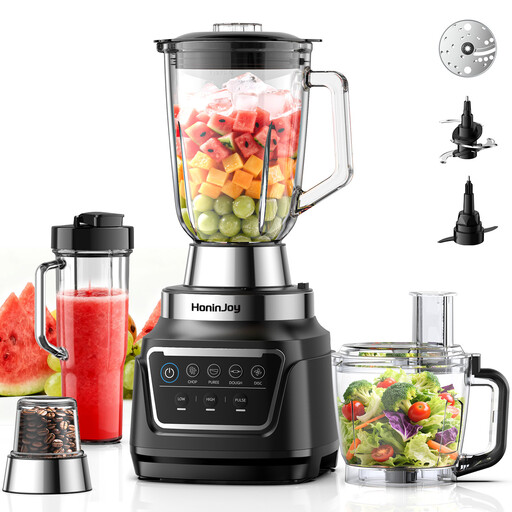
Why this product suits this profile: One appliance combines blending, chopping, grinding, kneading, slicing and grating. This can eliminate the need to buy several individual appliances if your household needs a range of functions.
The product data lists specific containers, attachments and programmes rather than simply stating a function count. Cleaning and the cooling period are also described.
1,300 watts maximum power, 1.5-litre glass jug, 2-litre food processor bowl and preset programmes.
Why this product suits this profile: The equipment includes glass and plastic containers, a safety lock, overheating protection and removable parts that can be cleaned on the top rack of the dishwasher.
The information distinguishes between the motor unit and the removable accessories. This prevents the common misunderstanding that the entire appliance is dishwasher-safe.
According to the product description, removable parts are suitable for the top rack, alongside a lid lock and overheating protection.
Why this product suits this profile: For regular meal-prep routines, different containers and accessories are available for drinks, sauces, vegetables, dough, ice and dry ingredients.
The intended applications are covered by specific attachments: a grinding cup, slicing function, grating accessories and a food processor bowl. The quantity limits must still be observed.
80-gram grinding cup, sports bottle, slicing/grating accessories and separate programmes for chopping, puréeing and dough.
We have put together a complete, regularly updated list of products that fully meet these strict selection criteria and the safety regulations applicable in the EU.
That depends on the accessories and quantities. For smoothies, sauces, dips, chopped vegetables and smaller amounts of dough, a combination appliance like this can handle several preparation steps. For very large quantities or particularly heavy doughs, you should check the instruction manual.
It is not possible to determine a fixed service life reliably from the wattage alone. Careful use, correct filling quantities, regular cleaning and observing the specified cooling times all affect operation. Blades, seals and plastic parts are wear components and should not be used further if damaged.
This figure refers to the maximum power consumption, not automatically to the energy used per operation. Actual electricity consumption depends on the running time, programme, quantity of food and workload. Short blending cycles use correspondingly less energy than prolonged continuous operation.