
Lieferung heute & morgen

Qualitätsgarantie

Willkommens-Angebote freischalten: KOSTENLOSE Lieferung | Bis zu 80 % RABATT | Kostenlose 30-Tage-JoyPlus-Testphase
App herunterladen
An 11kW portable wallbox offers incredible flexibility for electric car owners. Whether at home in a rented apartment, at a holiday home, or visiting friends, the ability to charge quickly without relying on public stations is a major advantage. However, the market is saturated with options, and the technical differences are often subtle. Making the wrong choice can lead not only to frustration but also to potential safety hazards. This guide highlights the most common pitfalls and explains the crucial criteria for making an informed purchasing decision.
Many buyers are swayed by marketing promises without verifying the technical fundamentals. This often leads to disappointment and unnecessary expenses. Pay close attention to these three points:
To avoid a poor investment, you should check three core technical aspects before buying. These determine the performance, safety, and convenience of your portable EV charging station.
The maximum charging power is determined by the power connection. To achieve the full 11 kW (3-phase, 16 amps), a red 11kW CEE charging cable plug is mandatory. These sockets, also known as 'high-power' or 'three-phase connections', are commonly found in garages, workshops, or at campsites. Before purchasing, verify that such a connection is available at your intended locations of use. Models that come exclusively with a Schuko plug are technically limited to single-phase charging at a lower power output.
A high-quality portable wallbox, sometimes referred to as an 11kW charging brick, allows for manual or app-controlled adjustment of the charging current (e.g., in increments of 8A, 10A, 13A, 16A). This feature is essential when charging on circuits whose load capacity you are unsure of. By reducing the current, you can prevent tripping the circuit breaker and ensure a stable charging process. App control enhances this flexibility by allowing you to schedule charging your EV on the go and monitor the process remotely.
Safety is the top priority. Look for integrated protective mechanisms such as:
Based on the criteria mentioned, we have identified several products suitable for different user groups.
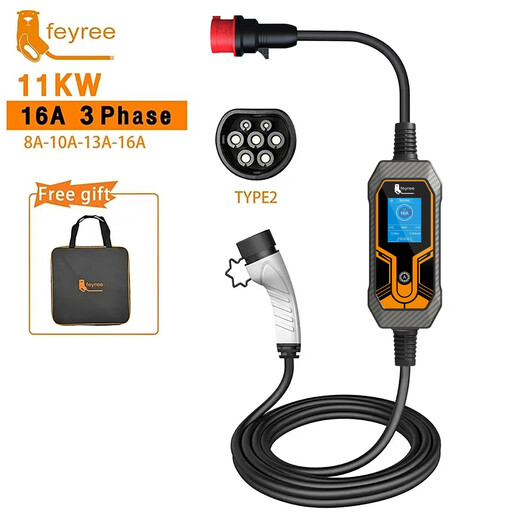
Why This Fits Their Persona: Ideal for users seeking a reliable and straightforward 11 kW charging solution for home or travel. The focus is on functionality and safety, without the complexity and cost of app integration.
This charger avoids the trap of incompatible plugs by coming equipped with a CEE plug for full 11 kW power. It addresses safety concerns with a comprehensive suite of protective mechanisms and an IP65 certification.
Features an LCD screen for monitoring charging data and an adjustable charging current. The robust ABS housing and the manufacturer-stated CE and T?V certifications (for the cable) build confidence.
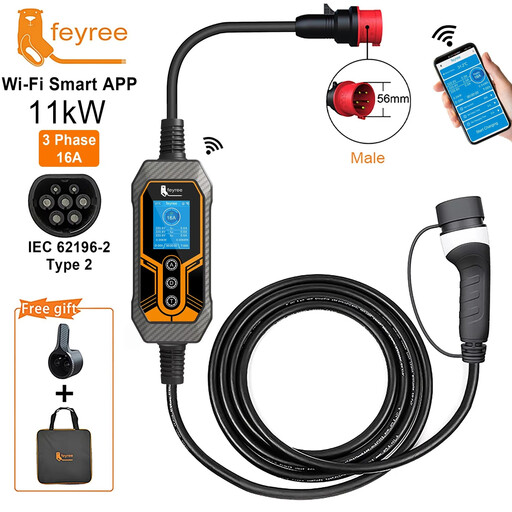
Why This Fits Their Persona: Perfect for users who want full control and efficiency. The app control allows them to schedule charging sessions during off-peak hours and flexibly adjust the current to suit the conditions, thereby reducing electricity costs.
This model avoids the trap of superfluous gimmicks by offering an app with tangible benefits: scheduling and current adjustment. According to the manufacturer, it has integrated Type B residual current protection (AC 30mA + DC 6mA), which represents a high safety standard.
Control via Wi-Fi and Bluetooth offers maximum flexibility. The ability to adjust the charging current between 8A and 16A protects both the power grid and the vehicle. The IP66 rating provides even greater protection against water.
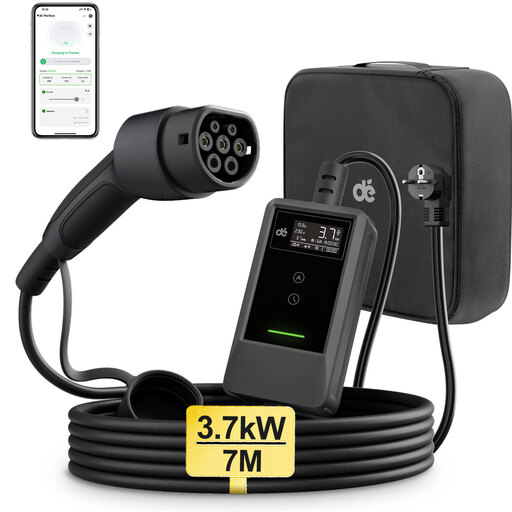
Why This Fits Their Persona: A supplementary charger for drivers who often need to charge in places without a high-power connection. This charger is designed for use with any standard domestic socket, offering a safe, albeit slower, charging option for emergencies or overnight top-ups.
This product avoids the trap of false performance claims by being clearly positioned as a 3.7 kW charger for Schuko sockets. It doesn't promise 11 kW but instead delivers reliable performance for its intended use case.
Universal compatibility with standard domestic sockets. The app control for remotely managing the power output (6-16 A, single-phase) is a useful feature even in this power class for protecting the electrical installation.
We have compiled a complete, up-to-date list of products that fully meet these strict selection criteria and safety regulations.
In many regions, portable EV charging equipment up to 11 kW does not require a formal permit. However, you may be required to register it with your local grid operator before first use. This reporting requirement helps ensure grid stability.
No, to achieve the full 11 kW charging power, a three-phase CEE 16A (high-power) connection is mandatory. Many portable chargers come with adapters for domestic sockets. When using an adapter, the charging power is automatically reduced to approximately 2.3 kW to 3.7 kW (single-phase) for safety reasons, preventing an overload of the socket and the home's wiring.
Look for a high IP rating, such as IP65 or IP66. IP65 means the device is protected against water jets from all directions. IP66 offers protection against even powerful water jets. This makes charging in the rain generally safe. However, the control box (the "charging brick") and the plug connections should never be left in puddles or exposed to heavy, prolonged rain. A sheltered position is always recommended.