
Lieferung heute & morgen

Qualitätsgarantie

Willkommens-Angebote freischalten: KOSTENLOSE Lieferung | Bis zu 80 % RABATT | Kostenlose 30-Tage-JoyPlus-Testphase
App herunterladen
You've decided on an electric car, but a key question remains: what's the most efficient and reliable way to charge it, whether at home or on the go? The range of charging solutions is vast, from permanently installed wallboxes to portable chargers. This guide will help you navigate the options, making it easier to select the perfect 11kW wallbox or a flexible charging alternative for your individual needs.
Before making a decision, there are a few fundamental aspects to consider. The right choice depends on your living situation, vehicle type, and daily driving habits.
A permanently installed home EV charging station is the most convenient solution for homeowners. Typically mounted in a garage or carport, it offers high charging performance and maximum operational safety.
A portable 11kW wallbox, on the other hand, offers flexibility. It can be used in various locations with a compatible power outlet (e.g., a CEE industrial socket)—ideal for those who charge their vehicle at multiple sites, like home and work, or for travel. For emergencies or when high-power connections are unavailable, there are also portable chargers for standard household sockets.
A charging power of 11 kW (three-phase) has become the standard for private charging in Europe. It provides a good balance between charging speed and grid compatibility. A Type 2 11kW charging cable is the European standard connector for most electric vehicles.
Portable chargers use different types of connectors:
A modern wallbox with app control allows you to schedule charging sessions, monitor charging status, and track energy consumption. This is especially useful for scheduling charges during off-peak hours with lower electricity rates.
Safety is a non-negotiable aspect. Look for integrated safety features like a residual current device (e.g., RCD Type B), which protects against both AC and DC fault currents, as well as protection against overcurrent, overvoltage, and overheating.
Here is a selection of charging solutions that cater to different user profiles—from flexible portable units to powerful, permanently installed wallboxes.
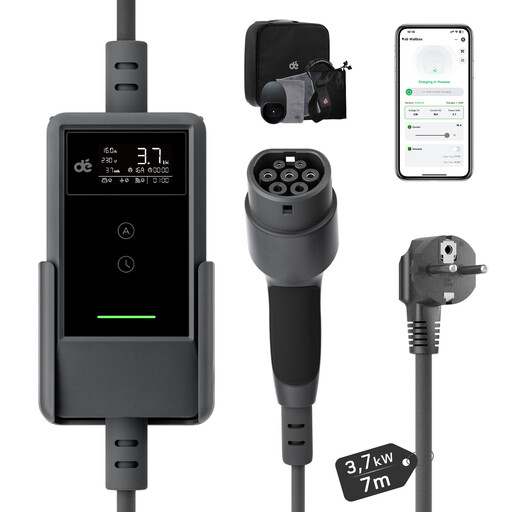
This portable charger is a plug-and-play solution for anyone needing a straightforward charging option from a standard household socket.
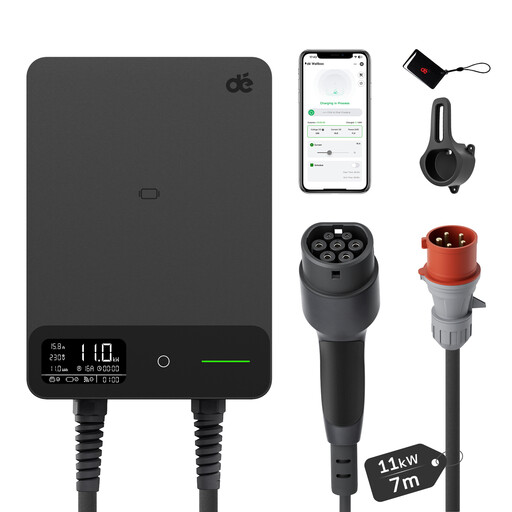
This permanently installed wallbox is designed for users who want a powerful and intelligent charging solution for daily home use.
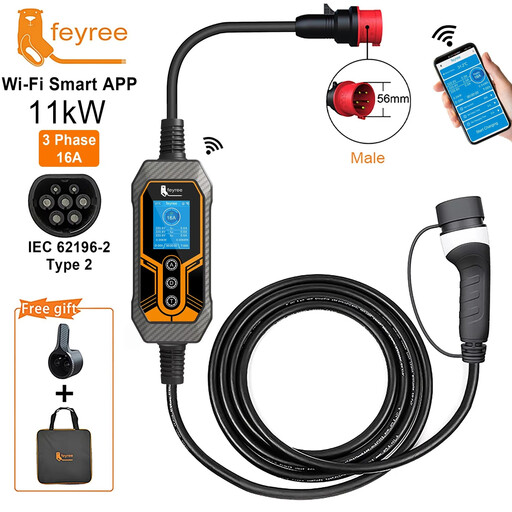
This portable 11kW wallbox bridges the gap between a simple Schuko charging cable and a permanently installed wallbox. It uses a CEE connector to deliver high charging power on the go.
If the models featured here don't perfectly match your requirements, or if you're looking for other accessories like adapters or mounts, it's worth exploring a wider range.
Discover our range of charging accessories, including Type A charging cables, and find the right equipment for your vehicle.
An 11kW wallbox charges on three phases and is fast enough for most private use cases. A 22kW wallbox offers double the charging power, but many EVs cannot accept this rate (their on-board charger is often limited to 11 kW). Furthermore, the installation is more complex.
No, in Germany, an 11kW wallbox only needs to be registered with the local grid operator. This is typically handled by the certified electrician performing the installation. The requirement for a permit, which applies to wallboxes with more than 11 kW of power, does not apply here.
Yes, portable chargers with a Schuko plug are designed for exactly this purpose. However, the charging power is limited to about 2.3 kW to 3.7 kW, resulting in long charging times. This solution is primarily intended as an emergency charging cable for your EV or for plug-in hybrids with small batteries. For continuous use, a professionally installed socket with its own dedicated circuit breaker is recommended.