
Lieferung heute & morgen

Qualitätsgarantie

Willkommens-Angebote freischalten: KOSTENLOSE Lieferung | Bis zu 80 % RABATT | Kostenlose 30-Tage-JoyPlus-Testphase
App herunterladen
You've decided on an electric car, but a key question remains: How can you charge it at home efficiently, safely, and cost-effectively? Installing your own home EV charging station is the natural choice. However, with the vast array of models and technical terms like load management, solar integration, or app control, selecting the right 11kW wallbox can seem daunting.
This article serves as a practical guide. It explains the most important criteria to consider when making your choice and presents a selection of models with different feature sets. Our goal is to provide you with a solid foundation for making an informed decision based on objective facts and your individual needs.
Before you decide on a model, three key aspects should be considered: charging capacity and its related regulatory requirements, smart features, and safety equipment.
The charging capacity determines how quickly your vehicle's battery is charged. An 11kW wallbox is perfectly adequate for most private use cases. It can fully charge a typical EV with a 60 kWh battery in about 5.5 hours—ideal for overnight charging. The key advantage in Germany: an 11 kW charging station only needs to be registered. This means you or your installer simply have to inform the grid operator before commissioning.
A 22kW wallbox, while charging twice as fast, requires formal approval from the grid operator. The operator can deny the connection if the stability of the local power grid is at risk. The installation is also often associated with higher costs for grid adjustments. For most users, the 11 kW version therefore represents the best compromise between charging speed, cost, and minimal red tape.
Modern wallboxes are far more than just power outlets. Intelligent features offer convenience, security, and help save money.
Safety is the top priority when installing a home EV charging station. An important feature is integrated DC fault current detection (usually 6mA). This feature saves you from installing an expensive external Type B RCD (Residual Current Device), as a more affordable Type A will then suffice.
For connecting EVs in Europe, the Type 2 connector is the established standard. To control access, especially if the wallbox is freely accessible (e.g., in the carport of an apartment building), a wallbox with RFID is recommended. Only authorized users can then start the charging process with a special card or chip.
Here is a selection of charging stations that cover different needs—from smart solar integration to straightforward installation.

Why it stands out: The Pulsar Max from Wallbox is a compact and intelligent charging station that stands out for its advanced energy management features. It is specifically designed for integration into a smart home, especially for users with their own photovoltaic system.
Advantages:
Who is it for? Ideal for homeowners with a solar panel system who want to maximise their self-consumption. It is also a future-proof choice for households with multiple electric vehicles or plans to install more charging points in the future, thanks to its intelligent load management.
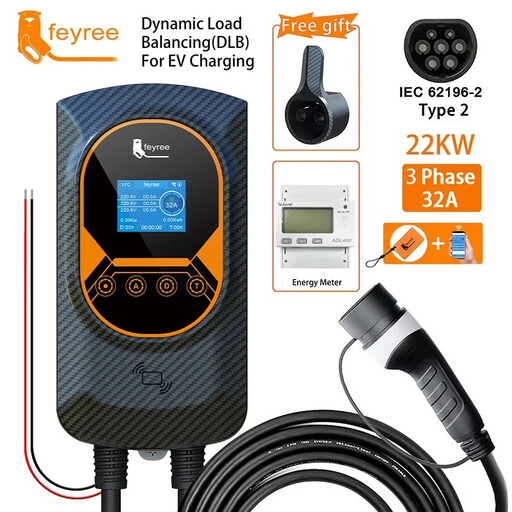
Why it stands out: This wallbox from feyree offers high flexibility with its adjustable charging capacity of up to 22 kW and a durable design. It can be controlled via the popular Tuya Smart app and comes with dynamic load balancing (DLB) included. For operation at the 11 kW level, which only requires registration, the power is configured accordingly by the installer.
Advantages:
Who is it for? A great choice for users who need a robust and weatherproof charging station for outdoor areas (e.g., an unsheltered carport). The integrated load management and control via the Tuya ecosystem make it attractive for smart home users.
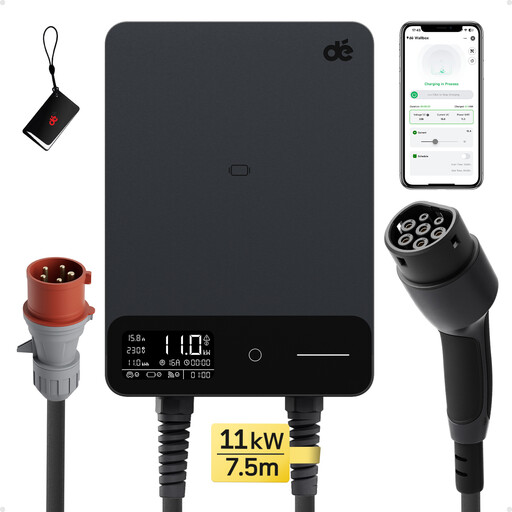
Why it stands out: The model from dé stands out with a particularly installation-friendly package. The already integrated all-current-sensitive Type B RCD is a major advantage that can significantly reduce installation costs. The extra-long charging cable also offers maximum flexibility at the parking space.
Advantages:
Who is it for? Perfect for budget-conscious buyers who value a simple and cost-effective installation. The long cable and straightforward operation make it a very practical solution for everyday use in garages or driveways.
Haven't found the right charging station for your needs yet? There are many other models with different features, cable lengths, and designs.
Explore our entire range of Type 2 EV Chargers and find the perfect solution for your EV.
1. Does an 11 kW wallbox need to be approved by the grid operator? No, an 11kW wallbox only needs to be registered with the responsible grid operator before it is commissioned. This is a simple notification process. In contrast, a 22kW wallbox requires formal approval, which is more complex and can also be denied.
2. Can I fully charge my EV overnight with an 11 kW wallbox? Yes, in the vast majority of cases. An 11 kW charging station delivers about 11 kWh of energy per hour. An electric car with a 60 kWh battery would therefore be charged from 0 to 100% in about 5.5 hours. For typical overnight charging (8–10 hours), this capacity is more than sufficient to fully charge even larger batteries.
3. What is solar surplus charging and which wallboxes support it?Solar surplus charging is the process where a wallbox specifically uses the excess power from a solar panel system to charge an electric vehicle. This maximises the self-consumption of your self-generated solar power and makes excellent financial sense. Models like the Wallbox Pulsar Max offer special operating modes (e.g., "Eco-Smart") that automatically manage this process in conjunction with an external energy meter.