
Lieferung heute & morgen

Qualitätsgarantie

Willkommens-Angebote freischalten: KOSTENLOSE Lieferung | Bis zu 80 % RABATT | Kostenlose 30-Tage-JoyPlus-Testphase
App herunterladen
The decision to switch to an electric car has been made, but a key question remains: How can you charge the vehicle at home efficiently, safely, and cost-effectively? The market for charging solutions is vast, and the technical details can be overwhelming. This article serves as a guide to help you navigate your options. It explains the essential features of an 11kW wallbox and presents a selection of models to provide you with an informed basis for choosing your EV home charger.
Before you decide on a model, several technical and practical aspects should be considered. These criteria will help you find a solution that fits your vehicle, your living situation, and your usage habits.
Wallboxes are typically available with 11 kW or 22 kW of power. An 11kW wallbox provides 3-phase charging and can fully charge the battery of a typical electric car overnight (adding approx. 60–70 km of range per hour). The decisive advantage lies in the registration process: while an 11 kW charging station merely needs to be registered with the grid operator, a 22 kW station requires an official approval process, which can involve additional effort and costs. For everyday private use, an 11 kW solution is therefore sufficient and more straightforward in most cases.
Safety is the top priority when charging high-voltage batteries. An essential safety component is the Residual Current Device (RCD). In the event of a fault, electric cars can generate DC fault currents that are not detected by a standard Type A RCD in a home's electrical system. For this reason, additional protection is required. Many modern wallboxes already have an integrated DC fault current sensor (e.g., with 6mA detection). This saves you the costly retrofitting of a separate Type B RCD in your home's distribution board and ensures that the charging equipment complies with applicable standards.
A wallbox with app control offers significant convenience and potential for cost optimisation. Using a smartphone application, you can schedule, start, and stop charging sessions. This is particularly useful for scheduling charging during off-peak hours with cheaper electricity tariffs (e.g., at night). Furthermore, smart features allow you to monitor power consumption, adjust charging power, and review charging histories. For users who install their charging station in an underground car park or a shared area, access control via an RFID card provides protection against unauthorised use.
Here is a selection of products that cover different needs—from a permanently installed home solution to a flexible, portable charger.
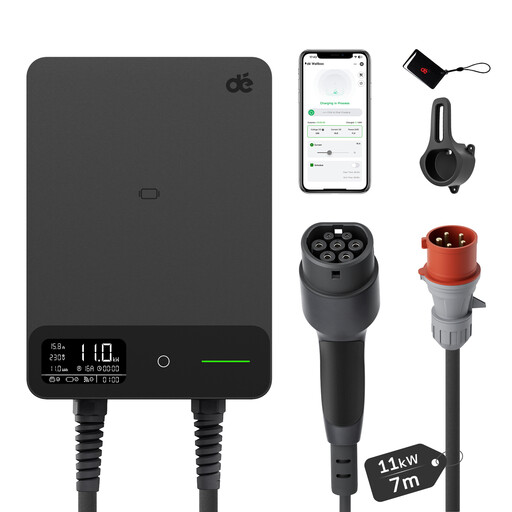
Why it stands out: This model is a comprehensive solution for permanent installation at home. It combines 11 kW of charging power with smart control options and integrated safety features, making it a complete and future-proof charging station for EVs.
Advantages:
Who is it for? For homeowners looking for a permanent, powerful, and intelligently controlled charging station with a full range of features for daily use.
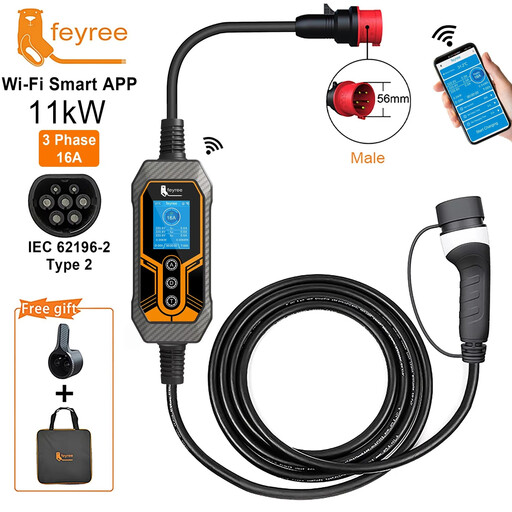
Why it stands out: This portable EV charger bridges the gap between a fixed wallbox and a simple emergency charging cable. It delivers the full charging power of 11 kW via a CEE industrial power socket while remaining completely mobile.
Advantages:
Who is it for? For renters who are not permitted to install a fixed wallbox, or for EV drivers who need a powerful yet mobile charging solution for various locations.
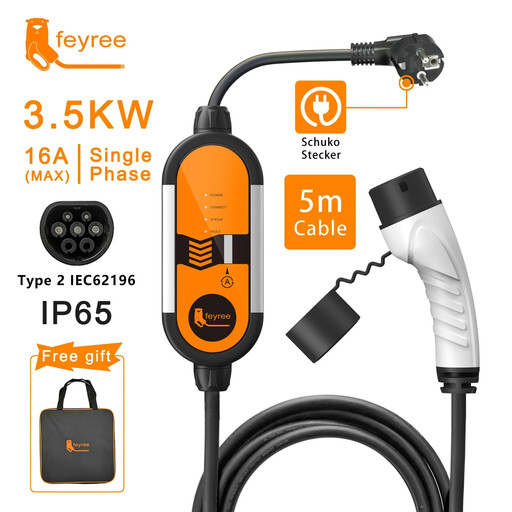
Why it stands out: This Type 2 portable charging cable is the universal solution for charging from any standard household socket (Schuko). It is compact, easy to use, and ideal as a secondary or emergency charger.
Advantages:
Who is it for? For drivers of plug-in hybrids or EVs with smaller batteries who are looking for a simple and flexible charging solution for home or on the go. It is also an excellent choice as a backup charger.
Haven't found the right solution yet? In our EV Charging Cables category, you'll find a wider selection of charging stations and portable charging cables that might meet your specific needs.
Yes, in many regions, including Germany (according to its Technical Connection Rules - TAR), any charging device with a power rating over 3.6 kVA (which applies to an 11 kW wallbox) must be registered with the local grid operator before commissioning. The installation electrician typically handles this registration. Unlike 22 kW stations, however, prior approval is generally not required.
A wallbox is a charging station for EVs that is permanently mounted on a wall and wired directly into the home's electrical system. It usually offers high charging power and often includes smart features. A portable charging cable is a portable EV charger that can be plugged into various types of sockets (e.g., CEE or Schuko), offering more flexibility for charging at different locations.
No, for safety and warranty reasons, the installation of a hardwired wallbox must be carried out by a qualified electrician. The electrician will check the existing electrical installation, perform the connection professionally, and ensure compliance with all applicable standards and regulations. Portable chargers that plug into an existing socket do not require installation, but the socket should be rated for continuous load.