
Lieferung heute & morgen

Qualitätsgarantie

Willkommens-Angebote freischalten: KOSTENLOSE Lieferung | Bis zu 80 % RABATT | Kostenlose 30-Tage-JoyPlus-Testphase
App herunterladen
As an owner of an electric car or plug-in hybrid, you know the drill: charging at public stations can be time-consuming and inconvenient. A dedicated home charging station offers convenience, security, and the ability to optimise charging costs through strategic scheduling. But the market can be overwhelming. Models differ in performance, features, and installation requirements.
This article serves as an objective guide. We'll explain the crucial criteria for selecting an 11kW wallbox and present a curated selection of models with various features to help simplify your decision.
The right EV charging station depends on your vehicle, your living situation, and your personal needs. Three factors are particularly relevant.
The charging power determines how quickly your vehicle's battery is charged.
For stable and efficient power transfer, a 3-phase wallbox is the standard, which aligns with most modern home connections in Germany.
Modern charging stations offer much more than just charging.
The established standard for charging connectors in Europe is the Type 2 wallbox plug. All models presented here are equipped with this connector, making them compatible with the vast majority of electric vehicles and plug-in hybrids on the road in Germany.
A crucial safety feature is an integrated Residual Current Device (RCD). A Type B RCD (often described as DC fault current detection) is particularly important for charging electric vehicles, as it protects against both AC and DC fault currents that can occur during the charging process. This enhances the safety of the entire home installation.
Based on the criteria mentioned, we have compiled a selection of charging stations that cater to different needs.
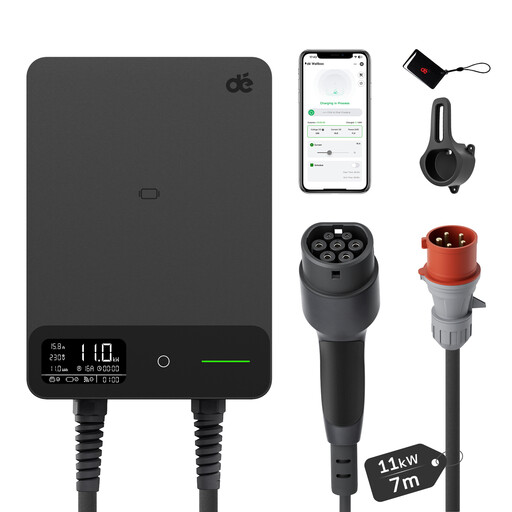
What sets it apart: This model is a well-balanced solution, combining the popular 11kW charging power with comprehensive smart features. Control via the Tuya Smart app allows for flexible charge scheduling and consumption monitoring. The additional RFID function secures access, while the integrated Type B RCD ensures a high level of safety. The 7.5-metre cable also offers plenty of flexibility when positioning your vehicle.
Benefits at a glance:
Who is this model for? For homeowners seeking an efficient, smart, and straightforward 11kW charging station for daily use, who also value a comprehensive safety package and flexible access options.
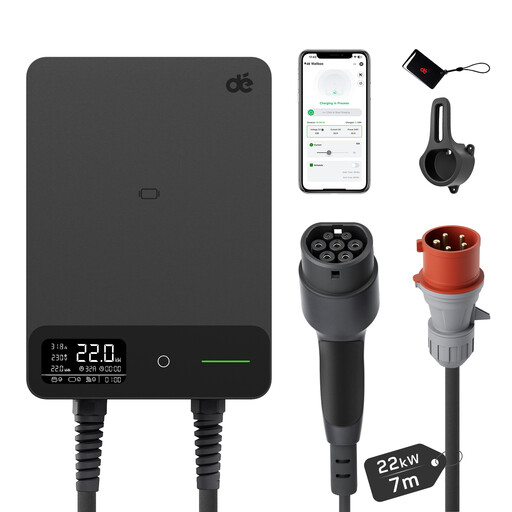
What sets it apart: With a maximum charging power of 22 kW, this model is designed for high-speed charging. A special feature is the integrated electricity meter, which enables precise consumption tracking—useful for billing a company car or for detailed cost control. The power is adjustable via the app, so the wallbox can also be operated at 11 kW if needed.
Benefits at a glance:
Who is this model for? For users who need a future-proof and particularly powerful EV charging station and are willing to undertake the approval process for a 22 kW installation. Ideal for drivers of vehicles with high charging capacity or for users who require precise electricity metering.
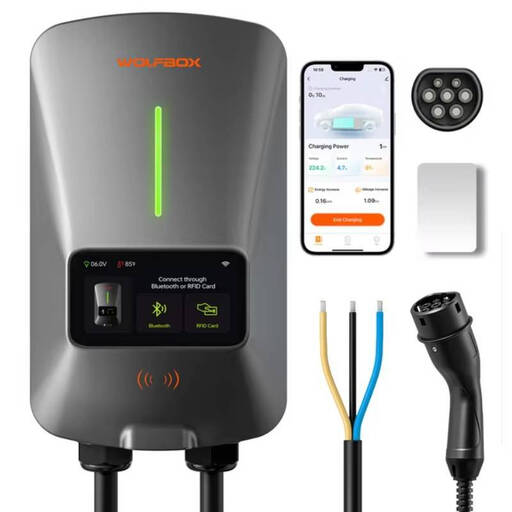
What sets it apart: This charging station is a compact solution for single-phase charging up to 7 kW. It combines key smart features like app control and RFID access management in a weatherproof housing. The integrated LCD display provides all important information about the charging process at a glance.
Benefits at a glance:
Who is this model for? For drivers of plug-in hybrids or electric cars with shorter daily commutes, where a single-phase installation is sufficient or preferred due to the home's electrical setup. A great choice for users looking for a smart and secure charging solution with essential performance.
The market for charging technology is constantly evolving. In addition to the models presented here, there are numerous other variants that differ in design, performance, and features. If you have specific requirements or simply want to compare more alternatives, it's worth taking a look at a broader range.
Discover our entire range of charging stations and find the right model for your vehicle and your needs in our Schnelllade-Autoladeger?t Steckdose category.
No, in Germany, an 11kW wallbox only needs to be registered with the responsible grid operator before commissioning. Prior approval is not required. The situation is different for charging stations with more than 11 kW of power (e.g., a 22kW wallbox), which must be approved by the grid operator before installation.
Most electric vehicles and plug-in hybrids in Europe use the Type 2 connector for AC charging. All charging stations presented here are equipped with this standard plug. However, the maximum charging power of your vehicle is also a key factor. A car that can only charge at 7.4 kW (single-phase) will not charge any faster at an 11 kW or 22 kW wallbox. The wallbox automatically adjusts the charging power to match the vehicle.
3-phase charging means the wallbox uses all three phases of a standard three-phase household electrical connection. This allows for higher and more stable charging power (typically 11 kW or 22 kW) compared to single-phase charging, which is usually limited to 3.7 kW to 7.4 kW. The result is a significantly shorter charging time for your vehicle.