
Lieferung heute & morgen

Qualitätsgarantie

Willkommens-Angebote freischalten: KOSTENLOSE Lieferung | Bis zu 80 % RABATT | Kostenlose 30-Tage-JoyPlus-Testphase
App herunterladen
Investing in your own EV charging station is a crucial step for any electric vehicle owner. An 11kW wallbox promises fast, safe, and convenient charging right at home. But the market is crowded and full of technical details that can quickly lead to expensive purchasing errors. Before you invest, it's essential to understand the common pitfalls often hidden behind tempting product descriptions.
As your Joybuy Product Recommendation Officer, I'll help you separate marketing hype from reality. In this guide, we'll focus on the critical features that define a reliable and future-proof 11kW home charging station.
Many buyers focus on the initial purchase price, overlooking crucial details that later lead to unexpected costs or daily frustration.
To avoid these pitfalls, you should focus on three core technical aspects. These define the quality, safety, and convenience of your future charging station.
A charging power of 11 kW has established itself as the ideal standard for home use in Europe. It offers an excellent compromise between charging speed and grid compatibility. Such a wallbox is connected to the grid via a 3-phase supply and charges an EV up to five times faster than a standard household socket. The crucial component here is the Type 2 connector (IEC 62196-2), which is the standard in Europe for almost all electric cars and plug-in hybrids.
This is the most critical point for saving on installation costs and ensuring maximum safety. When charging, EVs can produce DC fault currents that a standard Type A RCD cannot detect. Therefore, additional protection is required by law. Look for one of the following two solutions to be integrated directly into the wallbox:
A truly smart wallbox offers more than just a start-stop function via an app. Look for the following features:
Based on the criteria above, we have identified a few models that are well-suited for different user profiles.
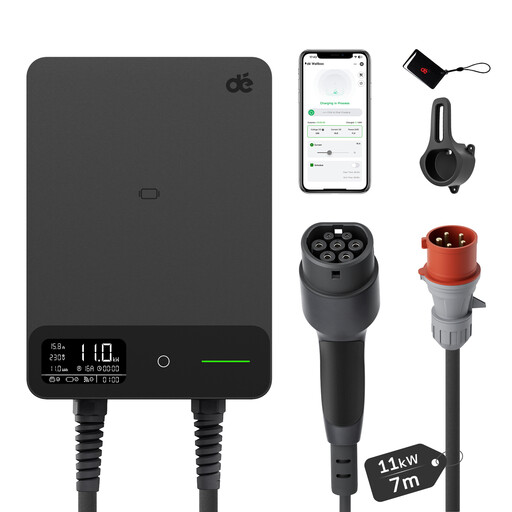
Why this model is a fit: For users who refuse to compromise on safety. This model offers an all-in-one solution that meets the highest protection standard and simplifies installation, as no external safety components are needed.
Bypasses the hidden cost trap because the expensive Type B RCD is already integrated. This significantly lowers the total installation cost.
Comprehensive safety package (AC 30mA + DC 6mA). Full control via the Tuya Smart App and access security with RFID cards.
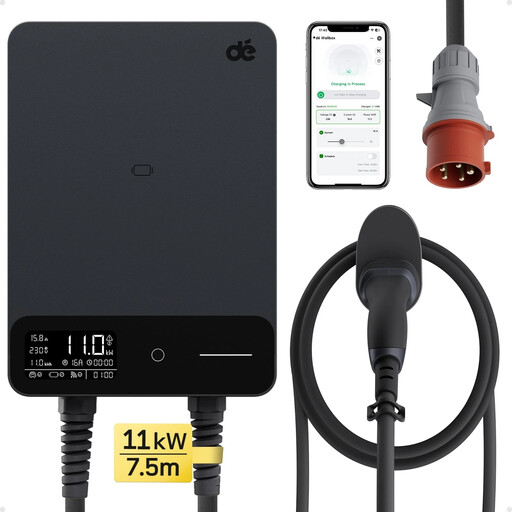
Why this model is a fit: Ideal for users seeking a technically sound, standard-compliant solution with excellent value for money. It provides all the smart features and necessary safety without the premium price of an all-current sensitive RCD.
Offers a fully functional and stable app connection that reliably enables scheduling and monitoring of charging sessions, thus avoiding the trap of useless "smart" features.
Standard-compliant safety with an integrated Type A RCD and DC fault current detection. A long 7.5m cable and cable holder provide a high level of convenience.
Why this model is a fit: Perfect for families or small businesses with multiple EVs. The RFID function allows for easy user management, while the long cable offers maximum flexibility for parking and charging different vehicles.
Solves the problem of insufficient flexibility with a 7.5-metre-long cable. The RFID access control also effectively prevents unauthorised use in shared areas.
User authentication via RFID cards for simple management. The extra-long cable effortlessly reaches multiple parking spots.
We have compiled a complete, up-to-date list of products that fully meet these strict selection criteria and stringent safety regulations.
Yes, in many European countries, including Germany, it is mandatory to report charging stations with a capacity up to and including 11 kW to the local grid operator. This notification must be done before installation. Unlike more powerful 22 kW stations, however, approval is generally not required, which significantly simplifies the process. The installation and registration are typically handled by the certified electrical contractor.
Installation costs can vary widely depending on the on-site conditions. Factors include the distance from the fuse box to the installation site, any necessary wall penetrations, and the existing electrical system. A significant cost factor is the RCD. If you choose a wallbox with an already integrated Type B RCD or a Type A + DC fault current detection, you can save several hundred euros, as the electrician won't need to install this expensive component separately. Costs can roughly range from €500 to over €2,000.
Most electric cars and wallboxes sold in Europe use the standardised Type 2 connector, ensuring broad compatibility. An 11 kW wallbox can, in principle, charge any EV. However, the actual charging speed depends on the vehicle's on-board charger. For example, a car that can only charge on a single phase will only draw about 3.7 kW from a three-phase 11 kW station. The wallbox automatically adjusts its power output to match the vehicle.