
Lieferung heute & morgen

Qualitätsgarantie

Willkommens-Angebote freischalten: KOSTENLOSE Lieferung | Bis zu 80 % RABATT | Kostenlose 30-Tage-JoyPlus-Testphase
App herunterladen
An 11 kW Wallbox Type 2 can make charging an electric car or plug-in hybrid at home far more predictable than using a standard Schuko socket. However, this depends on the power output, your vehicle, your home’s electrical connection and safety equipment all working together. If you only focus on app features or high charging power, you can easily overlook important details.
“11 kW” describes the maximum power of the wallbox, not necessarily the charging power of your car. A vehicle with a single-phase 7 kW onboard charger can only charge at a lower rate on a three-phase wallbox under the stated conditions. According to the product specifications from each vehicle and wallbox manufacturer, what matters is which phases and which current rating your vehicle supports.
Before buying, you should therefore check:
A 3-phase 11 kW wallbox typically requires a suitable 400 V three-phase connection. In a domestic setting, the cable cross-section, cable length, fuse protection, selectivity and residual current protection must all be coordinated.
In Germany, installation should be carried out by a qualified electrical contractor. Depending on your network operator, additional requirements for registration or approval may apply. A standard socket or an existing circuit is not automatically sufficient.
A Type 2 wallbox with app, WiFi or RFID can conveniently control charging times. However, it does not automatically prevent overloading your home’s electrical supply. For that, you need a properly planned load management system. If you have several high-consumption appliances, such as a heat pump, instantaneous water heater or electric heating, a wallbox with dynamic power adjustment can be worthwhile.
An 11 kW charging station for electric cars and plug-in hybrids typically operates on three phases at up to 16 A. The actual charging time depends on the usable battery capacity, the state of charge and the efficiency of your vehicle.
As a practical guide:
Look for specific details about residual current protection rather than vague terms like “safe” or “intelligent”. An RCD Type B can monitor AC and certain DC fault currents. Whether the integrated protection is sufficient or additional residual current protection is needed in your home installation must be assessed by an electrical contractor based on your specific system.
Other verifiable details include:
For a garage, a different protection rating is often sufficient compared to an exposed carport. IP54 indicates protection against limited dust ingress and splashing water. IP65 offers higher protection against dust and water jets. However, the protection rating alone does not replace professional installation.
Also check:
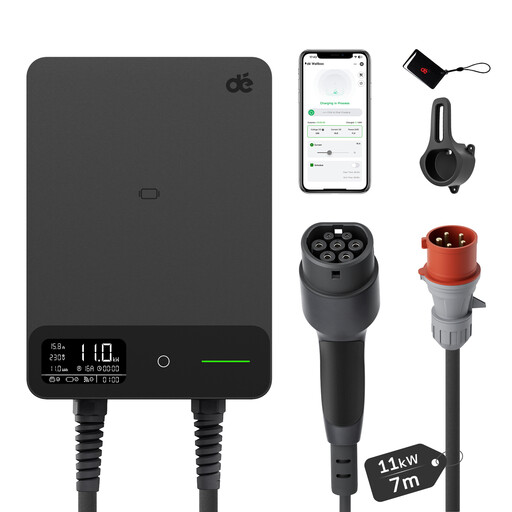
Why this product suits the profile: This wallbox is aimed at households with a 400 V three-phase connection who need app control and access management. According to the product specifications, 6–16 A is adjustable and a 7.5 m cable is integrated.
The technical description specifies concrete current ratings, cable dimensions and safety functions rather than just a general power output. Vehicle compatibility must still be checked beforehand.
7.5 m cable, LCD display, Tuya Smart app, RFID access and, according to product specifications, RCD Type B with AC and DC residual current protection.
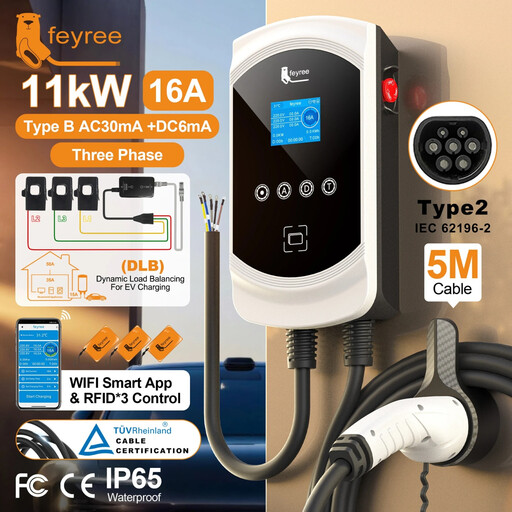
Why this product suits the profile: This model is interesting for households where the charging power needs to be coordinated with current electricity consumption. The product description mentions dynamic load management, app control and IP65.
The stated dynamic load management addresses the risk of several household appliances simultaneously placing a heavy demand on the connection. The specific integration must be planned by the installer.
According to product specifications: IP65, Tuya app, RFID function, colour LCD and RCD Type B with AC30 mA and DC6 mA.
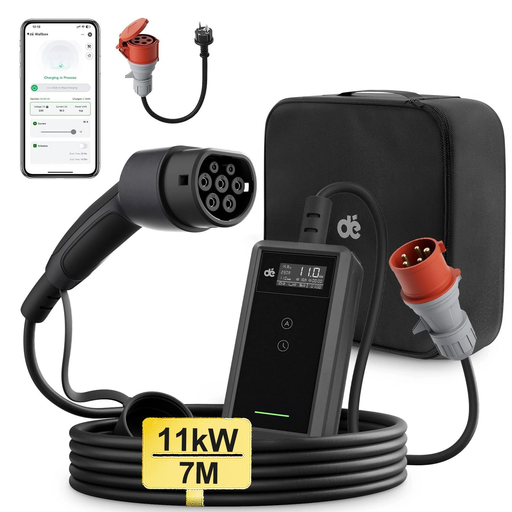
Why this product suits the profile: A mobile 11 kW wallbox is ideal for users who don’t always charge at a fixed parking spot. The CEE 16 A to Type 2 design can be used more flexibly where suitable infrastructure is available.
The mobile design reduces the commitment to a single wall-mounted location. Before each use, the CEE connection, fuse protection, earthing and local operating conditions must be suitable.
7 m charging cable, app function and adjustable charging power according to the product name. Connection is via CEE 16 A to Type 2.
We have compiled a complete, regularly updated list of products that fully meet these strict selection criteria and the safety regulations in force in the EU.
A permanently installed home electric car charging station should not be connected to your home’s electrical supply yourself. Before buying, it is worth consulting your electrician about the installation location, cable route, meter position, fuse protection and network operator.
Electricity costs are basically calculated as:
kilowatt-hours charged × electricity price per kilowatt-hour
An app can document charging times or start them on a timer. However, it does not guarantee a cheaper tariff. For that, you need a suitable electricity contract and must take your supplier’s billing into account.
When it comes to lifespan, the installation quality, protection against moisture, regular visual inspection of the cable and plug, and adherence to the manufacturer’s instructions all matter. A damaged cable or an unusually warm plug should not be used further.
That depends on the battery capacity and the AC charging power of the vehicle. A 50 kWh battery theoretically takes around five hours at 11 kW. Charging losses and the charging characteristic can extend the actual time.
This cannot be answered universally for every installation. What matters is the wallbox, its integrated DC fault current protection and the existing home installation. An electrical contractor will determine the required residual current protection based on the technical documentation and the applicable installation regulations.
WiFi is suitable for charging planning, remote control and charging session logs. RFID can restrict access to the charging point, for example on a shared parking space. If you don’t need these functions, a simpler wallbox may suffice. What remains crucial is vehicle compatibility, the electrical installation and the protection concept.