
Lieferung heute & morgen

Qualitätsgarantie

Willkommens-Angebote freischalten: KOSTENLOSE Lieferung | Bis zu 80 % RABATT | Kostenlose 30-Tage-JoyPlus-Testphase
App herunterladen
A 12 V electric go-kart for children can be suitable for supervised outdoor fun, depending on its design. However, an electric go-kart, a two-seater ride-on car and a small toy vehicle are quite different. The key considerations are not just bright colours or high motor output, but the recommended age, speed, battery, controls and intended surroundings.
A 12 V battery is an important specification, but it doesn’t automatically tell you how long the vehicle will run or how effectively it delivers power. Other factors include battery capacity in Ah, the number of motors, vehicle weight, surface and load. A heavy vehicle with two motors may behave differently on grass from a lightweight kart on tarmac.
So, check the following as well:
A children’s kart with drift mode may appeal to older children. However, the term describes only a particular driving feature. It doesn’t tell you whether the vehicle is suitable for your child, the space you have available or the surface they’ll be driving on.
For beginners, a low speed, an easily reached brake and plenty of clear space matter more than spectacular manoeuvres. If a children’s vehicle with adjustable speed is on your list, check that it clearly explains how to set the limit and whether parents can control the speed directly or indirectly.
A vehicle recommended for children aged 8 and over won’t automatically suit a younger child, even if they look big enough to ride it. The seating position, pedal reach, distance to the steering wheel and force needed to operate the controls all need to be suitable. For two-seater vehicles, the maximum total load matters too—not just the weight of one child.
Check the following:
A battery-powered kart for children needs to be fully recharged after use. A stated charging time of, for example, 8 to 12 hours means the vehicle may not be designed for several spontaneous rides back to back. Electricity costs per charge are usually modest, but over time, a replacement battery, charger and wear parts can affect the overall cost.
Before buying, check whether the battery is built in or replaceable. Also look for information about the charger, winter storage and recommended charging conditions. Store the vehicle somewhere dry and use it only on suitable, level surfaces.
A top speed of 3 to 8 km/h is common for children’s vehicles. A lower setting is usually easier for younger children to manage. Soft start and controlled stopping can reduce sudden movements, but they don’t replace adult supervision.
You can’t judge whether a safe electric vehicle for children is suitable based on a marketing term alone. Check for specific features such as:
Products that mention ASTM or CPSIA refer to US requirements. Buyers in Germany should also check for conformity information intended for the European market.
An electric vehicle for children aged 8 and over with a drift function needs plenty of space and should not be used on public roads. If you plan to use it in a courtyard, private driveway or paved play area, check the specific tyre and surface guidance. Large wheels and suspension can affect ride comfort, but they don’t guarantee the vehicle is suitable for every surface.
Before buying, measure the storage space, door widths and intended driving area. Even a compact kart needs a safe distance from walls, steps, vehicles and water.
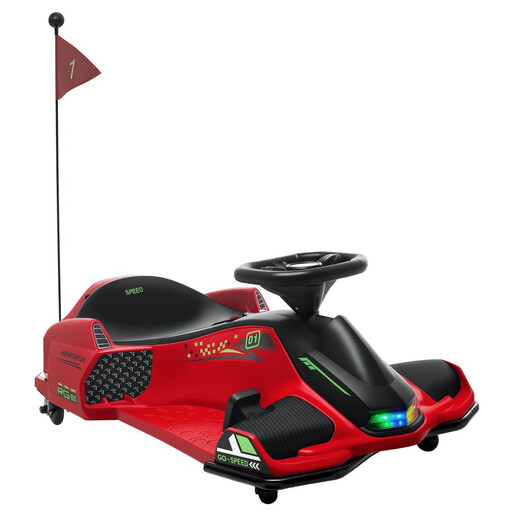
Why it suits this profile: According to the product name, this kart is intended for children aged 8 to 12 and combines a 12 V drive with adjustable speed and drift mode.
Adjustable speed means you don’t have to rely solely on the top speed setting. The age guidance also makes the intended age group clearer.
12 V system, drift mode and adjustable speed, according to the product details.
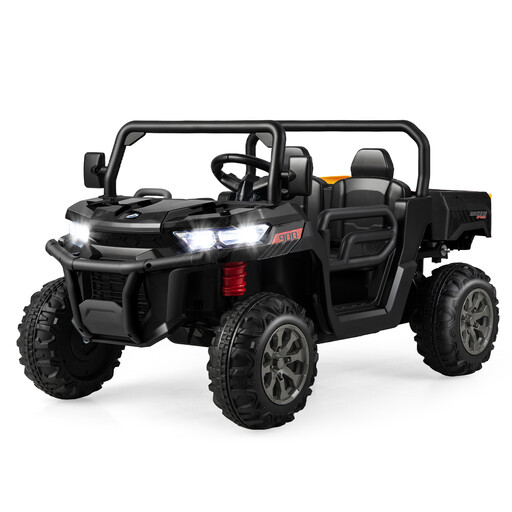
Why it suits this profile: According to the product details, this two-seater ride-on car is intended for children aged 3 to 8. It also comes with a 2.4 GHz remote control and three speed settings ranging from 3 to 8 km/h.
The remote control, soft start and seat belt help address the risks of uncontrolled acceleration. Before buying, compare the stated 50 kg load capacity with the combined weight of the children who’ll be riding.
Two seats, a 12 V battery, two motors, suspension and a remote control with an emergency brake function, according to the product description.
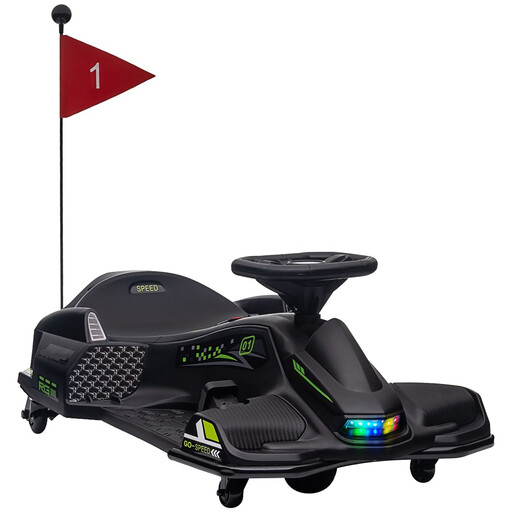
Why it suits this profile: The product name mentions drift mode, an adjustable speed of 3 to 8 km/h and dimensions of 90 × 53 × 99 cm. This makes it easier to assess how much space you’ll need before buying.
Adjustable speed means you’re not limited to a single setting. The dimensions also help you check narrow passages and storage space in advance.
12 V kart with drift mode, adjustable speed and clearly stated external dimensions.
We’ve put together a complete, regularly updated list of products that meet these strict selection criteria and fully comply with the safety requirements in force in the EU.
Run time depends on battery capacity, motors, surface, load and driving style, so there’s no reliable one-size-fits-all estimate. Check the manufacturer’s information and bear in mind that frequent use on grass or with a heavy load can put more strain on the battery.
That depends on the specific age and size guidance. Drift mode doesn’t mean the vehicle is suitable for everyone. For younger children, low speed settings, a stable seating position and direct adult supervision are particularly important.
As well as the electricity used for charging, you may need to pay for wear parts, tyres, a charger or a replacement battery. Before buying, check that these components are available and whether the battery can be replaced. Clean the vehicle with a dry cloth after each use and store it somewhere protected.