
Lieferung heute & morgen

Qualitätsgarantie

Willkommens-Angebote freischalten: KOSTENLOSE Lieferung | Bis zu 80 % RABATT | Kostenlose 30-Tage-JoyPlus-Testphase
App herunterladen
As a Joybuy Product Recommendation Officer, I analyse the market to provide you with clear, objective information for your purchasing decision. This article focuses on electric scooters in the 125cc equivalent class (L3e vehicle category), which represent an attractive alternative for urban and suburban commuting. The goal is to explain the essential criteria for selecting a suitable model and to present specific product options.
Choosing the right model depends on your individual requirements. The following three points are crucial for making an informed decision.
A key advantage of 125cc equivalent models is their accessibility for car licence holders. With the B196 licence extension in Germany, you can legally ride a road-legal electric scooter that reaches a top speed of up to 80 km/h.
Requirements for the B196 extension:
Vehicles in this performance class fall into the L3e electric motorcycle category. For registration, you will need the Certificate of Conformity (COC) papers provided by the manufacturer.
Range is a critical performance metric, especially for commuter electric scooters. Manufacturer specifications for range are often based on standardised test conditions (e.g., constant speed, flat terrain, specific rider weight). The actual real-world range can be affected by factors such as riding style, outside temperature, payload, and topography. Pay attention to the battery capacity (given in amp-hours, Ah) and voltage (Volts, V). Models with removable batteries offer additional flexibility, as they can be charged independently of the scooter's location.
The motor power, specified in watts (W), determines acceleration and the ability to handle inclines. A 125cc equivalent electric scooter typically has a nominal power of around 3000W. This allows for a top speed of approximately 80 km/h, which is sufficient to safely keep up with traffic in the city and on country roads. A powerful motor is also relevant for an electric scooter for 2 people to ensure adequate performance even when fully loaded.
Based on the criteria mentioned, we have compiled a selection of models suitable for various user profiles.

Why it stands out: The SUNRA Legend Black combines the classic design of a motorcycle with a powerful electric drive. Its long range and approval for two riders make it a practical option for longer commutes.
Objective Specifications:
Who is it for? This model is ideal for riders who appreciate the feel and look of a traditional motorcycle but want to leverage the benefits of a low-maintenance and cost-effective electric drive for their daily commute.
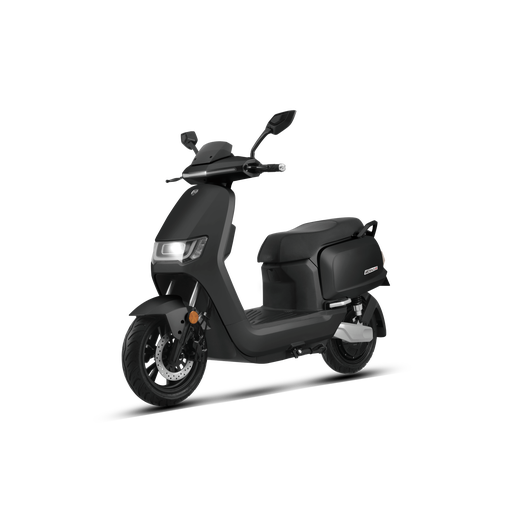
Why it stands out: The ROBO-S is distinguished by its modern technological features. Functions like app control, keyless entry via fingerprint, and a combined braking system (CBS) set it apart from other models.
Objective Specifications:
Who is it for? This 125cc equivalent electric motorcycle is aimed at tech-savvy users who value convenience, security, and smart features. The ability to manage and start the vehicle via an app offers a high degree of everyday utility in an urban environment.

Why it stands out: Classified as a 50cc equivalent moped (L1e), the SUNRA FUTURE is an accessible option for purely urban travel. It does not require the B196 extension and can be ridden with a standard car licence (Class B) or an AM licence.
Objective Specifications:
Who is it for? Ideal for riders who primarily navigate within the city and do not require speeds exceeding 45 km/h. Its easy handling and less stringent licence requirements make it a straightforward mobility solution.
Choosing an electric scooter is a highly personal decision. If the models presented here don't perfectly match your needs, there are other options to explore.
Explore our full range of electric motorcycles and scooters in the Motorcycle category.
1. What are the requirements to ride a 125cc class electric scooter with a car licence in Germany? To ride an electric scooter with a B196 extension, you must be at least 25 years old, have held a Class B driving licence for at least five years, and complete a special rider training course. An exam is not required.
2. What are the operating costs of an electric scooter compared to a petrol scooter? The operating costs are significantly lower. The cost of electricity for a charge that provides 100 km of range is often around 1 to 2 euros. Additionally, there are no costs for engine oil changes, and the maintenance for the brushless electric motor is minimal compared to an internal combustion engine.