
Lieferung heute & morgen

Qualitätsgarantie

Willkommens-Angebote freischalten: KOSTENLOSE Lieferung | Bis zu 80 % RABATT | Kostenlose 30-Tage-JoyPlus-Testphase
App herunterladen
A 12V 230V power inverter converts direct current from a battery into alternating current for devices with Schuko or Europlugs. This allows you to use chargers, televisions, small kitchen appliances and tools while you are on the move. The range extends from compact 12V to 230V voltage converters for the cigarette lighter to permanently installed models for motorhomes, boats, lorries or solar power systems.
However, a high wattage alone says little about whether an inverter is suitable. Three common buying misconceptions can result in an inverter not working as expected in everyday use.
Many products prominently advertise 3000, 4000 or even 5000 watts. This often refers to the short-term peak power, which may be relevant when starting a motor or compressor. For continuous operation, the crucial figure is the rated or continuous power.
For example, a product advertised as a 4000W inverter may offer 2000 watts of continuous power and 4000 watts of peak power. This may be sufficient for a 1500-watt coffee machine, but several powerful devices operating at the same time could exceed the continuous power rating.
An inverter with a modified sine wave is primarily suitable for simple consumers such as certain chargers, lamps or heaters. Sensitive electronics, audio systems, some power tools and certain chargers may react unexpectedly to this type of output.
If you want to power computers, televisions, fridges or motor-driven devices, you should choose a pure sine wave inverter. The product description should explicitly state the output waveform. A high wattage does not replace this information.
At an output power of 2000 watts, the theoretical current on the 12-volt side is more than 166 amps, not including conversion losses. An inverter of this kind should therefore normally be connected directly to a suitable battery, rather than to a standard 12-volt socket.
A car inverter with a cigarette lighter connection is intended for lower power levels. According to the product specifications, the Baseus Power Inverter Pro 150W has a DC input rated up to 20 amps. You should also check the vehicle’s operating manual for the permitted load of the vehicle socket.
First, add up the rated power of all devices you plan to run at the same time. Motors, compressors and tools also require their starting current to be taken into account. Allow some headroom rather than continuously operating at the stated maximum power.
As a general guide:
Depending on the model, a 2000W inverter may deliver 1000 or 2000 watts continuously, for example. Always check both figures.
For operating standard German household appliances, 220 to 240 volts AC and 50 hertz are relevant. A pure sine wave reduces the risk of humming or compatibility issues with sensitive electronics. Nevertheless, this does not guarantee that every device will function correctly.
For medical devices, follow the requirements specified by the relevant manufacturer. An inverter should not be used as a power supply for life-supporting or medically critical equipment without explicit approval.
Useful features include overload protection, short-circuit protection, under- and over-voltage protection, overheat protection and reverse-polarity protection. A power inverter with an LCD display can show the input and output voltage or the current power draw. This makes it easier to monitor the battery and load, but does not replace correctly sized cables and fuses.
For high power levels:
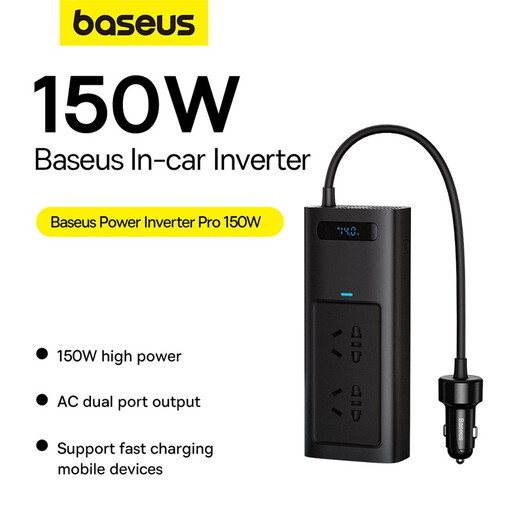
Why this product suits this profile: This compact model connects to a 12-volt cigarette lighter socket and is designed for smartphones, tablets, cameras and smaller power supplies in cars or motorhomes.
The stated maximum AC output is 150 watts, making its intended area of use clearer than products that only promote a high peak power rating. However, the output waveform is modified rather than pure sine wave.
12-volt input, 150-watt AC output and additional USB and USB-C ports in a compact housing.
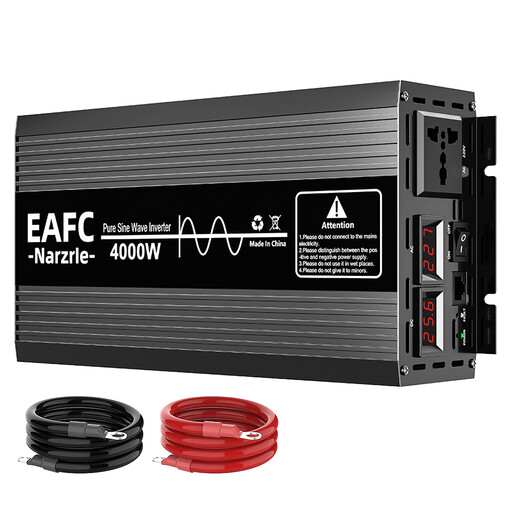
Why this product suits this profile: For motorhomes, lorries, camping or a stationary 12-volt battery, this model offers a pure sine wave as well as 2000 watts of rated power and 4000 watts of peak power.
Rated and peak power are listed separately. Digital displays for the input and output voltage make it easier to monitor the system continuously.
Pure sine wave, dual fans, LCD displays and protection against overload, overheating, short circuits, under-voltage and over-voltage.
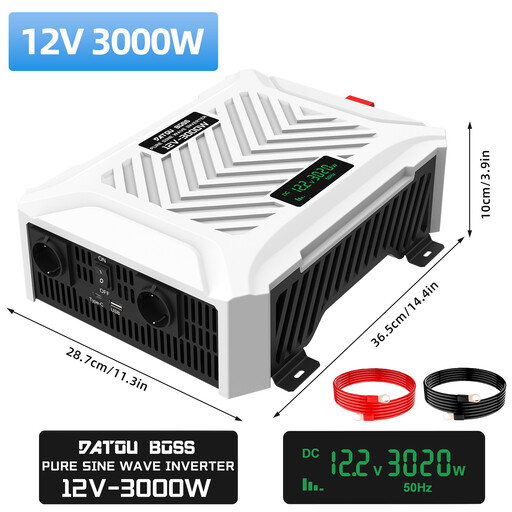
Why this product suits this profile: This model is aimed at users who want to power several devices with solar power, on a boat, in a motorhome or as backup power, and need an integrated status display.
The specifications distinguish between 3000 watts of continuous power and 6000 watts of peak power. Safety features and two temperature-controlled fans address typical load and heat-related issues.
Pure sine wave, LCD display, 12V input, 3000 watts of rated power and protection against overload, overheating, short circuits and reverse polarity.
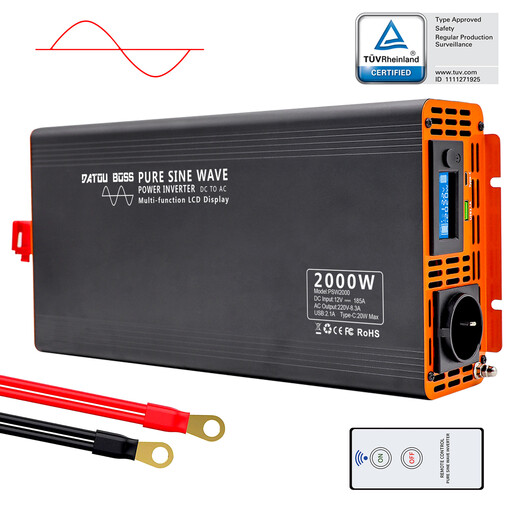
Why this product suits this profile: This device is an appealing option for camping, motorhomes, boats or solar power systems when you need a pure sine wave, remote control and an easy-to-read LCD display.
The product specifications distinguish between 2000 watts of rated power and 4000 watts of peak power. Under-voltage, over-voltage, overload, short-circuit and overheat protection are also listed as safety features.
LCD display, remote control, USB and USB-C ports, plus a temperature-controlled fan with a stated efficiency of over 90 per cent.
We have put together a complete, regularly updated list of products that fully meet these strict selection criteria and the safety regulations applicable in the EU.
Compact devices are usually plugged into the 12-volt socket. Models rated at 1000 watts or more should generally be connected directly to the battery using suitable cables and an appropriate fuse. The polarity must be correct. For motorhomes, solar systems and high-current installations, professional installation is advisable.
This depends on the battery capacity, efficiency and connected load. As a rough guide: divide the battery capacity in watt-hours by the power consumption. A 100-Ah battery at 12 volts has a theoretical capacity of 1200 watt-hours; conversion losses and the fact that the battery cannot be fully discharged significantly reduce the amount of energy available in practice.
For devices with motors or sensitive electronics, a pure sine wave inverter is generally the better choice. Check the continuous power rating and possible starting current. A power inverter with overload protection improves operating safety, but does not replace correctly sizing the battery, cables and fuse.