
Lieferung heute & morgen

Qualitätsgarantie

Willkommens-Angebote freischalten: KOSTENLOSE Lieferung | Bis zu 80 % RABATT | Kostenlose 30-Tage-JoyPlus-Testphase
App herunterladen
A 12V 230V pure sine wave inverter converts direct current from a battery into the mains-style alternating current you use at home. Depending on its rated power, you can run a laptop, television, fridge, coffee machine or power tools away from the mains grid. The term 12V to 220V voltage converter is also commonly used in shops, although the output voltage in the UK is typically given as 230V.
Before you buy, it’s worth taking a close look at the technical specifications. High wattage figures alone don’t tell you whether a device is suitable for your battery, your application and the appliances you want to connect.
Figures like “4000W” or “5000W” often refer to the short-term peak power. This helps when starting motors, compressors or power tools. What really matters for ongoing use, however, is the rated or continuous power.
A 2000W pure sine wave inverter might be advertised with 4000W peak power, but it delivers 2000W continuously. With a model rated at 1000W continuous, connected appliances must not draw more than 1000W on an ongoing basis – even if the product name says 2000W.
Sensitive power supplies, audio systems, certain chargers, fridge compressors and devices with motor control may need a smooth output wave. A pure sine wave is much closer to the mains electricity you get from a household socket than a modified sine wave.
That doesn’t automatically mean every device is compatible with every inverter. You should also check the power consumption, start-up current, frequency and the manufacturer’s instructions for your appliance.
A 12V system has to supply very high currents at high power. A 2000W inverter at 12V theoretically needs more than 160A, before you even account for conversion losses. Cables that are too thin or too long can overheat and cause voltage drops.
So it’s important to have:
First, add up the power consumption of all the devices you want to run at the same time. For motors, fridges and power tools, you should also factor in the start-up current. A 3000W pure sine wave inverter or 4000W pure sine wave inverter only makes sense if your battery, cables, fuse and charging source can support that power too.
You can estimate the approximate run time like this:
Battery capacity in Wh × efficiency ÷ power consumption in W = run time in hours
A 12V battery with 100Ah has roughly 1200Wh. Depending on the battery type and depth of discharge, not all of that capacity is usable. Efficiency figures from the manufacturer should be treated as guidelines and don’t replace a proper system plan.
Look for 230V AC and 50Hz if you want to run UK household appliances. Some product descriptions use 220V, 230V or 220–240V interchangeably, so check the specific technical details of each model.
Also worth considering are:
An inverter with USB ports is handy for mobile electronics, but it doesn’t automatically replace a separate charger for larger batteries.
For vehicles, boats and solar systems, low-voltage, over-voltage, overload, over-temperature and short-circuit protection are important features. Reverse polarity protection can limit damage if you connect the battery cables the wrong way, but it won’t prevent every mistake.
An inverter with an LCD display shows you input voltage, output voltage, power, frequency, temperature or protection status, depending on the model. This display makes monitoring easier, but it shouldn’t be seen as a substitute for a professional installation.
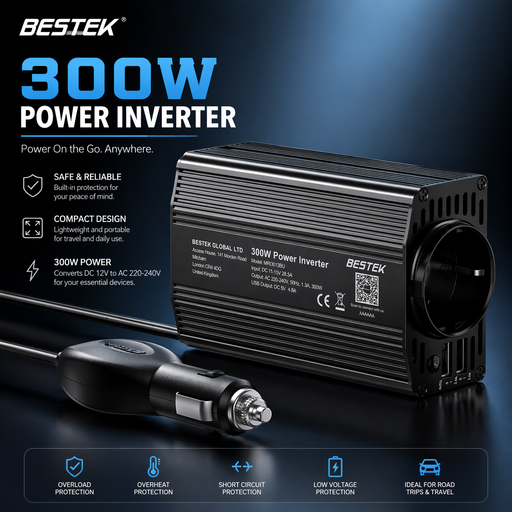
Why this product fits the profile: For your smartphone, tablet, camera and smaller on-board devices, this compact solution with 300W rated power is enough. The cigarette lighter connection is designed for this power level.
The rated power is clearly stated as 300W. This makes it easier to tell that high-power devices shouldn’t be used through the vehicle socket.
Two USB ports with a total of 4.8A, multiple protection features and a weight of 451g according to the supplier.
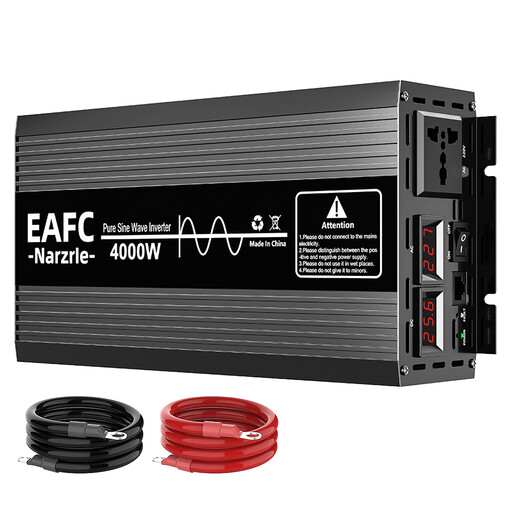
Why this product fits the profile: Motorhome and van owners who want to run several devices or appliances with higher start-up currents get 2000W continuous and 4000W peak power according to the product specification.
The continuous and peak power are listed separately. Two temperature-controlled fans and protection features address the heat build-up at higher loads.
Digital displays for input and output voltage, two intelligent fans and an operating noise of around 45dB according to the supplier.
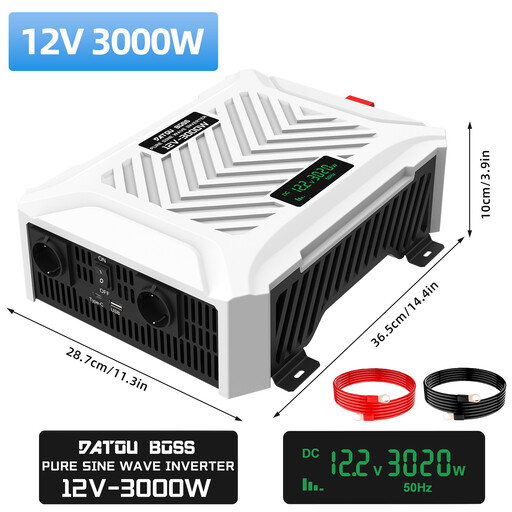
Why this product fits the profile: For larger motorhomes, boats, mobile workshops or off-grid solar systems, the stated 3000W rated power is designed for higher continuous loads.
The high power assumes a suitably sized battery connection. Overload, overheat, short-circuit and reverse polarity protection are integrated according to the supplier.
LCD display, two intelligent fans and, according to the product description, 3000W continuous and 6000W peak power.
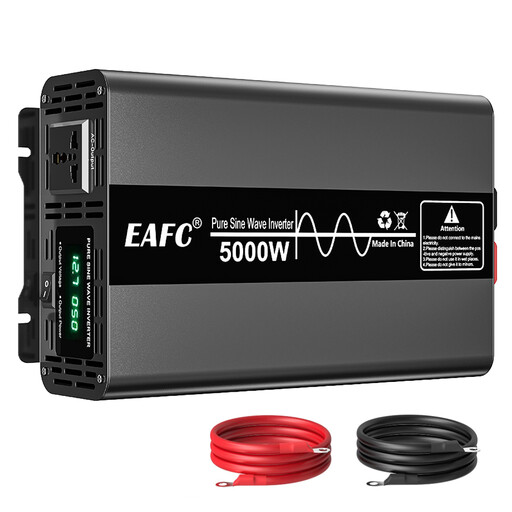
Why this product fits the profile: Users with high short-term start-up currents can consider the stated combination of 2500W continuous power and 5000W peak power.
LED indicators inform you about several protection situations, according to the supplier. Actual suitability still depends on cables, battery, fuse and load profile.
LCD status display, cooling, GFCI protection according to the product specification and several monitoring functions.
We’ve put together a full, regularly updated list of products that meet these strict selection criteria and the safety regulations that apply in the EU.
With an inverter for a motorhome, camping or a van, the battery should be as close to the unit as possible. First, connect the DC side according to the instructions and make sure the polarity is correct. Only then should you connect the AC load.
For a boat, there are extra requirements for moisture, corrosion, earthing and keeping the battery and electrical appliances physically separate. If you’re unsure about a fixed installation in a vehicle or solar system, it should be carried out by a qualified electrician. An inverter is not a substitute for an RCD or a properly protected household installation.
The run time depends on the battery capacity, depth of discharge, efficiency and the connected load. At high power, a 12V battery can be heavily drained in a short time. For longer run times, you’ll need a larger battery bank, a suitable charging system or a solar setup.
For chargers, camera equipment and small electronics, 300W can be enough. Coffee machines, power tools or fridges often need 1000W or more, and they can briefly draw much higher power when starting. What matters is the continuous power, plus the peak load you need.
Yes. The inverter itself consumes power even when idle, and this varies by model. Switch it off when you’re not using it, and don’t choose an unnecessarily powerful inverter for small loads. That saves your battery and reduces the overall energy demand of your system.