
Lieferung heute & morgen

Qualitätsgarantie

Willkommens-Angebote freischalten: KOSTENLOSE Lieferung | Bis zu 80 % RABATT | Kostenlose 30-Tage-JoyPlus-Testphase
App herunterladen
A dead car battery is more than just a nuisance—it can derail your plans and lead to unexpected costs, especially during the cold months or for vehicles left standing for long periods. However, when searching for a 12V 24V car battery charger, you'll quickly encounter a crowded market full of technical promises. Not every device delivers on its claims. As your Joybuy Product Recommendation Officer, I'm here to help you identify the critical features and avoid common purchasing traps.
Before you make a decision, you should be aware of the most common issues that lead to disappointment with many chargers on the market.
To avoid a bad purchase, focus on three verifiable technical specifications. These determine the performance, safety, and versatility of your charger.
The most fundamental requirement is compatibility with your vehicle fleet. A 12V 24V car battery charger offers the flexibility to service standard cars and motorcycles (12V) as well as larger vehicles like vans, RVs, or trucks (24V).
Equally important is the power, specified in watts. A powerful 400W charger can deliver a significantly higher charging current (amperes) than a weaker model. This is crucial for charging large batteries in a reasonable amount of time and for providing enough energy for demanding functions like pulse repair.
A modern smart battery charger is more than just a power source. It features a microprocessor that analyses the battery's condition and controls the charging process in multiple stages. Look for the following features:
A true pulse repair charger uses targeted, high-frequency current pulses to dissolve sulfate crystals that build up on the battery's lead plates over time. This process can partially restore the capacity and lifespan of a sulfated but otherwise intact battery. An effective repair function requires precise control and a sufficient power reserve, which is often lacking in very cheap devices.
Based on these objective criteria, we have identified products that offer a suitable solution for specific user groups.
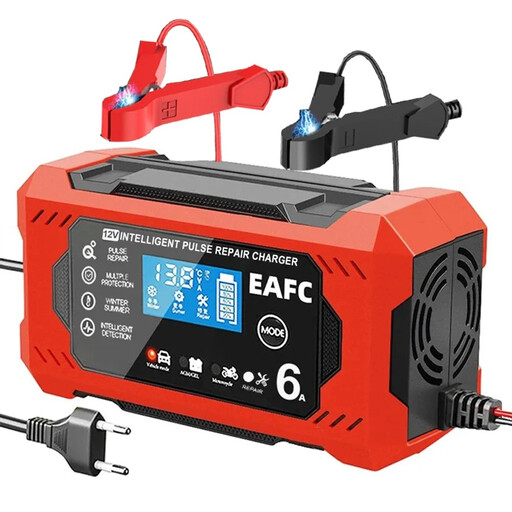
Why This Fits Their Persona: This device is a solid choice for users seeking a reliable charging and maintenance solution for their 12V vehicle batteries (car, motorcycle) without needing to invest in professional workshop equipment. It is ideal for winter storage or occasional top-ups.
It offers explicit charging modes for AGM, GEL, and wet-cell batteries, thus avoiding the "universal compatibility" trap. The microprocessor-controlled charging process ensures a gentle and complete charge.
Compact design with a clear LCD display that shows voltage, current, and charging status. Integrated protection features against overheating, short circuits, and reverse polarity.

Why This Fits Their Persona: For users with a mixed fleet (cars, trucks, boats) or a small workshop, this device is the right solution. The high power output and the ability to switch between 12V and 24V offer maximum flexibility and efficiency. It is designed for heavy-duty use and demanding battery maintenance.
This device delivers a true continuous power of 400W and a high charging current (up to 30A at 12V according to the manufacturer), setting it apart from models with misleading peak current specs. The Pulse Repair here is not an empty promise but a powerful function.
Automatic switching between 12V and 24V. The robust metal housing and temperature-controlled fan are designed for continuous use. It is suitable as a fully-fledged truck battery charger.
We have curated a current selection of products that meet these strict selection criteria and applicable safety regulations.
The charging time depends on the battery's capacity (in ampere-hours, Ah) and the charger's current (in amperes, A). You can get a rough estimate with the formula: (Battery Capacity in Ah / Charging Current in A) * 1.2. A typical 60 Ah car battery will take about 12 hours with a 6A charger. A powerful device with 30A can reduce this process to under 3 hours.
Yes, a modern smart battery charger with a maintenance charge function is designed for exactly that. After reaching a full charge, it switches to a monitoring mode and only delivers a minimal current when needed to compensate for self-discharge. This prevents overcharging and is ideal for winterizing vehicles.
No. The pulse repair function is intended to combat sulfation, a common problem in lead-acid batteries that are often only partially charged. However, it cannot repair mechanically damaged cells, short circuits, or batteries that have reached the end of their natural lifespan. It is a recovery attempt, not a guaranteed repair.