
Lieferung heute & morgen

Qualitätsgarantie

Willkommens-Angebote freischalten: KOSTENLOSE Lieferung | Bis zu 80 % RABATT | Kostenlose 30-Tage-JoyPlus-Testphase
App herunterladen
The performance and lifespan of a 12-volt vehicle battery depend heavily on proper maintenance. Battery voltage can drop significantly, especially for infrequent drivers, seasonal vehicles, or in low ambient temperatures. A modern 12V car battery charger not only recharges a depleted battery but also provides active maintenance through specific charging and conditioning modes. This article analyses the technical parameters to consider when selecting the right device.
Choosing a charger should be based on an analysis of its technical specifications to ensure compatibility with your vehicle and individual usage needs.
The charging current, measured in amperes (A), determines the charging speed. A common recommendation for optimal charging is a current that is approximately 10% of the battery's capacity in ampere-hours (Ah).
Modern vehicles use a variety of battery technologies. A charger must be explicitly designed for the specific battery type to prevent damage. Common types include:
A smart battery charger often detects the battery type automatically or offers selectable charging modes for different technologies.
Modern chargers offer more than just simple recharging.
Essential protection mechanisms are crucial for safe operation. These include:
Based on the technical criteria above, we present two models that cater to different user profiles.
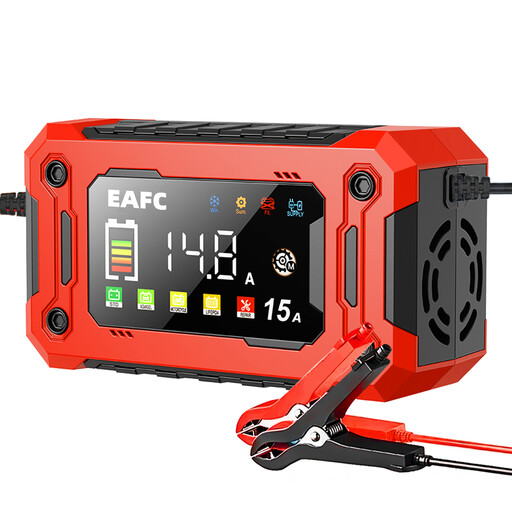
Why We Recommend This Product This model stands out with its high 15 A charging current and broad compatibility. It is suitable for a wide range of 12V lead-acid batteries, including AGM and start-stop types. The integrated pulse repair technology and automatic adjustment for winter and summer temperatures specifically address battery longevity and performance under various conditions. The large digital display provides clear status information.
Pros
Who It's For This charger is designed for users with large vehicle batteries (e.g., in SUVs, vans) or those who need the fastest possible charging. It is also an excellent choice for users looking for an advanced repair function to maintain older batteries.
Key Manufacturer Information Wide Compatibility: Charges 12V batteries for Cars, Motorcycles, SUVs, Minivans. Works with various lead-acid types including Start-Stop (EFB/AGM), Standard (Flooded/Wet, Dry, Maintenance-Free), Deep Cycle, and Storage Batteries. Fully Automatic Operation: Intelligently detects battery state and automatically stops charging when full (Full Self-Stop).
Manufacturers Jingdong Retail Germany GmbH Address:Kasseler Stra?e 7,35418 Buseck,Germany Email: custom-service@joybuy.com
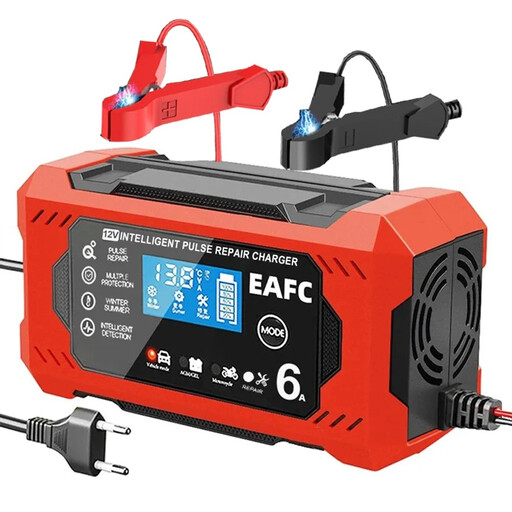
Why We Recommend This Product This microprocessor-controlled charger delivers a solid 6 A charging current, ideal for most standard car and motorcycle battery charger applications. It covers the most common battery types, including AGM, GEL, and wet cells. The combination of an LCD display, pulse repair function, and comprehensive protection mechanisms makes it a functional tool for regular battery maintenance and charging.
Pros
Who It's For This device is a fitting choice for car and motorcycle owners with standard batteries who need a reliable and compact car battery charger for regular maintenance, winter trickle charging, or recharging a depleted battery.
Key Manufacturer Information
- Microprocessor controlled
- Professional automatic switch mode
- For charging AGM,GEL,SLA and Wet batteries
- LCD display&pulse repair charge
- Overheat,overcharge,short circuit & reverse polarity protection
- Maximizes battery life
Manufacturers Jingdong Retail Germany GmbH Address:Kasseler Stra?e 7,35418 Buseck,Germany Email: custom-service@joybuy.com
For a wider selection of accessories and components for vehicle maintenance, visit our Automotive category.
1. How long does it take to charge a 12V car battery? The charging time depends on the battery's capacity (Ah), its state of discharge, and the charger's current (A). A rough estimate can be calculated with the formula: Charging Time (h) = Battery Capacity (Ah) / Charging Current (A). For example, a 60 Ah battery that is 50% discharged (requiring 30 Ah) would theoretically take about 5 hours for the main charging phase with a 6 A charger. Smart chargers require additional time for analysis and absorption stages.
2. What does the maintenance function on a battery charger do? The maintenance function, also known as "trickle charging," is a mode that a smart charger enters after the battery is fully charged. It supplies the battery with a very low, pulsating current to compensate for natural self-discharge. This keeps the battery at an optimal state of charge indefinitely without overcharging it, which is particularly useful during long periods of inactivity (e.g., over winter).
3. Can a pulse repair charger fix any battery? No. The pulse repair function is designed to reverse sulphation, a common cause of performance loss in lead-acid batteries. It can partially restore capacity in batteries that are sulphated due to deep discharge or age. However, it cannot fix mechanical defects such as an internal short circuit or damaged cells.