
Lieferung heute & morgen

Qualitätsgarantie

Willkommens-Angebote freischalten: KOSTENLOSE Lieferung | Bis zu 80 % RABATT | Kostenlose 30-Tage-JoyPlus-Testphase
App herunterladen
By the Joybuy Product Recommendation Officer, Published July 28, 2026
Reliable refrigeration is essential when you're on the road, whether for a camping weekend, a long RV trip, or the daily routine of a truck driver. A 12V compressor cooler is the perfect solution, promising consistent temperatures down to freezing, regardless of the outside air temperature. However, the market is crowded, and many products fail to live up to their advertising claims.
Before you make a decision, it's crucial to understand the most common pitfalls that can lead to disappointment and unnecessary expense.
This guide will show you which technical features to look for to make an informed purchasing decision and find a unit that will meet your needs for the long haul.
To separate the best from the rest, you should focus on three core aspects. These determine the performance, safety, and real-world usability of your portable cooler.
The crucial difference lies in the technology. While basic thermoelectric coolers can only lower the internal temperature by a fixed amount below the ambient temperature, a compressor cooler works just like a conventional refrigerator.
Therefore, pay close attention to the specified, adjustable temperature range. A range that goes down to -20°C is a clear indicator of a high-performance compressor unit.
Flexibility is key when travelling. A good 12V/230V electric cooler offers connections for both the vehicle's electrical system (12V for cars, 24V for trucks) and a standard home outlet. This allows you to pre-cool the unit before your trip begins.
Even more important is the integrated battery protection. This feature monitors your vehicle's battery voltage and automatically shuts off the cooler before the battery is drained to the point where the engine won't start. Look for a three-stage system (H/M/L) that allows you to adjust the cut-off threshold to match your battery's condition. This is an indispensable feature for any RV cooler or truck cooler.
The right size depends on your needs:
For maximum flexibility, some models offer a dual-zone cooler function. This divides the interior into two separate compartments whose temperatures can be controlled independently. This allows you to freeze food and chill drinks simultaneously. Modern conveniences like a cooler with app control via Bluetooth let you monitor and adjust the temperature without having to open the lid.
Based on the criteria above, we have identified several models that are particularly well-suited for specific use cases.
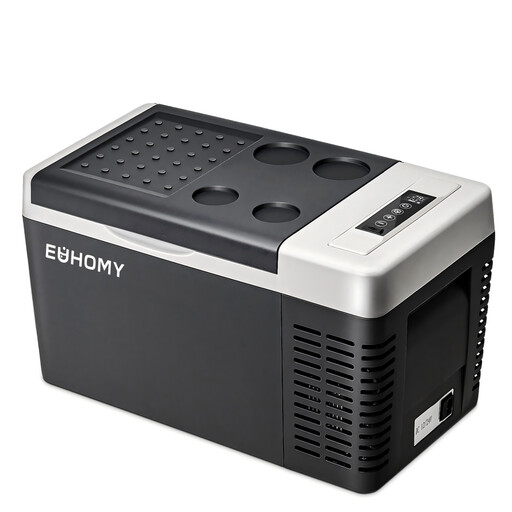
Why This Fits Their Persona: Ideal for day trips or weekend getaways in a car. Its compact 18-litre size is space-saving yet delivers true cooling and freezing performance thanks to its compressor technology. Perfect for anyone needing a reliable solution without the footprint of a large unit.
Features a true compressor for temperatures down to -20°C (avoids the performance trap) and a three-stage battery protection system (avoids the battery drain trap). Its quiet operation at around 42 dB bypasses the noise trap.
Compact design, app control via Bluetooth, and can be powered by 12/24V DC and 100-240V AC.
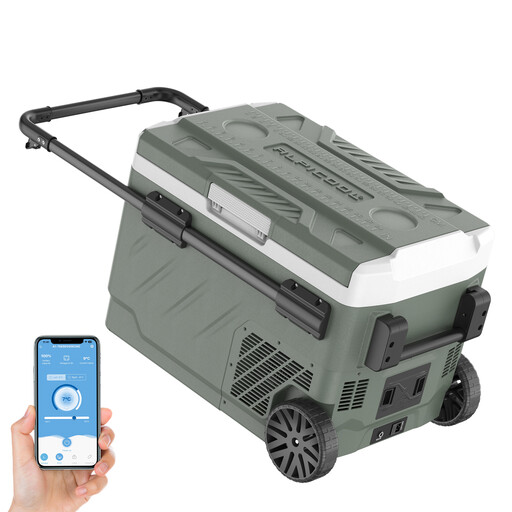
Why This Fits Their Persona: With a 40-litre capacity, two independently controlled zones, and convenient transport wheels, this model is tailored to the needs of families in an RV or on extended camping trips. The flexibility to cool and freeze simultaneously is a key advantage.
The dual-zone technology provides precise, on-demand cooling instead of a one-size-fits-all solution. Sturdy wheels and a retractable handle directly address the common complaint of impractical designs on larger coolers.
Dual-zone cooling with independent controls, app management, integrated transport wheels, and an included cutting board.
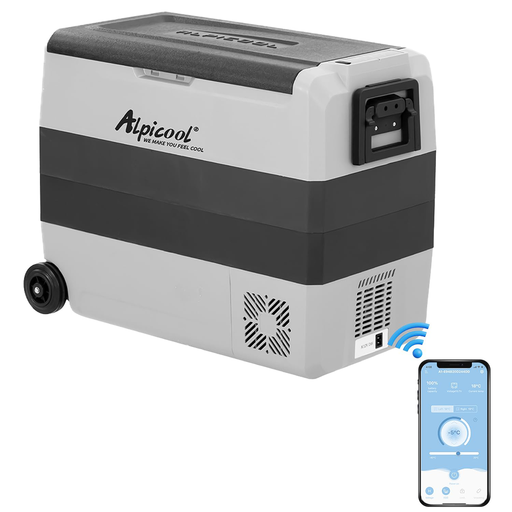
Why This Fits Their Persona: Designed for professional use in a truck, where reliability and maximum storage volume are paramount. The 60-litre capacity allows for stocking up on a full week's worth of supplies. Its rugged construction with wheels and a sturdy handle is built for demanding daily use.
With a removable divider, it offers a flexible dual-zone system that far surpasses the performance of basic coolers. The design, featuring robust wheels and a magnetic folding handle, is engineered for durability and ease of handling.
Very large 60-litre capacity, flexible use as one or two zones, heavy-duty transport wheels, and an integrated USB port for charging devices.
We have compiled a complete, up-to-date list of products that fully meet these strict selection criteria and all relevant safety regulations.
The runtime depends on several factors: the car battery's capacity, the cooler's efficiency (insulation, compressor), the set temperature, and the ambient temperature. A modern, efficient 40-litre cooler consumes about 40-60 watts on average. When the cooling cycle is active, it can draw around 1-2 amps per hour from the battery. A three-stage battery protection system is therefore crucial to prevent deep discharge. As a rule of thumb: with a healthy car battery, running the cooler overnight (8-10 hours) is generally not an issue if it's set to a moderate cooling temperature.
The main difference is the cooling technology. A compressor cooler works like a household refrigerator and can reach and maintain a set temperature (e.g., 4°C or -18°C) regardless of the outside temperature. A thermoelectric cooler can only lower its internal temperature by a fixed amount (e.g., 15-20°C) below the ambient temperature. On a hot summer day with 35°C inside the car, it will only cool down to about 15-20°C—too warm for many types of food. For true refrigeration and freezing, a compressor cooler is the technically superior solution.
Yes, it is recommended to treat a compressor cooler like a standard refrigerator. The cooling system contains oil that can circulate into the refrigerant lines if transported on its side. After being transported horizontally, the cooler should be left to stand upright for several hours (check the manufacturer's instructions, often 6-12 hours) before being turned on. This allows the oil to flow back into the compressor, preventing damage. Additionally, many models are designed to operate at an angle of up to 30-45 degrees, which is relevant for use on boats or on uneven terrain.