
Lieferung heute & morgen

Qualitätsgarantie

Willkommens-Angebote freischalten: KOSTENLOSE Lieferung | Bis zu 80 % RABATT | Kostenlose 30-Tage-JoyPlus-Testphase
App herunterladen
Reliable refrigeration is essential for multi-day trips in a camper, truck, or on a boat. If you need consistent cooling that won't fail in high ambient temperatures, you'll quickly find that conventional methods fall short. A 12V compressor cooler offers a powerful, off-grid solution that safely chills and can even deep-freeze your food.
This article serves as your guide. We'll highlight the key features to look for when making your choice and present a selection of models with different specialities to help you decide.
Choosing the right model depends on your individual needs. The following criteria will help you identify the features that are most relevant for your use case.
Power supply flexibility is a key feature. Most models can be powered as standard via a car's 12V socket or a truck's 24V socket. An additional 230V connection is practical for use at a campsite or at home.
For maximum self-sufficiency, models with an integrated or optional battery-powered cooler are gaining popularity. These allow for hours of operation without an external power source. Some units are also ready to connect to mobile solar panels, making a solar-powered cooler a sustainable option for extended stays off the grid. Pay attention to the stated energy consumption, often in watts (W) or amp-hours (Ah), to gauge the load on your vehicle's battery or power station.
Unlike thermoelectric coolers, whose performance depends on the ambient temperature, a portable refrigerator with compressor technology works just like your home fridge. It reliably reaches and maintains the set temperature, even in summer heat.
Many models offer a cooler with a freezer function, capable of reaching temperatures as low as -20°C. This is ideal for storing frozen goods for extended periods. Modern units also feature a cooler with app control, allowing you to conveniently monitor and adjust the temperature and other settings from your smartphone. Models with two independently controlled zones allow for simultaneous cooling and freezing.
The required capacity, measured in litres, depends on the length of your trip and the number of people you're providing for. Compact coolers around 20 litres are suitable for short trips or solo travellers, while families or long-term adventurers will likely need models with 40 litres or more.
If the cooler will be used in the sleeping area of a camper or truck cabin, a quiet compressor cooler is essential. The noise level is indicated in decibels (dB). Values below 45 dB are considered quiet and generally won't disturb your sleep.
Here is a selection of models that cover a range of needs—from maximum self-sufficiency to compact efficiency.
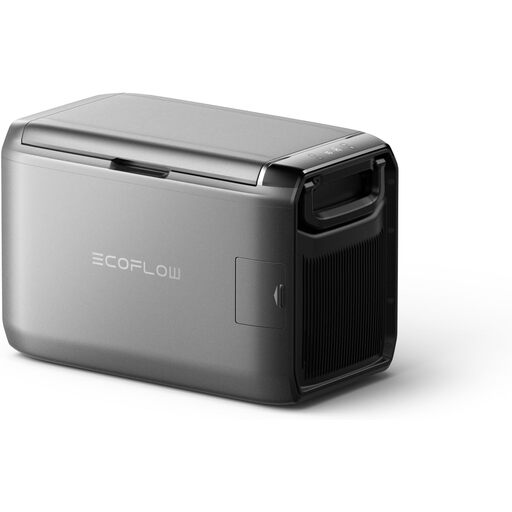
Why it stands out: The ECOFLOW GLACIER is distinguished by its dual-zone technology and the option for completely off-grid operation. With a separately available battery, it offers outstanding flexibility for longer adventures.
Pros:
Who it's for: Users looking for a versatile and high-performance cooling solution for multi-day, off-grid trips who value the flexibility of dual temperature zones.
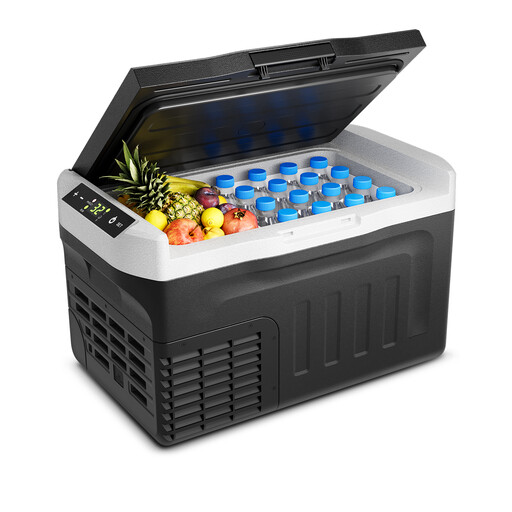
Why it stands out: This model combines a compact design with rapid cooling performance and modern app control, making it a practical solution for shorter trips or when space is limited.
Pros:
Who it's for: Solo travellers, couples, or users with smaller vehicles who need an efficient and fast-cooling portable refrigerator for weekend getaways or daily use.
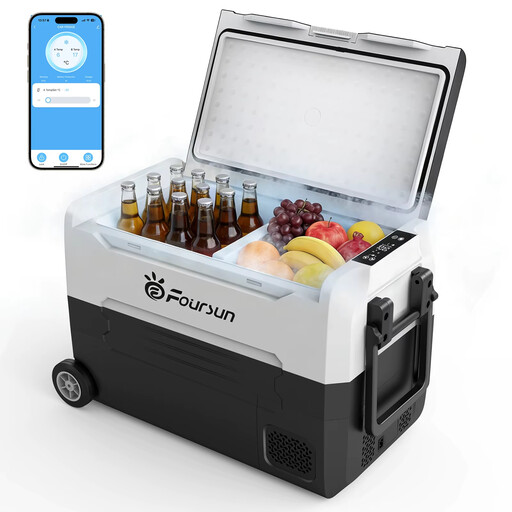
Why it stands out: The Foursun cooler focuses on energy efficiency and portability. Its ECO mode and integrated wheels make it a practical companion for extended use.
Pros:
Who it's for: Campers and van-life enthusiasts looking for a medium-sized cooler with very low energy consumption and practical transport features for versatile use.
The requirements for an electric car cooler are as varied as the adventures you take it on. If the models presented here don't exactly match your needs, there are numerous other options available with different sizes, features, and price points.
Power consumption depends on the cooler's size, the set temperature, the ambient temperature, and its insulation. During the active cooling phase, power draw is typically between 40 and 60 watts. However, thanks to good insulation and efficient compressors, the compressor only runs intermittently. Many models feature an ECO mode that further reduces consumption, optimising them for use with a vehicle battery or power station.
The main difference is the cooling technology. A compressor cooler works like a home refrigerator: it actively cools and can reach and maintain a set temperature (e.g., 4°C or -18°C) regardless of the outside temperature. In contrast, a thermoelectric cooler can only cool to a certain level below the ambient temperature (e.g., 20°C below). So, in 30°C weather, it will only reach 10°C at best and is not capable of freezing.
No, generally not. Almost all modern compressor coolers are equipped with an integrated, multi-stage battery monitor. This protective feature monitors the vehicle battery's voltage and automatically shuts off the cooler before the battery is drained to a point where the engine can no longer start. You can usually choose between different protection levels, depending on whether you are using a starter battery or a separate leisure battery.