
Lieferung heute & morgen

Qualitätsgarantie

Willkommens-Angebote freischalten: KOSTENLOSE Lieferung | Bis zu 80 % RABATT | Kostenlose 30-Tage-JoyPlus-Testphase
App herunterladen
Reliable cooling is essential when you're travelling, camping, or for professional long-haul drivers. But the market for portable cooling solutions can be overwhelming. Many buyers invest in an electric cooler for their car that fails to live up to its promises. Before you make a decision, it's crucial to understand the common pitfalls that lead to disappointment and unnecessary expense.
As your Joybuy Product Recommendation Officer, I'm here to help you cut through the noise. We'll highlight the three most common problems with portable coolers and show you which technical features truly matter.
The 3 Most Common Mistakes When Buying a 12V Cooler:
To avoid these problems, you should check three core aspects before buying. These features are what separate a high-performance 12V compressor cooler from an unreliable appliance.
The critical difference lies in the technology. While thermoelectric coolers are dependent on the outside temperature, a compressor-powered camping cooler works just like a conventional refrigerator.
A flexible power supply is crucial for versatile use. Look for models that can run on both 12V/24V DC (in your vehicle) and 100-240V AC (from a wall outlet). This type of 12V 230V cooler can be pre-chilled at home and then seamlessly continue running in your vehicle.
An indispensable feature is the three-stage battery protection (often labelled H/M/L for High/Medium/Low). This function monitors your car battery's voltage and automatically shuts off the cooler before the battery is drained to a point where the engine won't start.
The right size depends on your needs. For day trips, 15–25 litres is sufficient. Families or long-term travellers in an RV will often need 40 litres or more.
Some advanced models offer dual-zone technology. This allows you to set the temperature of two compartments independently—for example, one for cooling drinks and the other for freezing food. Also, look for a durable build with good insulation and a tight-sealing lid to efficiently keep the cold inside.
Here are some models that, based on their technical specifications, represent a smart choice for different user profiles.
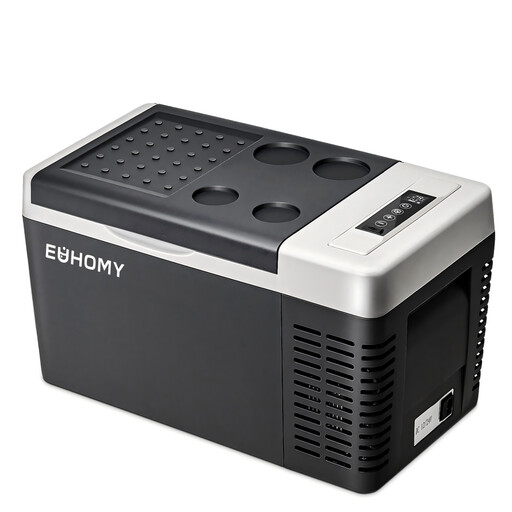
Why This Fits Their Persona: Ideal for day trips or weekend getaways. Its compact footprint fits easily into smaller vehicles, yet its compressor technology delivers reliable cooling and freezing performance sufficient for safely storing provisions.
This model bypasses the "temperature trap" by using a true compressor. The integrated three-stage battery protection also reliably prevents a dead car battery.
Compact Power: True freezing capability down to -20°C in a small footprint. Flexible Power Options: Can be operated via 12/24V DC and 100-240V AC.
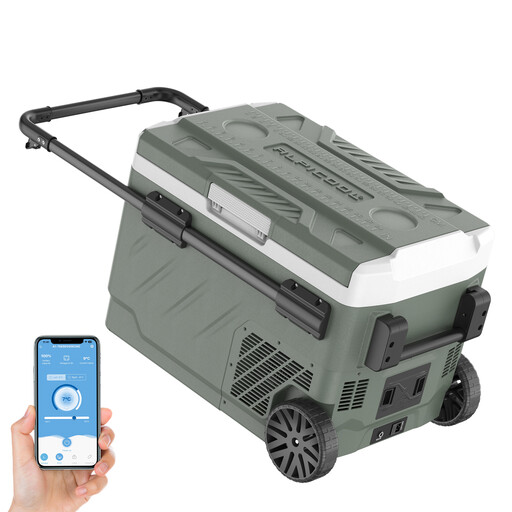
Why This Fits Their Persona: Perfect for families or extended camping adventures. The dual-zone function allows for simultaneous cooling and freezing, while the 40-litre capacity provides enough space for several days' worth of provisions. Wheels and a retractable handle make it easy to transport.
The solid insulation and efficient compressor minimise power consumption and runtime. Its dual-zone technology offers a level of flexibility that basic models can't match.
Dual-Zone Control: Two independently controlled temperature zones. High Portability: Equipped with sturdy wheels and a telescopic handle for easy transport.
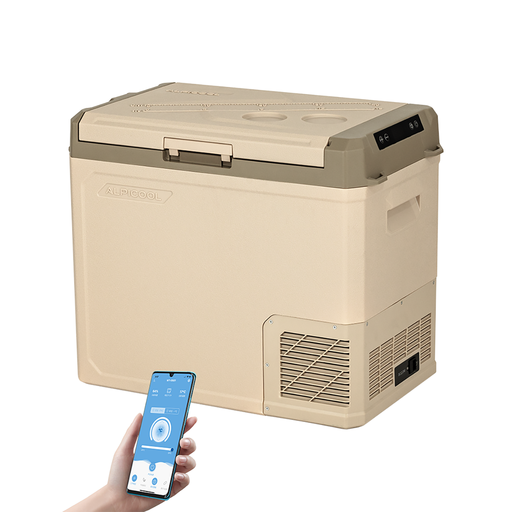
Why This Fits Their Persona: Designed for heavy-duty use in RVs, trucks, or on boats. The large 50-litre capacity holds supplies for long trips. Its robust construction and ability to operate at inclines of up to 40 degrees ensure reliability in demanding conditions.
This model is built for durability and efficiency. The excellent insulation and reliable battery protection are optimised for continuous use, keeping power consumption and noise disruption to a minimum.
Large Capacity: 50 litres provides space for up to 68 cans (355 ml). Incline Operation: According to the manufacturer, it functions at inclines of up to 40 degrees, ideal for boats or uneven terrain.
We have compiled a complete, up-to-date list of products that fully meet these strict selection criteria and safety regulations.
The runtime depends on the car battery's capacity, the set temperature, the ambient temperature, and the cooler's insulation. A good portable cooler with a 50-watt compressor that runs cyclically will consume an average of 10–15 ampere-hours (Ah) per day. A healthy 60 Ah car battery could theoretically power the cooler for 1–2 days before the battery protection system kicks in. However, for extended stationary periods, it's recommended to recharge the battery by driving or using an external power source.
The MAX mode (or Turbo mode) uses the compressor's full power to bring the cooler down to the target temperature as quickly as possible. This is useful when you've just loaded it with warm items. The ECO mode reduces the compressor speed and power consumption once the target temperature is reached. It's ideal for efficiently maintaining the temperature and minimising energy use during long drives or when stationary.
It is highly recommended. If you have the option to pre-chill the cooler at home using an AC outlet (100-240V), you will significantly reduce the strain on your car battery. Placing already-chilled food and drinks into a pre-chilled cooler is the most energy-efficient method. The compressor then only needs to maintain the temperature, rather than having to cool the entire contents down from room temperature.