
Lieferung heute & morgen

Qualitätsgarantie

Willkommens-Angebote freischalten: KOSTENLOSE Lieferung | Bis zu 80 % RABATT | Kostenlose 30-Tage-JoyPlus-Testphase
App herunterladen
A 12V cool box needs to keep things reliably chilled on the road without draining your vehicle battery unnecessarily. Yet product names and marketing promises don't always lead you straight to the right choice. If you only look at capacity or an impressively low temperature rating, you can easily miss important details.
As Joybuy's Product Recommendation Officer, I focus on verifiable product data, the intended use case and potential purchasing pitfalls. These points will help you compare mobile cool boxes for your car, motorhome, boat or camping trips objectively.
A thermoelectric cool box usually works with a fan and can only cool to a limited extent below the ambient temperature, depending on the surrounding conditions. It is often compact and, on suitable models, can also be used as a combined cooler and warmer.
A compressor cool box works much like a small fridge. It often reaches lower temperatures according to the product specs and is better suited for longer trips, perishable food, or a cool box with a freezing function. However, weight, purchase price and noise levels can be higher.
So a claim of "down to -20 °C" should always be considered alongside the cooling technology, ambient temperature and actual interior space.
An electric cool box for the car isn't necessarily compatible with every power source. Check whether the unit can actually run on 12V DC, additionally on 24V DC for lorries or larger vehicles, and if necessary on 100–240V AC.
For motorhomes, caravans and boats, it's also crucial whether a suitable mains adapter is included in the box. On some compact models, a 220–240V adapter is sold separately.
A large cool box won't automatically fit in your boot, under a seat bench or into a motorhome's storage space. Measure before you buy:
For a cool box used on a boat or for camping, you should also consider how to secure it safely during travel or movement.
For drinks and snacks on short journeys, a small thermoelectric box may be sufficient. If you want to store food for several days or freeze items, you should choose a compressor cool box with a clearly stated temperature range.
Models with two zones allow separate temperature control, depending on the design. One zone can be used for cooling, for example, while the other is used for freezing. Pay attention to the actual size of both compartments: a nominally large total capacity may be split across several differently sized areas.
The power consumption in watts is only part of the equation. Running time, ambient temperature, insulation and operating mode all affect the actual consumption. An ECO mode can reduce energy demand, while a MAX mode can cool more quickly.
For use in a vehicle, multi-stage battery protection is a sensible feature. With several devices, you can choose between low, medium and high cut-off thresholds. The right setting depends on your vehicle, battery and planned stationary time. Don't leave a 12V cool box running unattended for long periods if you can't monitor the battery condition.
Compressors and fans generate operating noise. Manufacturer claims of 40 or 45 dB are therefore relevant for sleeping areas, motorhomes and cabins. The noise level can vary depending on the operating mode and where the unit is placed.
A cool box with app control is handy if you want to monitor the temperature and operating mode from a distance. However, it doesn't replace checking the power supply, ventilation and secure positioning. Wheels, carrying handles, LED lighting and USB ports can make transport and use on the go easier.
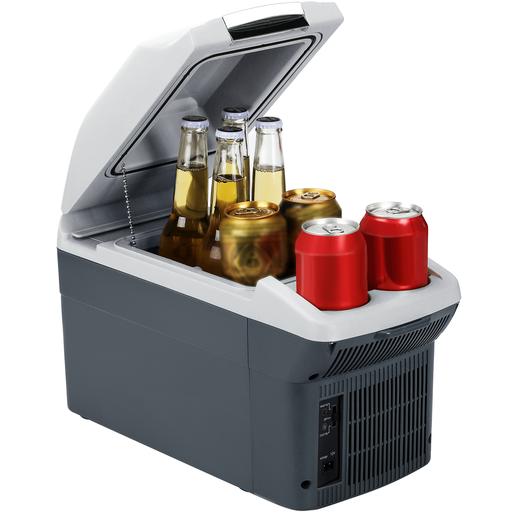
Why this product fits the profile: This compact 12V cooler and warmer box is designed for car journeys, snacks and drinks. According to the product specs, it offers 9 litres of capacity, two cup holders and a carrying strap.
The product description mentions the cooling and warming function as well as its dependence on ambient temperature. This makes the intended use clearer than a vague cooling promise.
12V operation, approximately 40 dB according to the product spec, two cup holders and an optional 220–240V adapter.

Why this product fits the profile: This compressor cool box is aimed at users who need more storage space and flexible power supply in their motorhome, car, boat or when camping.
The temperature range of -20 °C to 20 °C, the two storage compartments and three battery protection levels are all clearly stated.
12/24V DC and 110/240V AC, LCD control panel, Bluetooth app, ECO and MAX modes, and 40 dB according to the product spec.
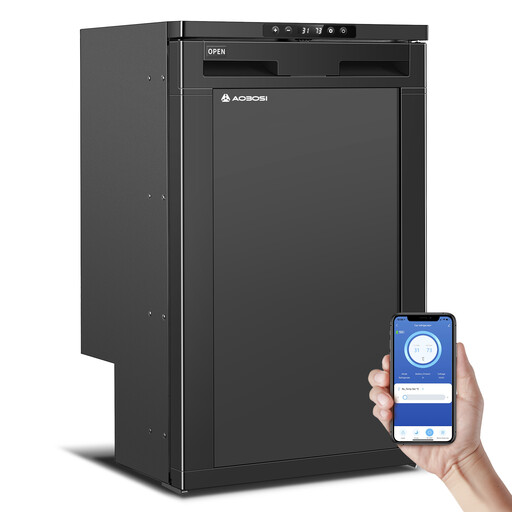
Why this product fits the profile: The stated capacity is suitable for longer stays in a motorhome, caravan, lorry or on a boat, provided the external dimensions fit your installation space.
As a compressor unit, it is designed for continuous cooling. The product description also mentions a zone division and app control, rather than just general comfort promises.
83 litres according to the product name, 12/24V operation, LED lighting and a touch panel with app control according to the product description.
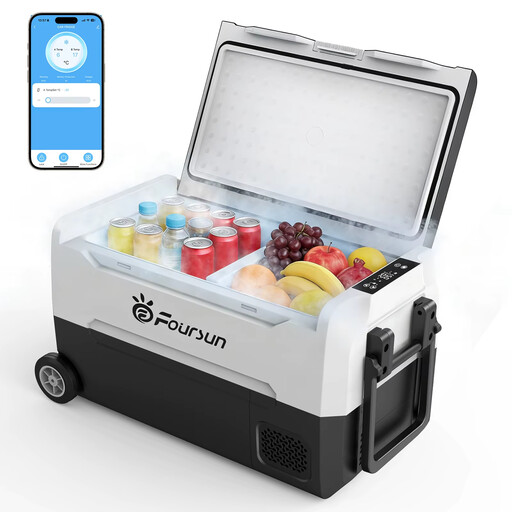
Why this product fits the profile: For regular trips by car, camping vehicle or with a power station, this model offers multiple connection options and operation via the Tuya Smart app.
The seller states specific variants, the temperature range of -20 °C to 20 °C, and DC and AC inputs. This makes it easier to match your choice to the available space.
35-litre variant, 12/24V DC, 100–240V AC, app control and wheels according to the product specs.
We've put together a complete, regularly updated list of products that fully meet these strict selection criteria and the safety regulations in force in the EU.
That depends on the battery capacity, cut-off threshold, ambient temperature, insulation and operating mode. For longer stationary periods, the cool box should be connected to a suitable auxiliary battery or power station. The battery protection reduces the risk of complete discharge, but doesn't replace monitoring the power supply.
The right technology depends on your use. A thermoelectric box is interesting for short journeys, drinks and occasional warming. A compressor cool box is better suited for longer trips, lower target temperatures and models with a freezing function. What matters most are the temperature range, capacity, power consumption and available space.
No. A 12V 24V cool box must be explicitly designed for both DC voltages. Check the technical specifications and the included connector before using the unit in a lorry, motorhome or on a boat.