
Lieferung heute & morgen

Qualitätsgarantie

Willkommens-Angebote freischalten: KOSTENLOSE Lieferung | Bis zu 80 % RABATT | Kostenlose 30-Tage-JoyPlus-Testphase
App herunterladen
Converting direct current (DC) from a battery into alternating current (AC) for household appliances is a fundamental requirement for mobile and off-grid applications. A power inverter, also known as a voltage converter, is the core component that performs this task. Selecting the right device depends on precise technical parameters tailored to the specific use case—whether in a camper van, truck, boat, or as part of a solar power system for emergency power backup.
The decision to purchase a power inverter should be based on an analysis of its technical specifications. The following parameters are crucial for making an informed choice.
The inverter's input voltage must match the voltage of the vehicle's electrical system or battery bank.
The output voltage of 230V at 50 Hz corresponds to the European household grid, ensuring compatibility with standard appliances.
An inverter's power output is specified in watts (W) and is the most important criterion for practical use.
To calculate the required size, add up the wattage ratings of your appliances (found on the nameplate) and plan for a buffer of about 20%.
The quality of the generated AC power is determined by its waveform.
A high-quality inverter includes various protection mechanisms to safeguard both the battery and the connected devices. These include:
The efficiency rating indicates what percentage of the energy drawn from the battery is actually converted into 230V AC power. Values above 90% are an indicator of a modern and low-loss design.
Based on the technical criteria mentioned, we present two models suitable for different requirement profiles.
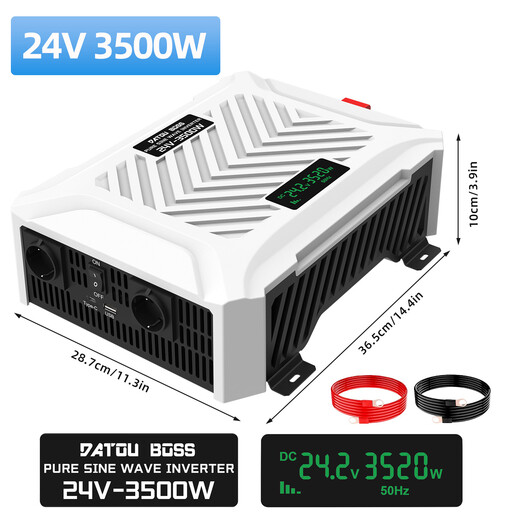
Why We Recommend This Product This model is designed for use in 24V systems and offers significant power reserves with 3500 watts of continuous power and 7000 watts of peak power. The pure sine wave output ensures the reliable operation of sensitive and high-power appliances. The integrated LCD display allows for continuous monitoring of input voltage and power output, supporting controlled operation. Equipped with two EU sockets as well as USB-A and USB-C ports, it offers high flexibility.
Pros
Who It's For This device is aimed at users of vehicles and systems with a 24V electrical system, such as truck drivers, operators of self-sufficient workshop vehicles, or owners of larger off-grid solar systems who need to run multiple powerful devices simultaneously.
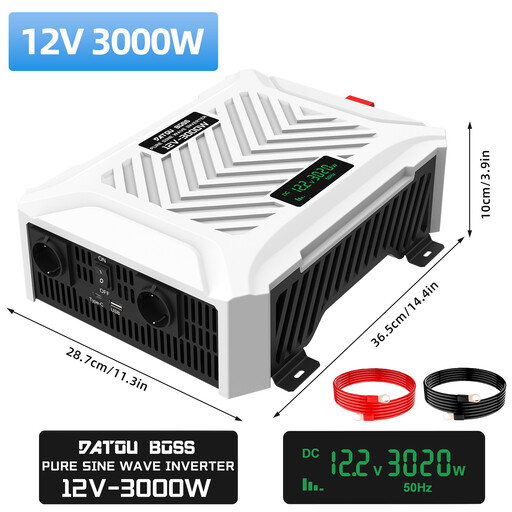
Why We Recommend This Product This 3000W inverter is designed for common 12V systems and provides a powerful solution for camping and mobile use. With 3000 watts of continuous power and 6000 watts of peak power, it can operate even energy-intensive appliances like coffee makers, small hobs, or power tools. The pure sine wave protects the electronics. Two temperature-controlled fans ensure efficient cooling under load, while the LCD display provides a clear overview of its status.
Pros
Who It's For This model is an excellent choice for owners of camper vans, motorhomes, and boats who need a self-sufficient 230V supply for comfort appliances and tools. It is also suitable for tradespeople with service vehicles or for securing a household during power outages.
While high-performance inverters are designed to run 230V appliances, mobile devices like smartphones, tablets, or laptops often only require a direct DC charging source. For permanently installed and compact charging solutions in a 12V or 24V system, a USB C Socket could also be a sensible and efficient addition to meet the charging needs of modern devices directly.
A pure sine wave inverter generates a smooth, periodic alternating voltage that matches the quality of the public grid. It is suitable for all types of electrical appliances, especially sensitive electronics. A modified sine wave inverter produces a stepped, approximated wave that can cause malfunctions, humming noises, or even damage to many modern devices.
To determine your needs, add up the power consumption (in watts) of all the devices you want to operate simultaneously. You can find this information on the nameplate of each device. Choose an inverter whose continuous power rating is at least 20% higher than this total value to have a safety margin and to account for the peak power required for inrush currents.
No, this is not permissible under any circumstances. An inverter is designed for a specific input voltage (e.g., 12V or 24V). Connecting it to a battery with the wrong voltage will lead to the immediate and irreparable destruction of the inverter and poses a significant fire hazard. Always use an inverter whose input voltage matches your battery's voltage.