
Lieferung heute & morgen

Qualitätsgarantie

Willkommens-Angebote freischalten: KOSTENLOSE Lieferung | Bis zu 80 % RABATT | Kostenlose 30-Tage-JoyPlus-Testphase
App herunterladen
A 12V two-seater electric car for children can let two children play together, while giving parents extra control with a remote control. But product images and terms such as “off-road”, “dual drive” or “realistic driving experience” don’t tell you much about how practical a vehicle will be day to day. What matters are the technical specifications, safety features, available space and the type of surface it’s designed for.
The 12 V rating describes the battery voltage; it doesn’t automatically tell you the range, speed or off-road capability. Two ride-on cars with 12-volt batteries can differ considerably in motor power, weight, running time and ability to handle inclines. Families should also check the number of motors, maximum speed and maximum load.
A children’s car with two seats can be handy for siblings or friends. Even so, parents should check that both children will fit comfortably, taking their age and size into account. Important details include the seat width, the distance to the steering wheel and controls, and the maximum load. The vehicles featured here have a stated maximum load of 50 kg. This is a technical limit, not a guarantee that every combination of two children will be suitable.
A children’s electric car with a remote control can be operated by an adult from a distance. This can be useful when starting off, reversing or navigating narrow paths. However, a remote control is no substitute for supervision. Likewise, a children’s car with a seat belt reduces the risk of a child slipping out of the seat while driving, but it doesn’t replace a suitable surface or an appropriate speed.
A battery-powered ride-on car for children needs to be charged regularly. The two-seaters described here use a 12 V 7 Ah battery. The stated charging time is 8 to 12 hours. In practice, this means plugging the vehicle into the charger in good time after use, rather than waiting until just before the next outing.
Actual running time depends on factors such as total weight, surface, outdoor temperature, inclines and speed. A general range estimate could therefore be misleading. If you expect to use the vehicle frequently, it’s also worth checking whether batteries, chargers and replacement parts will be available later.
The red and black two-seaters both have two motors. The product specifications state a speed of 3 to 8 km/h, with three speed settings available via the 2.4 GHz remote control. A soft-start function and emergency brake are useful features for parents to look for.
A four-wheel-drive children’s jeep, or one with several driven wheels, may perform better on firm grass, asphalt or concrete than a basic single-motor model. However, “off-road” shouldn’t be taken to mean it can handle every kind of terrain. Deep sand, mud, steep inclines and wet surfaces can put considerable strain on the motor, battery and tyres.
The featured two-seaters measure approximately 119 × 68 × 65 cm. Before buying, check that doorways, garden paths, cellar access and the intended storage space are wide enough. With a net weight of around 21.5 kg, an adult can transport one, but it will take some effort.
For a children’s car with two seats, weight distribution matters as well as the load limit. Heavy objects shouldn’t be left loose on the seats or loading area. An electric ride-on dumper with a load bed and shovel offers extra play features, but shouldn’t be used to transport heavy materials.
When choosing an electric car for children aged 3 and over, look for:
Lights, music, USB, AUX and Bluetooth features add to the fun, but they’re no substitute for a suitable drive system, secure seating and the right dimensions. A children’s car with lights and music should also be used in a way that ensures the audio doesn’t completely drown out the sounds around you.
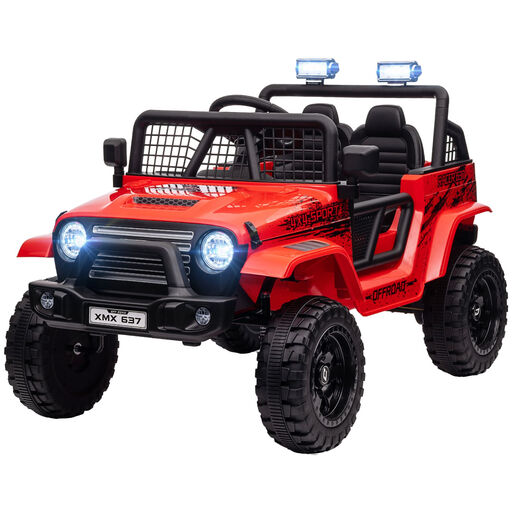
Why this product suits this profile: This 12V two-seater combines a remote control, lights, music and a seat belt in a relatively straightforward package for children aged 3 to 7.
The product name clearly specifies the dual drive and remote control. This makes it easier to check key buying criteria before placing an order.
12V system, two seats, remote control, and lights and music according to the product details.
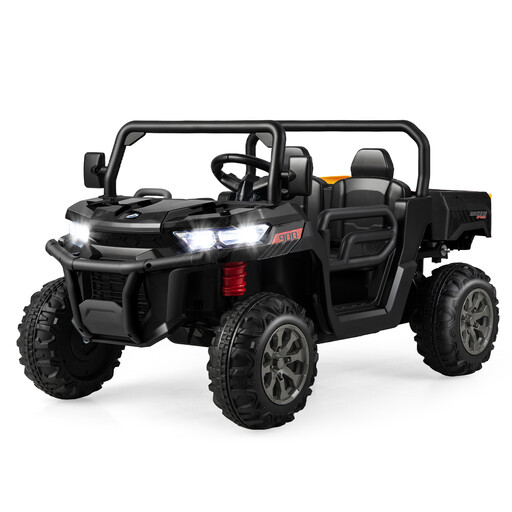
Why this product suits this profile: The black two-seater has clearly stated specifications, including a 50 kg maximum load, a speed of 3 to 8 km/h and a 12 V 7 Ah battery.
The load limit, dimensions, charging time, speed and battery specifications are all listed, making it easier to check the details before buying.
Two seats, suspension, adjustable seat belt, soft start, three speed settings and an emergency brake button on the remote control.
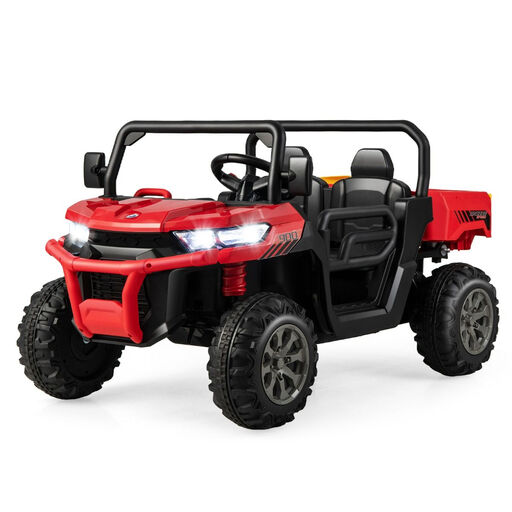
Why this product suits this profile: With its tipping skip, tailgate and shovel, this children’s construction vehicle is aimed at kids who enjoy role-play and frequent outdoor use.
Suspension, four large wheels and two motors are listed as specific features. This makes it easier to judge whether the vehicle is suitable for firm outdoor surfaces than relying on vague off-road claims.
Automatic tipping function, shovel, two seats, 50 kg maximum load, suspension and connections for music devices according to the product description.
We’ve put together a complete, regularly updated list of products that meet these strict selection criteria and fully comply with the safety regulations in force in the EU.
It’s not possible to give a reliable running time without precise information from the manufacturer. Weight, surface, speed, inclines and outdoor temperature all affect battery use. For the models mentioned, charging the 12 V 7 Ah battery takes around 8 to 12 hours.
The product details for the featured models state that they’re suitable for children aged 3 and over. You should also consider the child’s height, seating position and ability to understand instructions. An adult should use the remote control if the child isn’t yet able to steer and brake safely on their own.
No. Multiple motors and large wheels can help with driving on asphalt, concrete or firm grass. Deep sand, mud, water and steep inclines aren’t automatically suitable surfaces. Before each outing, check the surface, weather, battery level and load.