
Lieferung heute & morgen

Qualitätsgarantie

Willkommens-Angebote freischalten: KOSTENLOSE Lieferung | Bis zu 80 % RABATT | Kostenlose 30-Tage-JoyPlus-Testphase
App herunterladen
A 12V electric ride-on vehicle for children can give children from around the age of three a controlled driving experience in the garden, on the patio or on paved paths. At the same time, models differ considerably in terms of motorisation, controls, battery capacity and features. An eye-catching body or a long list of multimedia functions therefore says little about whether a vehicle is suitable for its intended use.
Before buying, parents and grandparents should avoid three common purchasing mistakes in particular.
“12V” initially describes the battery’s electrical voltage. It does not automatically indicate how well the vehicle will perform on grass, light gravel or inclines. The following factors are also decisive:
A 12V kids’ car with two motors may be better suited to outdoor use than a simpler model. However, its actual off-road capability still depends on the tyres, suspension and surface.
A children’s ride-on vehicle for ages 3 to 8 may be a good fit for a three-year-old depending on the seat and interior space, but already feel cramped for a significantly larger eight-year-old. Height, leg length and maximum load capacity should therefore all be considered when making a purchase. For a two-seater kids’ car, it is also important to check whether the stated load capacity applies to two children combined.
A children’s ride-on vehicle with remote control allows parents to stop the vehicle or influence its direction. However, the remote control is no substitute for supervision. The product description should clearly state the range, response behaviour, emergency stop function and whether the vehicle can start gradually at a low speed. A suitable children’s electric car with a safety belt, sturdy doors or side panels and clear operating instructions are equally important.
Lead-acid batteries with a capacity of 7 Ah are common in 12V models. Actual driving time depends on factors including load, surface, temperature, speed and inclines. Manufacturer runtime estimates should therefore be treated as guidance only.
Pay attention to:
A vehicle intended for regular use should be charged after every drive in accordance with the instructions. If purchasing a spare battery, check that its voltage, connector and physical design are compatible.
For younger children, low-speed settings and a gentle start are advisable. When comparing a children’s electric car, maximum speed should not be considered in isolation. Three selectable speed levels, reverse gear and an easily accessible braking system are often more relevant in everyday use than a higher top speed.
A children’s electric Jeep with two motors and suspension may offer greater capability on paved outdoor surfaces. In Germany, however, such a toy vehicle must not be used on public roads like a road-legal motor vehicle. Suitable locations include private, clearly visible areas with sufficient distance from traffic and obstacles.
Before ordering, measure the storage area, door width and available transport space. PP plastic bodies and metal frames can form a practical combination, but edges, hinges and seat mounts should be inspected regularly.
A children’s electric dump truck also requires care: remove dirt after use, do not overload the tipping bed and store the vehicle in a dry place. Water, sand and prolonged exposure to direct sunlight can affect the electronics and battery.
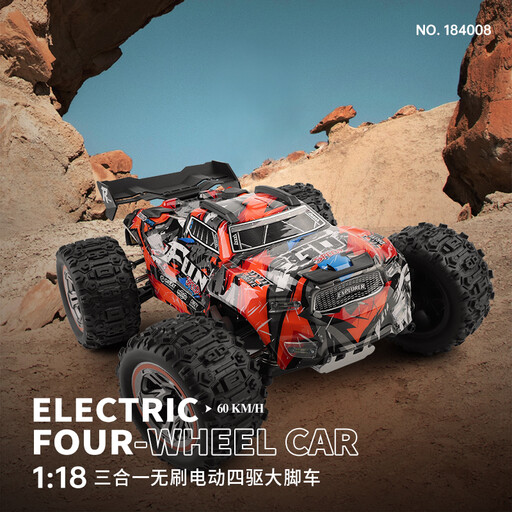
Why does it suit this profile? This compact, remote-controlled model is suitable for families looking for a smaller electric vehicle for controlled play areas. It is not a ride-on car for children, but a 1:18-scale remote-controlled kids’ car.
The product type is clearly identified: anyone looking for a ride-on vehicle should not confuse this model with a 12V ride-on car.
Compact design, remote-controlled operation and four-wheel-drive designation according to the product name. Check the recommended age and included accessories before buying.
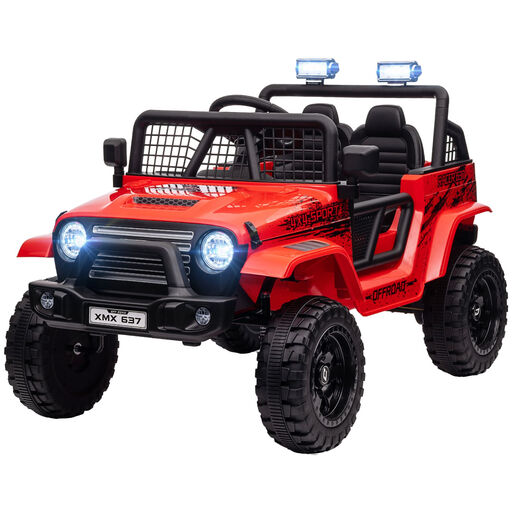
Why does it suit this profile? According to the product name, this model is designed for children aged 3 to 7 and combines a 12V drive system with remote control, lighting, music and a safety belt.
The remote control is understood as an aid to supervision, not a replacement for it. Check the range, charging time and dimensions before ordering.
12V dual drive according to the product name, remote control, lights, music and safety belt. Confirm the precise equipment against the current product page.
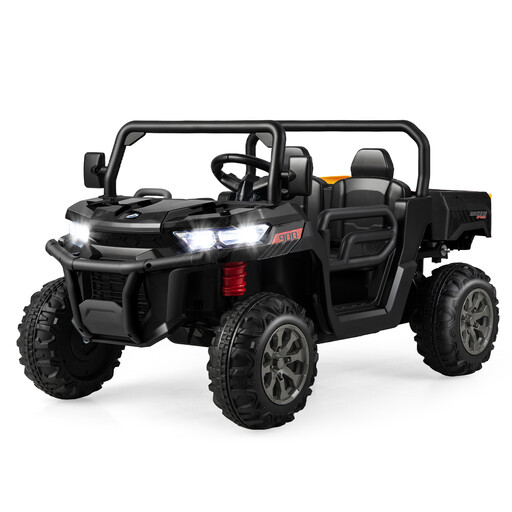
Why does it suit this profile? According to the product information, this two-seater kids’ car is designed for ages 3 to 8, features two motors, supports up to 50 kg and reaches speeds of 3 to 8 km/h.
The 50 kg load capacity is explicitly stated. You should also check the seat dimensions, belt adjustment and actual suitability for two children.
Two seats, 12V battery, two motors, 2.4 GHz remote control, three speed levels, suspension and safety belt according to the product description.
The full category includes more electric ride-on cars, allowing you to compare features, dimensions and intended use in detail.
The electricity costs of a 12V kids’ car depend on battery capacity, charge level and the electricity tariff. A 12V, 7 Ah battery has a theoretical capacity of approximately 84 Wh; charging losses must also be taken into account. For a precise calculation, the charger’s power consumption can be measured. With frequent use, the cost of a replacement battery, charger and wear parts is usually far more significant than the electricity used for charging.
Before every drive, parents should check that:
For products sold on the German market, also look for clear manufacturer or importer details, German-language or otherwise comprehensible instructions and the required product markings. A stated ASTM or CPSIA certification does not automatically cover all requirements applicable to the EU market.
Runtime per charge varies depending on load, speed, surface and temperature. For a vehicle with a 12V, 7 Ah battery, refer to the product instructions for the charging time. Regular charging according to the instructions and dry storage are important for extending battery life.
That depends on the motors, tyres, ground clearance and suspension. Short, dry grass may be suitable for certain models. Wet, deep or heavily uneven ground increases the load and may cause the vehicle to become stuck. Before buying, compare the manufacturer’s specifications with the conditions in your own garden.
A remote control is particularly useful for younger children and in areas with limited visibility. It allows parents to influence the speed and direction. Nevertheless, children should only drive under direct supervision and on a suitable private surface.