
Lieferung heute & morgen

Qualitätsgarantie

Willkommens-Angebote freischalten: KOSTENLOSE Lieferung | Bis zu 80 % RABATT | Kostenlose 30-Tage-JoyPlus-Testphase
App herunterladen
A 14-litre electric food steamer is designed for households that want to prepare larger quantities of vegetables, fish, meat, rice or desserts. Models with two tiers, an external water tank, viewing windows and a timer are especially practical. However, a large capacity or high wattage alone tells you little about how well a steamer will work in everyday use.
The “14 l” figure usually describes the available steaming space. It’s also important to check the actual size of each tier and whether you can use bowls or plates inside. For family meals, the steaming trays should offer plenty of space, rather than being narrow and stacked directly on top of one another.
Look out for:
A two-tier food steamer can cook several ingredients at once. However, you’ll need to allow for different cooking times, as the top and bottom tiers may not cook at exactly the same rate, depending on the design.
A 2,000-watt food steamer can heat water quickly and produce a larger volume of steam. However, its actual performance also depends on the design of the heating element, the seal and how the steam is distributed. A higher power rating also means higher electricity consumption while the appliance is running.
So, when choosing a model, it’s worth considering several details:
A food steamer with a viewing window lets you check on your food without constantly opening the lid. This can help keep the temperature and steam more stable inside the steamer. However, viewing windows should be easy to clean and give you a clear view of both tiers.
A food steamer with a water tank is more practical if you can access the tank from the outside. You can check the water level without removing the hot tiers. Check whether the tank can be removed and whether its opening is large enough for easy filling without spills.
A stainless-steel food steamer is a good choice for many households, as stainless-steel surfaces are generally durable and easy to wipe clean. However, it’s worth checking which parts are actually made of stainless steel. On some appliances, only the inserts are stainless steel, while the casing, lid or water channels are made of plastic.
Useful features for everyday use include:
Presets make an appliance easier to use, but they don’t replace checking the quantity and size of the food or how well cooked you want it. Always follow the instructions in the user manual.
The product details for the model below cover several common requirements. As the available information here focuses on one suitable electric food steamer, we’ve considered the same model for different types of use.
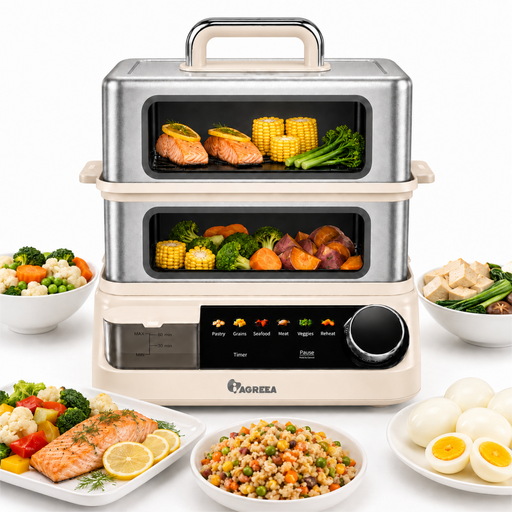
Why this product suits this household: It combines a dial with six preset programmes and a timer. This makes it easier to get started with steaming vegetables, fish, meat and grains, as well as reheating food.
The product description gives specific dimensions, two tiers, a 2.5-litre water tank and a power rating of 2,000 watts, rather than simply making a vague claim about its large capacity.
14 l total capacity, six programmes and an external water tank with a visible water-level indicator.
Why this product suits this household: According to the product details, the two removable stainless-steel trays each measure 300 × 230 mm. Panoramic windows on both tiers let you check on your food while it cooks.
The visible tiers and external tank mean you don’t need to open the appliance as often. The removable inserts also make portioning and cleaning easier.
Two stainless-steel trays, panoramic windows and separate tiers for different foods.
Why this product suits this household: With a 14 l capacity, 2,000 watts, two tiers and a timer, it’s well suited to larger portions and regular cooking routines in the family kitchen.
You can access the external 2.5-litre tank while the steamer is running. A pause function and six programmes help you follow consistent cooking routines.
Large steaming space, 2,000-watt heating system, six presets and a timer with a pause function.
We’ve put together a complete, regularly updated list of products that meet these strict selection criteria and fully comply with the safety regulations in force in the EU.
Place the food steamer on a stable, level, heat-resistant surface with good ventilation. Do not cover the steam outlets. Accessible surfaces can become very hot during use. Keep children away from the appliance and its power cable.
To care for your steamer:
It depends on the cooking time, quantity of food and model. An external 2.5-litre tank, like the one on the model mentioned here, can support longer cooking times. Before each use, fill the tank according to the markings and instructions in the user manual.
The cost depends on the power rating, how long you use the appliance and your electricity tariff. A 2,000-watt appliance running for an hour would theoretically use 2 kWh if it operated at full power throughout. In practice, actual consumption may vary. You can measure it more accurately with an electricity meter.
There’s no reliable way to give a fixed lifespan. It depends on how often you use the appliance, how you clean it, limescale build-up and how you handle the containers and lid. Regular care, storing the appliance dry and following the user manual can help reduce wear and tear.