
Lieferung heute & morgen

Qualitätsgarantie

Willkommens-Angebote freischalten: KOSTENLOSE Lieferung | Bis zu 80 % RABATT | Kostenlose 30-Tage-JoyPlus-Testphase
App herunterladen
A 150 kg folding sack truck should move heavy boxes, crates of drinks, tools or garden supplies safely, while taking up little space when you’re finished. In practice, though, the stated load capacity is only one part of the buying decision. The frame, loading platform, wheels, handle and intended use are just as important.
Whether you need one for moving house, the storeroom, workshop or garden, understanding the specifications will help you avoid a poor purchase and choose a folding sack truck that suits your transport needs.
With a traditional sack truck, the load is usually carried upright against the backrest. A 2-in-1 transport trolley, on the other hand, can switch between sack truck and platform modes. These modes often have different load limits.
The 2-in-1 models featured here have a stated capacity of 80 kg in sack truck mode, while the platform trolley can carry up to 150 kg. Overlooking this difference could put too much strain on the frame.
Wheel diameter, tyre material and bearings all play a part. TPR wheels can run relatively quietly on hard floors, but need suitable bearings and should be kept free of sand, threads and damp dirt. Standard 360-degree swivel wheels aren’t automatically suitable for stairs.
A stair-climbing sack truck has a specially arranged set of wheels for steps. A model with four swivel wheels, by contrast, is better suited to flat surfaces, ramps and paths.
Don’t focus on the frame price alone. Check whether straps, a non-slip loading platform, a parking brake or an adjustable-height handle are included. A budget model without suitable load securing may mean extra purchases for awkward items.
The “150 kg” rating describes the maximum permitted load under the conditions specified by the manufacturer. It shouldn’t be taken as a recommendation for every everyday situation. Loads should be distributed evenly, and tall or unstable items should be secured separately.
With a 150 kg platform trolley, the load sits flat on the platform. This can be handy for boxes and crates. A traditional sack truck with a large toe plate, on the other hand, is better suited to individual items carried upright.
An aluminium sack truck is often lighter than a comparable steel model. This makes it easier to store and lift, but doesn’t in itself indicate how sturdy it is. Look for:
A total weight of 7 kg can be practical for domestic use and keeping in the boot. For regular professional use, you should also consider how often it will be loaded, the condition of the floor and how easy it is to maintain.
An adjustable-height handle can be adapted to different user heights and operating modes. The 2-in-1 models in this selection have several handle heights, depending on the mode. Make sure the telescopic handle is fully locked into place before moving a load.
A sack truck with a brake offers an extra way to secure the trolley on slopes or when parked. However, the brake doesn’t replace load securing and shouldn’t be relied on as the only safeguard on steep slopes.
The models below differ mainly in their design, features and intended uses. Technical details are based on the relevant product descriptions.
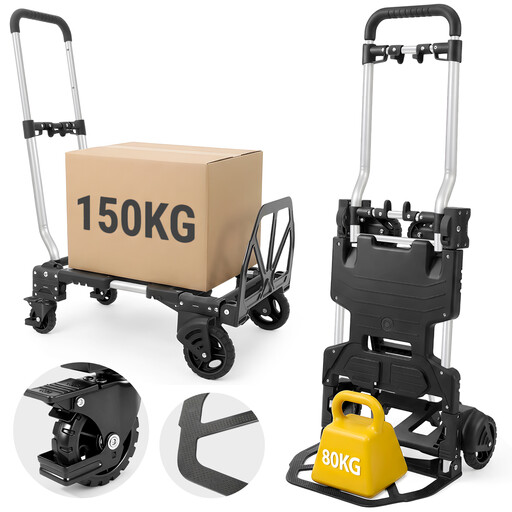
Why it suits this type of user: This trolley combines sack truck and platform functions, and the product details state that it folds down compactly. With a capacity of 80 kg in sack truck mode and 150 kg in platform mode, it’s suitable for a range of domestic transport tasks.
The different load limits for the two modes are clearly stated, making it easier to check the maximum capacity before buying.
Aluminium frame, TPR wheels with double ball bearings, parking brake and adjustable handle.
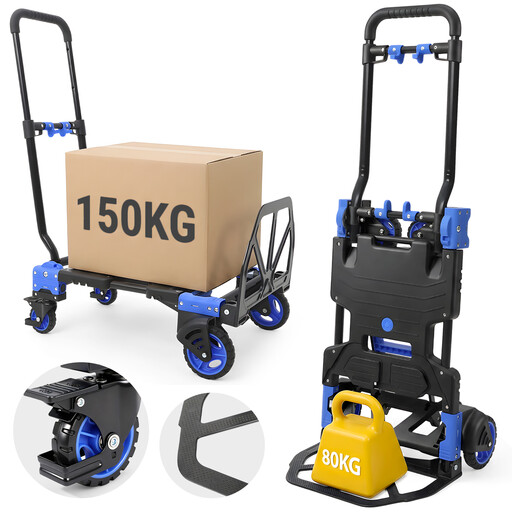
Why it suits this type of user: Its folding design, platform function and multiple handle heights make it a good fit for homes, house moves and storerooms with changing transport needs.
The product contents and operating modes are clearly described. This reduces the risk of mistaking a basic sack truck for a platform trolley.
150 kg platform capacity, 80 kg sack truck capacity, TPR wheels with double ball bearings and an integrated brake.
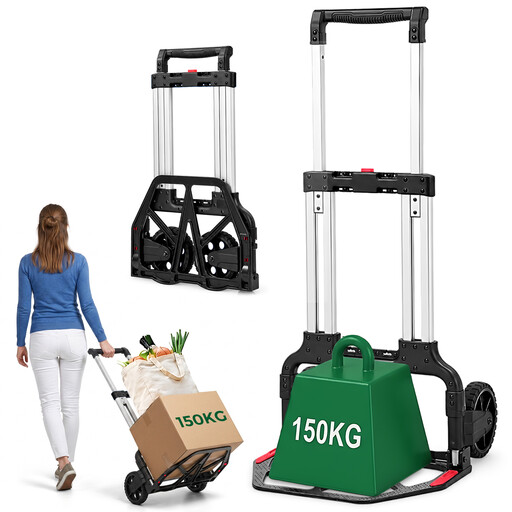
Why it suits this type of user: Its large loading platform and two expansion straps make it worth considering for house moves, workshops, gardens, storerooms and building sites, where you may need to secure loads directly.
As well as the load capacity, the product details mention fastening points, the loading platform and straps. This makes it easier to prepare for uneven or taller loads.
150 kg capacity, XXL loading platform, height-adjustable handle at 77 or 107 cm, and two expansion straps.
We’ve put together a complete, regularly updated list of products that meet these strict selection criteria and fully comply with the safety regulations in force in the EU.
Not necessarily. Models with standard wheels are designed primarily for flat floors, paths and ramps. If you regularly use a sack truck on stairs, you’ll need a stair-climbing sack truck specifically designed for the job. Even then, the step height, load distribution and securing method must be suitable for the design.
Its lifespan depends on the load, surface, storage and care. Regularly going over edges, exposure to moisture, overloading and unsecured loads can put extra strain on the frame, wheels and joints. Storing it in a dry place and checking the locks will help you get reliable use from it.
There are usually no regular running costs during normal use. However, you may need replacement parts such as wheels, bearings or straps. When choosing a model, it’s worth checking the wheel design, availability of compatible parts and recommended maintenance.