
Lieferung heute & morgen

Qualitätsgarantie

Willkommens-Angebote freischalten: KOSTENLOSE Lieferung | Bis zu 80 % RABATT | Kostenlose 30-Tage-JoyPlus-Testphase
App herunterladen
A 16 cm stainless steel kitchen sieve is a practical addition to many kitchens. It takes up very little space and can be used for flour, icing sugar, cocoa, sauces and small quantities of food. However, choosing the right household sieve is not always straightforward. Product images and marketing claims often distract from the details that really matter.
For a sieve for baking, the mesh size is crucial. A coarse pasta strainer can drain liquids quickly, but it will not separate flour or icing sugar as evenly. If you are looking for a fine kitchen sieve, you should therefore look for a specific mesh aperture measurement. If this information is missing, it is unclear whether the sieve is suitable for fine dry ingredients.
A stainless steel sieve may have a frame, handle and mesh made from different materials. A plastic frame can reduce the weight, but it may be more sensitive to high temperatures than a model made entirely from stainless steel. For contact with food, you should also follow the manufacturer’s specifications and intended-use instructions.
A dishwasher-safe sieve is convenient for everyday use. However, very fine mesh, handle connections or plastic components may be subjected to greater strain by frequent intensive cleaning cycles. Before buying, it is worth checking the material, cleaning instructions and shape of the sieve. A hanging loop is also useful if you want to keep this kitchen utensil within easy reach while saving space.
A sieve with a fine mesh is useful for flour, icing sugar and cocoa. The Leifheit ProLine sieve with a diameter of 16 cm has a stated mesh aperture of 1.5 mm. This size is designed for many baking applications and for straining fine ingredients. For large quantities of pasta or vegetables, a wider household sieve with greater capacity is usually more practical.
A pasta strainer, on the other hand, mainly needs to offer sufficient drainage and stability. The term “fine” should therefore not be assessed in isolation: a fine flour sieve and a spacious pasta strainer are designed for different tasks.
A diameter of 16 cm offers a good compromise for small to medium quantities. The sieve can be used over a bowl or saucepan and is easy to handle for everyday use in many homes.
A 22 cm model holds more ingredients and is better suited to larger portions. Its depth should also be taken into account when choosing. A sieve that is too shallow may allow flour to spill out when shaken, while a very large model will require more storage space.
An ergonomically shaped handle or thumb rest can make handling easier when sieving for longer periods. A kitchen sieve hanging loop provides a visible, space-saving storage option on a hook rail.
For stainless steel products, specifications such as rust-resistant material, dishwasher-safe construction and an easy-to-clean surface are relevant. Sharp edges should be avoided or handled with care. For plastic components, you should also check whether they are designed for use with hot liquids.
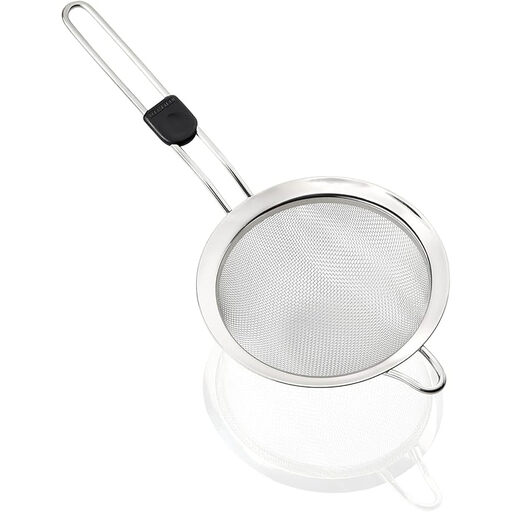
Why this product suits this profile: The 16 cm sieve is suitable for everyday small baking and kitchen tasks without taking up as much space as a large pasta strainer.
The stated mesh aperture of 1.5 mm makes its suitability as a flour sieve clearer than a purely promotional description without technical information.
16 cm diameter, stainless steel construction, thumb rest, hanging loop and stated dishwasher suitability.
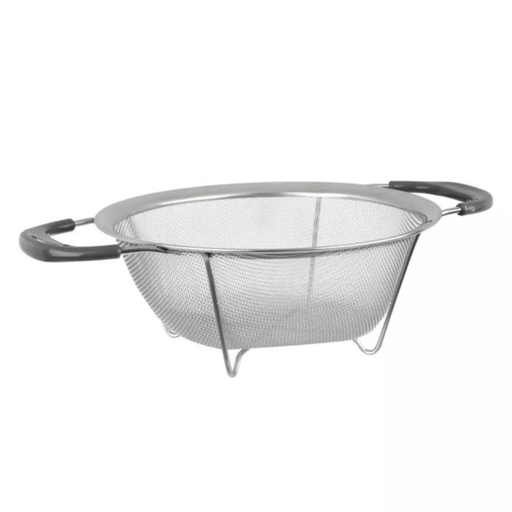
Why this product suits this profile: The larger format is designed for versatile kitchen tasks such as straining, rinsing and processing larger quantities.
The material and cleaning instructions are clearly specified: the sieve has a 316 stainless steel mesh, a plastic frame and is dishwasher-safe.
22 cm diameter, 316 stainless steel mesh, suitable for food contact, and designed for sieving, straining and rinsing.

Why this product suits this profile: The expandable design is aimed at households that frequently strain pasta, vegetables or larger quantities of food.
The expandable design is intended for sinks of different sizes, reducing the need for an exactly matching sink rim.
3.6-litre capacity, stainless steel material, expandable length of 53.5 cm and ergonomic handle.
A 16 cm sieve is suitable for flour, icing sugar, cocoa, small quantities of fruit and straining fine ingredients. For large portions of pasta or vegetables, a model with a larger diameter and greater capacity may be more practical.
Not every product description explains the exact quality of the material. When choosing, look for specific manufacturer information such as “rust-resistant stainless steel” or a particular stainless steel grade. After cleaning, the sieve should be stored dry to prevent residue and moisture from collecting around the connections.
This depends on the individual product. A sieve specifically described as dishwasher-safe can generally be cleaned in the dishwasher. For plastic frames or delicate connections, hand-washing with warm water and a soft sponge may reduce material stress.
We have put together a complete, regularly updated list of products that fully meet these strict selection criteria and the safety regulations applicable in the EU.