
Lieferung heute & morgen

Qualitätsgarantie

Willkommens-Angebote freischalten: KOSTENLOSE Lieferung | Bis zu 80 % RABATT | Kostenlose 30-Tage-JoyPlus-Testphase
App herunterladen
A cordless drill/driver is an essential piece of kit in many homes. You can assemble furniture, make repairs, fix items to walls and tackle small woodworking jobs without a mains cable. Yet the wide choice doesn’t automatically make it easy to pick the right one. High voltage ratings, large accessory cases and an impressive number of torque settings are often promoted more heavily than the features that really matter.
This guide explains which specifications to look at when buying a cordless drill/driver, which claims to check carefully and which model might suit different needs.
A 21V cordless drill/driver or 24V cordless drill/driver sounds powerful on paper. However, the voltage rating mainly describes the electrical system voltage. For practical comparisons, you also need to consider torque, speed settings, battery capacity and how effectively the power is transferred.
A tool with 45 Nm of torque may behave quite differently when driving screws from a model with less torque. Its suitability also depends on the material, the drill bit and the torque setting you choose.
A drill/driver set with 29 or more pieces can look appealing. What matters is whether the included bits and drill bits are suitable for the jobs you have planned. In particular, check:
For occasional furniture assembly, a smaller set is often enough. If you regularly take on renovation jobs, a drill/driver with an accessory case and two batteries may be more practical.
Battery capacity is usually given in Ah. A 2.0 Ah battery can last longer than a 1.5 Ah battery when used with comparable tools. Actual runtime varies, though, depending on the material, torque, speed and workload.
Also check whether the set includes one battery or two. A second battery means less time spent waiting for a charge, but it doesn’t replace a higher-capacity battery. Always consider runtime claims alongside the battery capacity.
Torque is measured in newton metres, abbreviated to Nm. A figure such as 45 Nm of torque describes the maximum turning force. For delicate materials, though, the highest setting isn’t what matters most: a choice of finely spaced settings is more useful.
Many tools offer 18+1 or 25+1 torque settings. These extra positions allow you to control the power more precisely when driving screws. When working with wood, plastic or furniture fittings, start on a low setting and increase it only if needed. The drill mode is generally used without the clutch.
A 2-speed gearbox lets you tackle different jobs:
For example, a model with 0–400 rpm in first gear and 0–1,400 rpm in second gear is set up differently from one that reaches 2,000 rpm. Higher speeds aren’t better for every job. When working with metal or delicate surfaces, it’s important to start in a controlled way.
A keyless 10 mm chuck makes it easier to switch between bits and drill bits. Check that the bit is held securely and that your accessories fit the chuck’s clamping range.
An LED work light helps when you’re working in darker spots, but it’s no substitute for good room lighting. For longer jobs, a soft-grip handle, balanced weight distribution and an easy-to-reach forward/reverse switch all make a difference. Remember to factor in the battery when considering the tool’s total weight.
A cordless drill/driver isn’t always the right choice for very precise holes in small workpieces. A bench-mounted mini drill provides a fixed guide and a set working height. For typical household and assembly jobs, however, a cordless drill/driver offers greater flexibility.
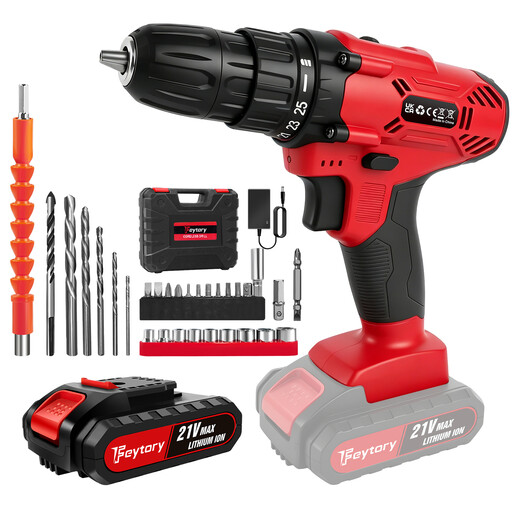
Why this product suits this user: This set is aimed at DIY beginners looking for a ready-to-use tool for furniture, wood, plastic and plasterboard. It includes a battery, charger, accessories and storage case.
The specifications include 45 Nm of torque, a 2-speed gearbox and 25+1 torque settings. This gives you a clearer picture of what the tool offers than a vague claim about power.
45 Nm maximum torque, LED work light, 29-piece accessory set and one battery included.
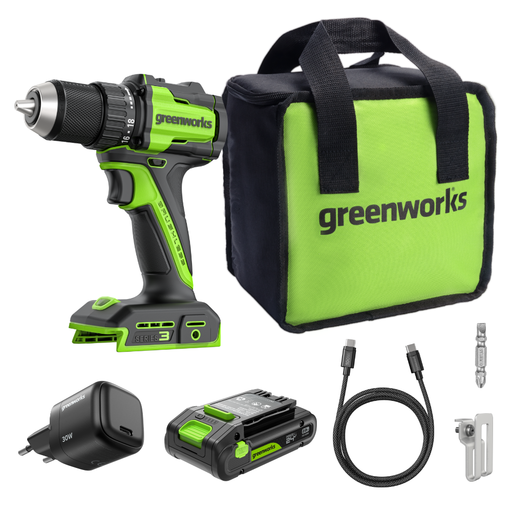
Why this product suits this user: This model is worth considering if you value a brushless motor, a wider speed range and compatibility with an existing 24V battery system.
As well as the 24V rating, the specifications state 45 Nm of torque, 18+1 settings, speeds of 0–450 and 0–2,000 rpm, and specific drilling capacities.
Brushless motor, 2-speed gearbox, LED light, 2.0 Ah USB-C battery and compatibility with the Greenworks 24V system, according to the product specifications.
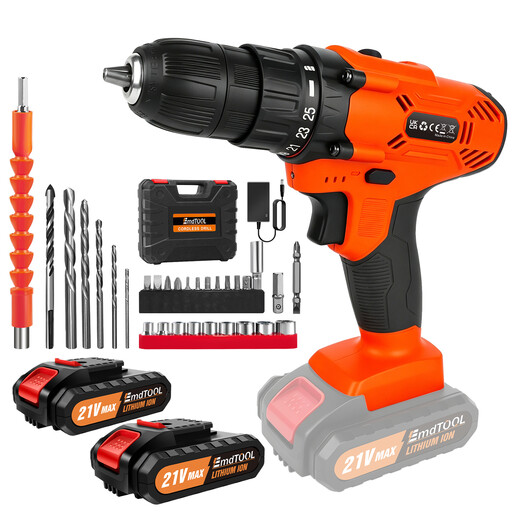
Why this product suits this user: Two 1,500 mAh batteries are handy for longer jobs in the workshop, at home or when making furniture, as you can use one while the other is charging.
The set offers more than just accessories: it clearly specifies the number of batteries, their capacity, the speed ranges and 18+1 torque settings.
Two batteries, 29-piece set, 45 Nm maximum torque, 2-speed gearbox and built-in LED work light.
We’ve put together a complete, regularly updated list of products that meet these strict selection criteria and the safety regulations in force in the EU.
Runtime depends on battery capacity, material and workload. A 1.5 Ah battery is more compact, while a 2.0 Ah battery stores more energy under comparable conditions. For longer projects, a set with two batteries is a good choice. After use, store the battery somewhere dry and follow the manufacturer’s instructions.
Not every model is suitable for masonry. A standard cordless drill/driver uses a rotary action. For regular drilling into concrete, you’ll generally need a tool with a hammer function or a rotary hammer. Check the materials the tool is specifically rated for, and use suitable drill bits.
The electricity used to charge a small lithium-ion battery usually costs very little compared with the purchase price. More important factors are battery life, charging time and whether you can buy replacement batteries. Use only compatible batteries and chargers, and remove the battery before carrying out maintenance or changing bits.