
Lieferung heute & morgen

Qualitätsgarantie

Willkommens-Angebote freischalten: KOSTENLOSE Lieferung | Bis zu 80 % RABATT | Kostenlose 30-Tage-JoyPlus-Testphase
App herunterladen
As a Joybuy Product Recommendation Officer, I see daily how customers are confused by unclear product descriptions and exaggerated marketing promises. Especially with safety-critical tools like a trolley jack, the wrong choice can be not just frustrating, but also dangerous. This guide will help you separate fact from fiction and find a model that precisely fits your requirements.
Before we delve into the technical details, let's highlight the three most common issues that lead to a poor purchase:
low-profile car jack must have a very low minimum clearance to actually fit under a jack for lowered cars or sports cars. Many models advertised as "low-profile" are still too high for such vehicles.To make an informed decision, focus on these three objective parameters. They are the key to selecting a suitable and safe tool.
The specified load capacity should always be chosen with a safety margin. A vehicle is never lifted completely off the ground, but only at one point. Nevertheless, it is a best practice to choose a jack whose rated load is significantly more than half the vehicle's weight.
jack for an SUV, a model with a 2.5-tonne capacity is a sensible choice. This provides a sufficient safety reserve, especially if the vehicle is unevenly loaded. A 2.5t hydraulic trolley jack covers most common cars, estates, and SUVs.The lifting range, defined by the minimum and maximum height, is perhaps the most important criterion.
extra-low-profile trolley jack should have a minimum clearance of under 100 mm, ideally around 85 mm, to slide effortlessly under side skirts and jacking points.jack for a tyre change on an SUV or off-road vehicle, a high maximum lift height is required to get the wheel clear of the ground. Values around 380 mm or more are recommended here.Look for official certifications. They are the only objective proof of the safety and quality of a workshop jack.
Here are some models tailored to specific user profiles that meet the criteria mentioned above.
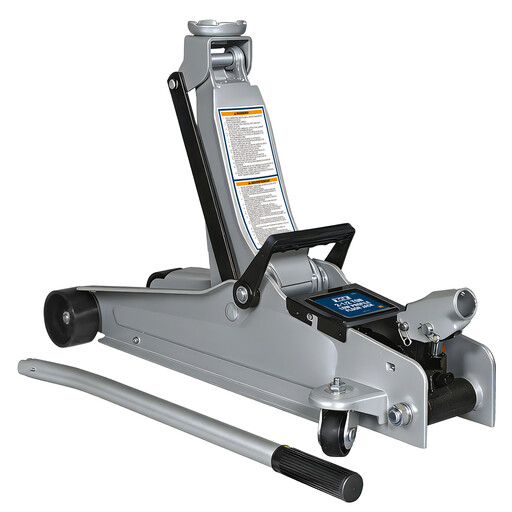
Why This Fits Their Persona: Ideal for hobby mechanics who work on both their lowered second car and the family SUV. The combination of high load capacity and an extremely low profile eliminates the need for a second jack.
It has verifiable EN 1494 + CE certification, a realistic load capacity of 2.5 tonnes, and a verified minimum clearance of just 85 mm, making it a true low-profile jack.
High versatility due to a wide lifting range (85-380 mm); robust steel construction for durability in workshop use.
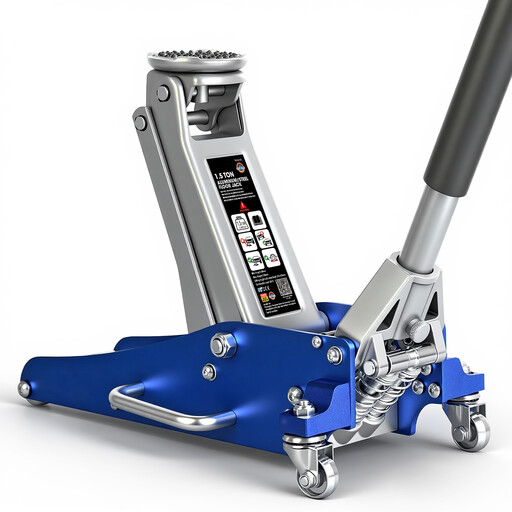
Why This Fits Their Persona: Perfect for drivers who take their jack to the racetrack or want to keep it in the boot for emergencies. Its low weight makes transport and handling effortless.
Despite its lightweight construction, safety is guaranteed by its EN 1494 + CE certification. The load capacity is clearly defined at 1.5 tonnes for lighter sports cars and saloons, without making false promises.
Extremely lightweight (approx. 14.3 kg) due to its aluminium alloy; dual-pump system for rapid lifting.
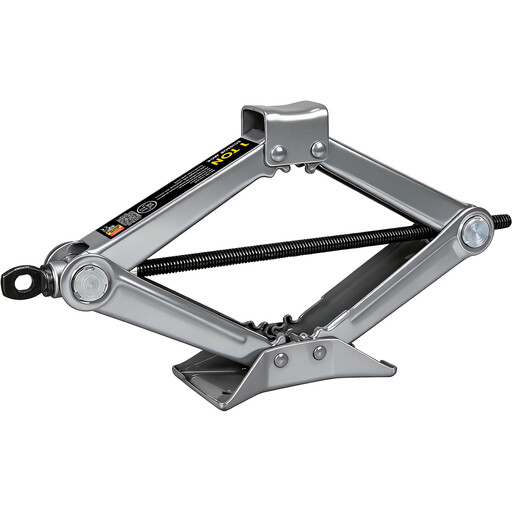
Why This Fits Their Persona: For drivers looking for a reliable but very compact solution for an emergency tyre change. It fits easily into the spare wheel well or a side pocket of the boot.
The capacity is clearly declared at 1 tonne for lighter vehicles. Its strength lies in its extremely low starting height of 88 mm, which makes it usable even for heavily lowered cars where many hydraulic models fail.
Very compact, foldable design for easy storage; manual, low-effort operation.
We have compiled a complete, real-time list of products that fully satisfy these strict selection criteria and UK safety regulations.
Find your vehicle's kerb weight in its registration document. As a rule of thumb, the jack's load capacity should be at least 75% of the total vehicle weight. Choosing a higher rating (e.g., a 2.5-tonne jack for a 2-tonne vehicle) provides an additional safety margin and reduces wear on the jack's components.
The EN 1494 standard is a European regulation that sets specific safety requirements for mobile or semi-mobile lifting equipment like trolley jacks. A product with this certification has been tested for aspects such as stability, overload protection, material strength, and safe operation. It is a reliable indicator that the jack has been designed for safe use in both professional workshops and private garages.
Yes, absolutely. A hydraulic jack is a lifting tool, not a holding device. As soon as the vehicle is raised to the desired height, it must be immediately secured with suitable axle stands, such as the TCE 3 Ton Heavy Duty Car Jack Stands, at the vehicle's designated support points. Never work under a vehicle that is only supported by a jack.