
Lieferung heute & morgen

Qualitätsgarantie

Willkommens-Angebote freischalten: KOSTENLOSE Lieferung | Bis zu 80 % RABATT | Kostenlose 30-Tage-JoyPlus-Testphase
App herunterladen
A 2 mm transparent PVC table protector should protect your tabletop without hiding its surface. Many shoppers also want a waterproof, wipe-clean and ideally non-slip solution for the kitchen, dining room, desk or commercial spaces. In practice, however, thickness alone does not determine whether it is suitable.
Air bubbles or areas of adhesion can form on glass, high-gloss finishes or highly polished tabletops. Several product descriptions specifically recommend placing a thin cloth between the table and the protector. A clear table protector is often easier to use on matt wood, plastic or coated surfaces.
Some models are rated as heat-resistant up to 80 °C. This may be relevant for warm plates, cups or serving dishes. However, pans taken straight from the hob or oven can reach much higher temperatures and deform PVC. A heat-resistant table protector is therefore no substitute for a trivet.
PVC table protectors are often delivered rolled and may settle slightly once laid out. Depending on the product, a shrinkage tolerance of around 1 to 5 mm may be stated. If you want to measure precisely to the edge of the table, unroll and smooth the protector first, then check how far it extends. For a 100 x 180 cm clear table cover, you should also check whether the measurement refers to the tabletop itself or the coverage you want.
A 2 mm-thick PVC protector is more substantial than a thin plastic tablecloth and can help guard against scratches, spills, stains and everyday wear. It works as a scratch-resistant table protector for dining tables, desks, craft areas or care settings. However, its thickness also makes it heavier and less flexible when cutting it to size.
A smooth, waterproof table protector can usually be cleaned with a soft, damp cloth and mild detergent. Oil, water and food residue stay on the surface rather than immediately reaching the tabletop. A textured underside can improve grip on matt surfaces. On glass or high-gloss surfaces, however, it is a good idea to use an underlay to reduce the risk of bubbles forming.
A straight-cut edge can feel uncomfortable against your arms, especially if the protector extends beyond the table. A table protector with a bevelled edge and 45-degree V-cut is a good option for dining and work tables, as the edge tapers more gently. This makes it more comfortable to rest your arms on and reduces sharp corners. Before buying, check that the bevelled edge will sit along the visible outer edge of the tabletop.
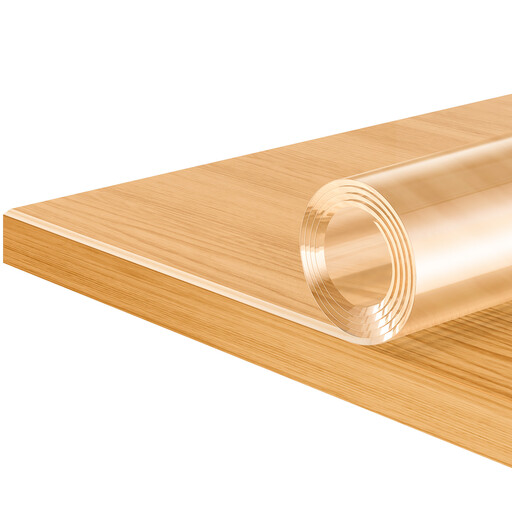
Why this product suits this profile: Its compact size is ideal for smaller kitchen, dining or work surfaces. The protector can be trimmed if needed and cleaned with a damp cloth.
Its 2 mm thickness and V-shaped edge take both protection and edge comfort into account, rather than relying on a thin PVC tablecloth.
Transparent 2 mm PVC, a waterproof surface and a textured underside, according to the product description.
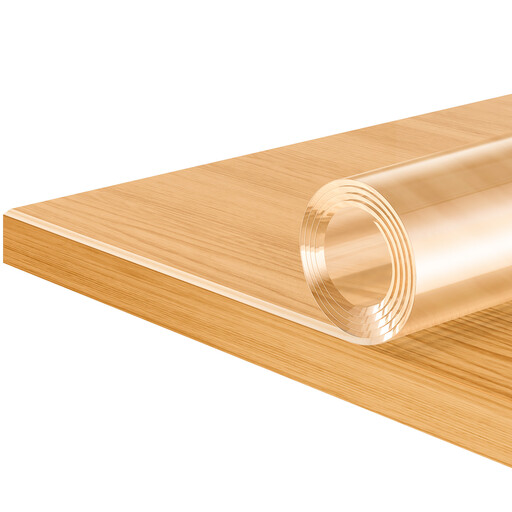
Why this product suits this profile: Its larger size fits many standard dining tables, while the clear finish lets the table’s surface show through.
The stated 1–5 mm tolerance is a reminder to smooth and position the protector before trimming it to its final size.
2 mm PVC, a waterproof and grease-resistant surface, and a 45-degree bevel, according to the manufacturer.

Why this product suits this profile: Its size suits smaller tables, desks or work surfaces. It is worth considering for areas where spills and everyday mess are regular occurrences.
The product details say it can be trimmed to size. This lets you tailor it to your tabletop instead of having to put up with an overhang that is too large.
Water- and oil-resistant surface, 2 mm thickness and stated heat resistance up to 80 °C.
We’ve put together a complete, regularly updated list of products that meet these strict selection criteria and fully comply with the safety regulations in force in the EU.
Unroll the protector on the tabletop and leave it to rest at room temperature. Placing heavy books along the edges can help. Only use heat from a hairdryer or heater if the product instructions explicitly allow it.
There is no fixed lifespan that applies to every protector. It depends on exposure to sunlight, cleaning products, how often objects are moved across it, sharp edges and heat. Gentle cleaning and keeping it away from direct heat can help it last longer.
Ongoing costs are usually limited to water, a soft cloth and, if needed, mild detergent. As the protector is not machine-washable, you avoid the washing involved with a wipe-clean fabric tablecloth. Cleaning it correctly is key to keeping it clear.