
Lieferung heute & morgen

Qualitätsgarantie

Willkommens-Angebote freischalten: KOSTENLOSE Lieferung | Bis zu 80 % RABATT | Kostenlose 30-Tage-JoyPlus-Testphase
App herunterladen
Dark kitchen cabinets, wardrobes and hallways can be lit precisely without drilling or installing permanent wiring. A 2-pack of LED cabinet lights with motion sensors can be particularly practical: you can distribute the two lights across several areas, recharge them via USB and have them switch on automatically when movement is detected.
However, wireless cabinet lights vary considerably in battery capacity, sensor technology, installation and lighting options. If you focus only on a low price or a high number of LEDs, you may overlook important details. Three common buying misconceptions are particularly relevant.
The number of LEDs alone says little about the actual lighting effect. The design, light distribution and—where specified—the luminous flux in lumens are also crucial. A slim LED strip for a wardrobe may illuminate the interior more evenly than a shorter light with a more concentrated beam.
A clearer light colour is usually sensible for kitchen work areas. In a bedroom or child's room, warmer light with lower brightness can feel more comfortable. Specifications such as 2800–3200 Kelvin, 4500–5000 Kelvin or 6500–7000 Kelvin help you assess the options.
Many models use a PIR sensor. This responds to changes in thermal radiation rather than simply detecting every sound or movement in the room. The range and detection angle need to suit the installation position. The lights featured here specify detection ranges of 3 to 5 metres in some cases.
Ambient brightness is also relevant. Some sensor lights only switch on in the dark, while others also offer a constant-light mode. A darkness sensor can be useful for a USB LED night light beside the bed or in the hallway, whereas manual continuous operation may be more practical in a frequently used storage room.
A drill-free cabinet light is often attached using adhesive strips. The surface should be dry, clean, free from grease and as smooth as possible. Adhesion may be weaker on rough plaster, dusty cellar walls or damp tiles. Before installation, you should also check whether the light can be easily removed for charging.
Magnetic mounts and hooks offer a flexible alternative. They can be particularly useful for tenants, older people or households that do not want to make permanent changes to walls or furniture.
A rechargeable LED under-cabinet light does not need a socket where it is used. Battery capacity is measured in milliamp hours, abbreviated to mAh. Under comparable conditions, a 1100 mAh battery stores more charge than a 500 mAh model. However, actual battery life depends on the brightness setting, how long the light is switched on and the operating mode.
Look out for:
Damaged or swollen batteries should no longer be used. The lights should also be protected from water, high humidity and extreme temperatures.
Measure the available space before buying. Models measuring 20, 30 or 40 cm in length are suitable for cabinet shelves, shelving and base units of different widths. A slim housing approximately 10 mm high can be advantageous in narrow spaces.
For a motion-sensor kitchen light beneath a wall cabinet, it is also important that the sensor is not obstructed by a side panel, decoration or stored items.
An LED light strip with 3 colour temperatures allows you to choose between warm, neutral and cooler light. Warm white in the region of around 2800–3200 Kelvin is often suitable for subtle orientation lighting. Neutral white at around 4000–5000 Kelvin can work well in hallways, kitchens or wardrobes. Cool white at approximately 6500–7000 Kelvin appears clearer, but may feel more noticeable in a bedroom.
If you are looking for a dimmable LED night light, you should also check the number of brightness levels and how the light is operated. Not every light with colour-changing capability can also be dimmed.

Why this product suits this profile: The 30 cm design is suitable for smaller cabinets, shelving and kitchen areas. Two lights allow you to use them in separate areas without installing permanent wiring.
The specifications state PIR detection with a range of 3–5 m, three colour temperatures and USB charging. This makes it easier to assess the sensor range and light colour more precisely before buying.
41 LEDs, 1100 mAh battery, 30 × 3.8 × 1 cm and adhesive installation without drilling.
Why this product suits this profile: The longer light is designed for wider base units, wardrobes and shelves. The three light colours let you tailor the lighting to your kitchen, bedroom or hallway.
The product data includes not only the number of LEDs, but also the length, battery capacity, charging parameters and sensor range. This makes it easier to check whether the light suits the available space.
61 LEDs, 1100 mAh battery, 40 × 3.8 × 1 cm and USB charging at 5 V/0.5 A.
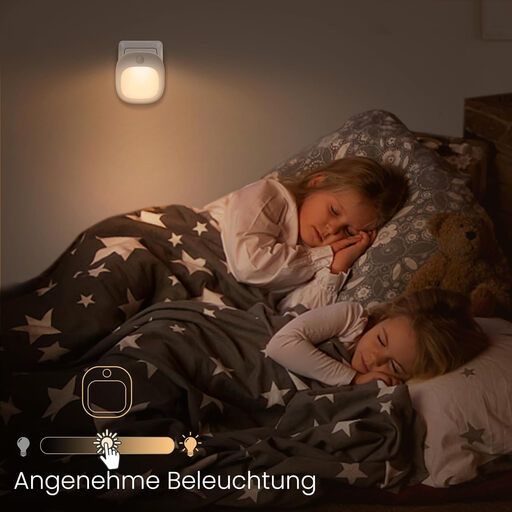
Why this product suits this profile: For bedrooms, children's rooms, hallways or getting around at night, this model offers two operating modes, five brightness levels and three colour temperatures. Its compact design is also suitable for small surfaces.
As well as motion detection, a constant-light mode is specified. Brightness can be adjusted across five levels rather than simply switching between on and off.
500 mAh battery, up to 10 hours in sensor mode according to the product specifications, 30 lm and colour temperatures from 2800–6500 K.
We have put together a complete, regularly updated list of products that fully meet these strict selection criteria and the safety regulations applicable in the EU.
Depending on the model, installation is carried out using adhesive strips, magnets or hooks. The surface should be cleaned and dried beforehand. With adhesive installation, it is advisable to position the light without applying any load initially and check the adhesion. For rented homes, removable or magnetic mounting is often more flexible.
Battery life depends on how often the sensor is triggered, how long the light remains on and which brightness setting is selected. Manufacturer claims such as “up to 10 hours” refer to defined operating conditions. For a realistic estimate, you should consider the intended use—for example, occasional orientation lighting or frequent kitchen lighting.
LED lights require relatively little electrical power during operation. With a rechargeable version, regular charging cycles replace continuous mains operation. Actual consumption depends on the LED output, brightness setting, usage time and charging losses. If you want to keep consumption low, use PIR mode and set the brightness to the level you need.