
Lieferung heute & morgen

Qualitätsgarantie

Willkommens-Angebote freischalten: KOSTENLOSE Lieferung | Bis zu 80 % RABATT | Kostenlose 30-Tage-JoyPlus-Testphase
App herunterladen
A 20-inch children’s electric motorbike is generally aimed at older children or teenagers who want to ride not only on flat private land, but also on suitable trails and off-road tracks. However, your choice should not be based solely on motor power, top speed or eye-catching design. The key factors are the combination of the rider’s height, riding ability, braking system, suspension, battery and permitted area of use.
The figure “750 watts” sounds clear at first. However, in product descriptions it may refer to the rated power or to the maximum power achievable for a short period. In practice, torque, gearing, rider weight, inclines and surface conditions also matter.
A 750-watt children’s electric motorbike may behave differently on paved paths than on damp woodland or loose gravel. More power does not automatically make it the right choice for beginners. Several speed settings and an easily accessible cut-off are therefore important selection criteria.
Range depends on factors including rider weight, riding mode, temperature, tyre pressure, gradient and surface conditions. A battery rated at 36 volts and 7.5 Ah corresponds to around 270 Wh in theory. This is a useful basis for comparison, but it does not guarantee a particular riding time.
The RFN EVO RACING 20 is stated to offer a range of up to 39 km and a riding time of up to 80 minutes. Such figures should be understood as manufacturer estimates under specific conditions. For longer trips, an electric motorbike with a swappable battery may be more practical, provided a suitable replacement battery is available.
A children’s off-road electric motorbike needs more than deeply treaded tyres. Suspension travel, ground clearance, frame strength and brakes must be suitable for the terrain. An IP rating describes the protection of specific components against dust or water, but it does not mean the vehicle is approved for every weather condition. The protection rating of the motor, controller, battery and display may also vary.
In addition, many powerful models may only be ridden on private land or designated off-road tracks. Public roads, pavements and cycle paths are not automatically permitted. Before buying, parents should check the manufacturer’s information and local regulations.
A children’s motorbike with 20-inch tyres has larger wheels than a 12- or 14-inch model. Larger wheels can roll over obstacles more smoothly and are often suitable for taller riders. However, the actual seat height remains decisive. The rider should be able to stand securely and reach the handlebars comfortably and with control.
Before placing an order, compare the following details:
According to the product data, the RFN EVO RACING 20 weighs 22.3 kg net and can carry up to 75 kg. These figures help you assess whether the model can be moved, loaded and controlled safely in everyday use.
An electric dirt bike for children should offer speed settings suited to the rider’s current ability. The RFN EVO RACING 20 is listed with three modes of 15, 25 and 35 km/h. This enables a gradual progression, but it does not replace proper instruction and supervision.
An electric motorbike capable of 35 km/h should not be treated like a slow toy vehicle. At this speed, a protective helmet, gloves, knee and elbow protection, and suitable footwear are particularly important. Beginners should start in the lowest mode on clear, level private land.
An electric dirt bike with suspension can absorb uneven ground more effectively than a rigid model. It is important to check whether only the front fork is sprung or whether the rear wheel is suspended as well. The RFN EVO RACING 20 is listed with an aluminium dual-crown hydraulic fork and an air-pressure shock absorber.
Hydraulic brakes are worth considering for controlled braking on downhill sections. According to the specification sheet, the model has hydraulic brakes at the front and rear. Even so, an electric motorbike with hydraulic brakes should be checked before every ride for braking distance, lever feel and visible damage. Brake pads and discs are wear parts and require regular inspection.
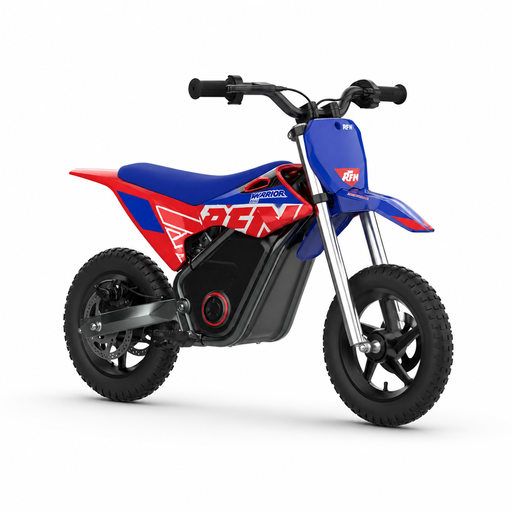
Why this product suits this profile: The 14-inch model is more compact than a 20-inch dirt bike and may be easier for smaller riders with some initial off-road experience to handle. The product data lists three speed settings of up to 30 km/h, a seat height of 490 mm and a maximum load of 50 kg.
The three modes make it easier to get used to the bike gradually. Before buying, parents should double-check the different motor specifications shown in the title and specification sheet.
Front and rear suspension, disc brakes and 14×2.4-inch off-road tyres.
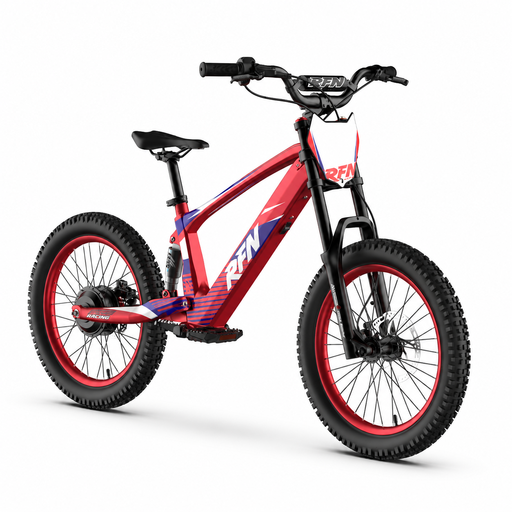
Why this product suits this profile: This model combines 20-inch mountain tyres with a 36-V/750-W motor, three speed settings and a stated top speed of 35 km/h. It is aimed at taller children or teenagers using suitable off-road areas.
The equipment specifies clear values for the battery, tyres, brakes and riding modes. The 39 km range should be treated as a manufacturer figure that depends on the conditions of use.
Hydraulic front and rear brakes, front suspension, air-pressure shock absorber and a quick-swap battery design.
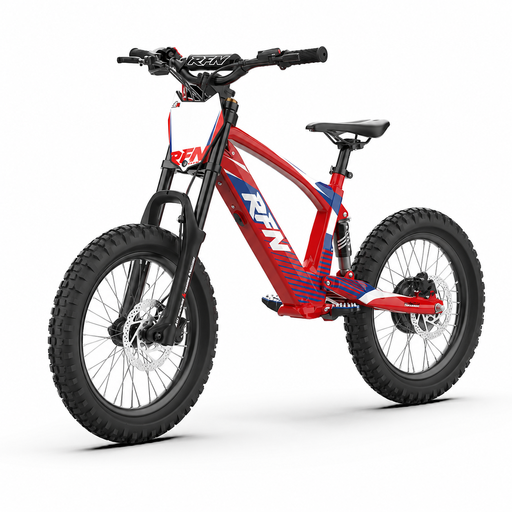
Why this product suits this profile: The 18-inch version is an alternative when a 20-inch wheel is still too large, but you are looking for a powerful children’s off-road motorbike. It is listed with 500 watts of rated power, three modes of up to 30 km/h and a maximum load of 70 kg.
The smaller wheel size may make the bike easier to handle. The stated 15 km range should be factored in alongside charging breaks for regular trips.
Hydraulic brakes, 18×2.5-inch mountain tyres, front suspension and a swappable-battery design according to the product description.
We have put together a complete, regularly updated list of products that fully meet these strict selection criteria and the safety regulations applicable in the EU.
The wheel size alone is not enough to go by. Seat height, frame geometry and the rider’s inside-leg measurement are also important. The child should be able to place both hands securely on the handlebars and bring the motorbike to a controlled stop. The manufacturer’s information on maximum load and recommended rider height should take priority.
This depends on the battery capacity, riding mode, rider weight, terrain and temperature. A battery with a higher watt-hour rating generally stores more energy. Manufacturer figures such as a range of 15 or 39 km are comparison values and may be lower on demanding terrain. An electric motorbike with a swappable battery reduces waiting times if a second compatible battery is available.
In addition to electricity consumption, you may need to budget for protective clothing, tyres, brake pads, the chain, charger and replacement battery. With off-road use, components wear at different rates depending on the surface and riding style. Carrying out a brief check before every ride and storing the motorbike somewhere dry in accordance with the instructions can help you identify maintenance needs at an early stage.