
Lieferung heute & morgen

Qualitätsgarantie

Willkommens-Angebote freischalten: KOSTENLOSE Lieferung | Bis zu 80 % RABATT | Kostenlose 30-Tage-JoyPlus-Testphase
App herunterladen
Inflating a stand-up paddleboard with a hand pump can take considerable time and effort, depending on the board’s size and operating pressure. A 20 PSI electric SUP air pump does the job automatically and, depending on the model, can also deflate the board. However, maximum pressure isn’t the only thing to consider when choosing one.
The 20 PSI figure indicates the maximum selectable pressure, not the pressure required for every board. Always follow the operating pressure recommended by your SUP’s manufacturer. Exceeding it can put unnecessary strain on the valve, seams or material.
A good high-pressure air pump should therefore have an adjustable pressure range and automatic shut-off. This lets you set the right pressure for your board or inflatable boat.
High litres-per-minute figures often refer to the first pump stage, which operates at low back pressure. As the pump reaches the higher pressure required for a SUP, it usually switches to a second stage with a lower air flow rate. So, when buying, check both figures:
A battery-powered SUP pump is useful at waterside launch spots, campsites or car parks without a mains connection. The stated capacity in Wh gives you an objective indication of how many times you may be able to inflate your board. A 12V model, on the other hand, runs from your vehicle’s power socket and is handy for use right by the car.
When using a 12V SUP air pump for an extended period, the vehicle’s engine should be running if the product instructions say so. Otherwise, the pump may drain the vehicle’s battery. Never let an electric pump come into contact with water while it’s running.
Look for a digital display, an easy-to-read PSI reading and automatic shut-off when the selected pressure is reached. A range of 0.5 to 20 PSI covers many inflatable SUPs and other products. For inflatable boats, check whether the manufacturer clearly states the intended pressure range.
Automatic shut-off reduces the risk of the pump continuing to run after reaching the set pressure. However, it doesn’t replace checking the instructions or making sure you’re using the correct adapter.
A two-stage design combines rapid inflation with a high-pressure stage. Active cooling or stated overheat protection can be useful if you’re inflating several boards one after another. Even so, take breaks if the instructions recommend them.
If you regularly inflate a pump for stand-up paddleboards, an inflatable boat or several watersports items, also check the filter, hose length and nozzles supplied. A sand filter, for example, is useful at the beach but needs to be cleaned regularly.
Before buying, check:
An electric pump for inflatable boats can be versatile, provided it comes with suitable nozzles and has an appropriate pressure range. Not every SUP pump is automatically suitable for every air chamber or valve.
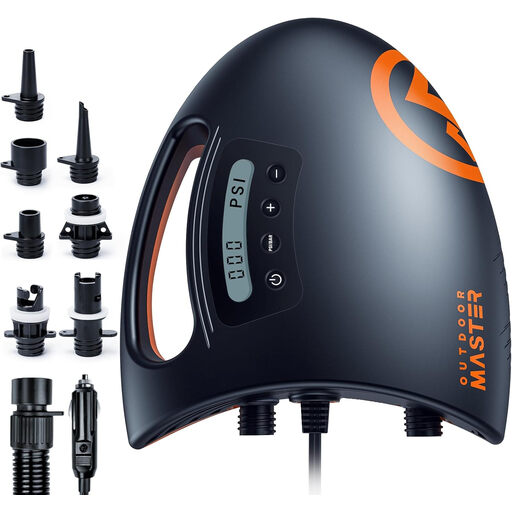
Why it suits this profile: This 12V model is ideal if you usually inflate your boards by the car and don’t need a built-in battery.
Pressure can be set digitally from 0.5 to 20 PSI, and automatic shut-off prevents the pump from continuing unnecessarily once it reaches the target pressure.
12V DC connection, 350 l/min in the first stage, 70 l/min in the high-pressure stage, a deflation function and three nozzles.
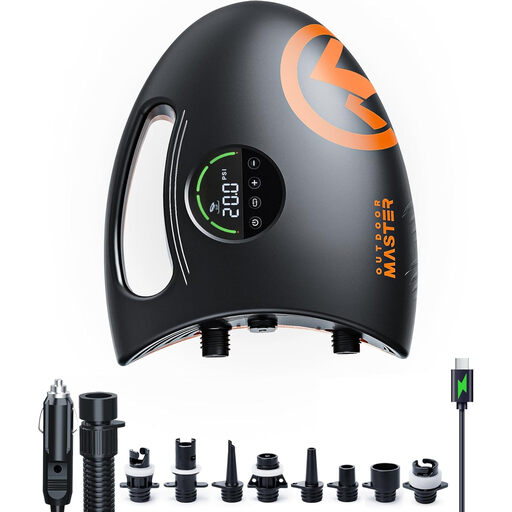
Why it suits this profile: Its combination of a battery and several power options makes it a good choice for families and watersports enthusiasts planning to inflate several boards wherever they are.
The battery capacity is clearly stated as 88,8 Wh. It also supports USB-C fast charging and has 12V and 15,8V DC inputs.
According to the product specifications, it can inflate up to six SUPs on a single charge. It also features digital pressure adjustment, automatic shut-off, deflation and eight nozzles.
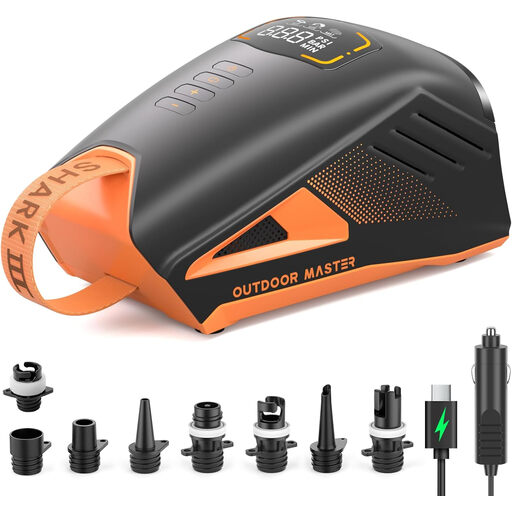
Why it suits this profile: This model is designed for anyone who wants a compact battery-powered option for regular SUP trips, along with an additional way to power it from a vehicle.
Its stated battery capacity of 74 Wh, maximum setting of 20 PSI and cooling system make its capabilities clearer than claims based on speed alone.
According to the product specifications, it takes 3 minutes and 50 seconds to inflate a 10,6-foot board to 15 PSI. Type-C and 12V/15,8V connections are included.
We’ve put together a complete, regularly updated list of products that meet these strict selection criteria and fully comply with the safety regulations in force in the EU.
Before inflating your SUP, place the board on a flat, dry surface and choose the right valve or adapter. Then set the pressure recommended by the board’s manufacturer. Don’t leave the pump unattended while it’s running.
Follow these steps to help keep your pump in good condition after use:
The casing may get warm during longer pumping sessions. If it does, follow the instructions for letting it cool down.
It depends on the board. Many models require around 12 to 20 PSI, but you should always follow the board manufacturer’s specifications. A pump with a maximum pressure of 20 PSI isn’t automatically intended to be used at 20 PSI.
It depends on where you’ll be using it. A battery-powered pump gives you more freedom from your vehicle, while a 12V pump lets you inflate boards for longer or more often without needing to recharge it first. A 12V model can be handy for family trips when you’re by the car; a battery-powered model is more flexible for remote launch spots.
There’s no reliable one-size-fits-all answer. Its lifespan depends on factors such as how often you use it, how long it runs, exposure to dust, how it’s stored and whether you allow it to cool as recommended. Check the product information for details of battery cycles, spare parts or warranty coverage.