
Lieferung heute & morgen

Qualitätsgarantie

Willkommens-Angebote freischalten: KOSTENLOSE Lieferung | Bis zu 80 % RABATT | Kostenlose 30-Tage-JoyPlus-Testphase
App herunterladen
For professionals, students, and travellers, a dead laptop battery is more than just an annoyance—it’s a halt to productivity. A high-performance power bank promises a solution, but the market is flooded with products that have exaggerated marketing claims and hidden flaws. This guide will help you correctly interpret technical specifications and make an informed decision based on objective criteria.
Before you invest, you should be aware of three common issues that often lead to a bad purchase:
To find a suitable 20000mAh 65W power bank for your laptop, focus on these three core technical features:
The output power, measured in watts (W), determines how quickly your device charges. For most modern ultrabooks and MacBooks, an output of 65 watts is the de facto standard for fast and efficient charging. The crucial element here is the USB Power Delivery (PD) protocol. A 65W USB-C power bank with PD technology actively communicates with the connected device to negotiate the optimal voltage and current. This ensures not only high speed but also a safe charging process. Check the specifications explicitly to see if "65W PD" or "Power Delivery 3.0" is listed.
Capacity indicates how much energy the external battery can store. 20000mAh is a common value that is typically enough to fully charge an average laptop once or a smartphone three to four times. A more precise metric, and the one relevant for air travel, is watt-hours (Wh). Most airlines limit batteries in carry-on luggage to 100 Wh. A 20000mAh power bank typically has around 74 Wh (20 Ah × 3.7 V), making it fully compliant for air travel.
A portable battery for a MacBook and other devices should be versatile. A good configuration includes at least:
Here are a few models tailored to specific use cases that avoid the pitfalls mentioned above.
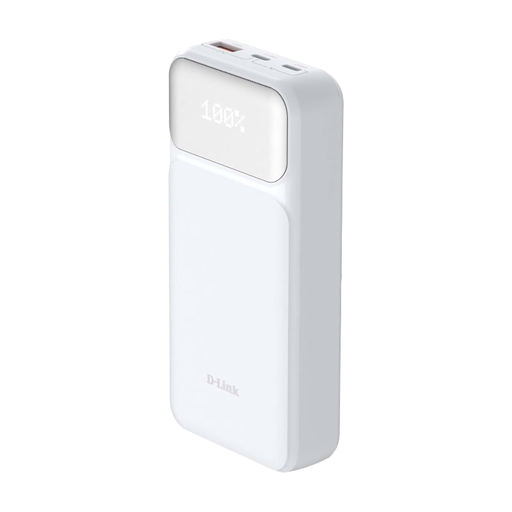
Why This Fits Their Persona: Ideal for professionals who need a reliable power source on the go for their laptop, tablet, and smartphone. The high capacity and power output cover the energy needs of an entire workday.
The specifications explicitly list 65W Power Delivery 3.0, ensuring compatibility with laptops. As a product from an established brand like D-Link, it meets the necessary safety standards.
Combines high capacity (20000mAh) with high output (65W) and the ability to charge three devices simultaneously. The LED display shows the battery status with precision.

Why This Fits Their Persona: For users looking for a compact, stylish accessory for their handbag. Perfect for keeping smartphones or headphones powered throughout the day without sacrificing aesthetics.
This model doesn't advertise laptop charging capabilities, thus avoiding false expectations. It is clearly positioned as a fast-charging power bank for mobile devices and has CCC certification.
Very compact dimensions and an elegant design with an LED ambient light. The rated capacity of 5,500mAh (5V/3A) is transparently stated.
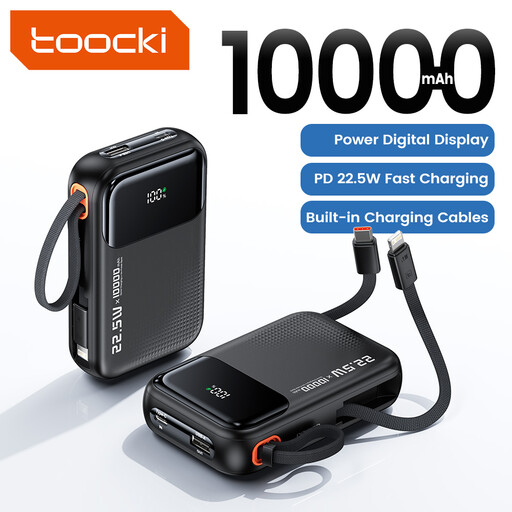
Why This Fits Their Persona: Ideal for students or commuters who need an extremely slim and lightweight solution for their pocket or backpack to get their smartphone through the day.
The digital display shows the remaining capacity as a percentage, providing a level of transparency often missing from simple LED dot indicators. It supports PD3.0 and QC4+ for fast charging of compatible mobile devices.
Extremely slim and lightweight design. The precise percentage-based digital display is a practical feature not always found in this price range.
We've compiled a complete, up-to-date list of products that fully meet these strict selection criteria and rigorous safety standards.
This depends on your laptop's battery capacity. A typical ultrabook (like a MacBook Air) has a battery of around 50 Wh. A 20000mAh power bank, with approximately 74 Wh, can deliver about one full charge after factoring in conversion losses (around 20–30%). For laptops with larger batteries (e.g., gaming notebooks), the capacity is sufficient for a partial charge of 60–80%.
Yes, it's completely safe. Power banks with Power Delivery (PD) are smart. They communicate with the connected device and only deliver as much power as it can safely handle. A 65W power bank will therefore charge your 20W smartphone at exactly 20W and will not overload it.
Yes. International air travel regulations (IATA) limit batteries in carry-on luggage to 100 watt-hours (Wh). At approximately 74 Wh, a 20000mAh power bank is well below this limit. It is important to note that the power bank must always be carried in your carry-on luggage and not in checked baggage.