
Lieferung heute & morgen

Qualitätsgarantie

Willkommens-Angebote freischalten: KOSTENLOSE Lieferung | Bis zu 80 % RABATT | Kostenlose 30-Tage-JoyPlus-Testphase
App herunterladen
A 2000 W ceramic fan heater can warm rooms quickly and can be moved flexibly between the bedroom, living room, study or office. However, high power consumption alone says little about ease of use, energy consumption or suitability for everyday use. The key factors are the heat settings, temperature control, safety features and suitability for the size of the room.
2000 W describes the maximum electrical power. At this setting, a device uses 2 kWh per hour of operation in theory. The actual cost depends on how long it runs, your electricity tariff and the selected heat setting.
An energy-saving fan heater does not automatically produce the same amount of heat using less energy. However, an ECO mode or thermostat can reduce operating time by adjusting or pausing the heating output once the target temperature has been reached.
A fan heater needs a fan to distribute warm air around the room. The noise level can therefore be perceived differently depending on the power setting, distance and room acoustics. If you are looking for a quiet fan heater for the bedroom and office, look for a specific decibel rating and check whether it applies to all operating modes or only the lowest setting.
A fan heater with overheat protection and tip-over protection switches off automatically under certain conditions. These features do not replace a firm, dry position or sufficient clearance from curtains, furniture and textiles. The device must not be covered, and the air vents must remain unobstructed.
A PTC ceramic fan heater warms air using a ceramic heating element and a fan. For quick supplementary heating in medium-sized living rooms or workspaces, several power settings are more practical than operating exclusively at 2000 W.
Look out for:
A fan heater with thermostat allows you to set a target temperature. A fan heater with ECO mode can regulate the output depending on the ambient temperature. Both functions can help limit unnecessary continuous operation, but they are not proof of a specific percentage saving in costs or energy for your household.
The following features are also useful for everyday use:
A portable fan heater should be placed on a level, stable and dry surface. Keep to the safety clearance specified in the instruction manual; the product details available for these models sometimes state a minimum distance of 1 m from flammable materials. Use a suitable socket and check the cable and casing for visible damage before use.
A bathroom is not a suitable general-purpose location for every electric fan heater. Even if a product description states a protection rating, you must follow the specific manufacturer’s instructions and take the local conditions into account. Water, moisture and electrical heating appliances require particular care.

Why this product suits this profile: Five operating modes, an ECO mode, an adjustable thermostat and a 24-hour timer cover typical uses in bedrooms, living rooms, basements or offices.
Maximum output is not the only option: three heat settings and ECO operation allow for more tailored use instead of running continuously at 2000 W.
PTC ceramic heating, temperature display, carry handle, plus overheat and tip-over protection according to the product details.

Why this product suits this profile: For users who prefer precise temperature settings, low noise levels and comprehensive controls for living rooms or workspaces.
The product details specify a range of 25–42 dB, a 12-hour timer and a thermostat range of 5–35 °C. This provides specific figures rather than broad marketing claims.
2000 W, 70° oscillation, remote control, eight-stage safety system and CE marking according to the product description.
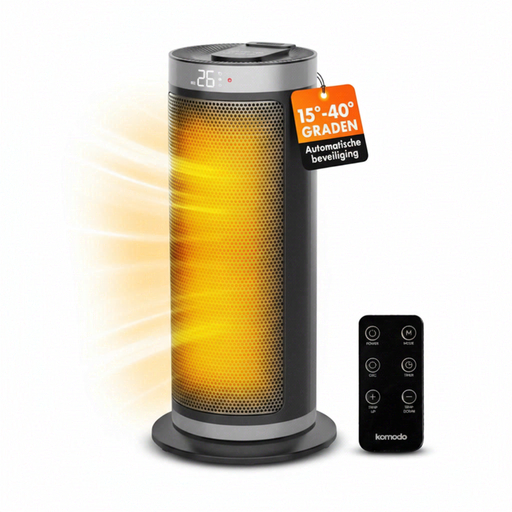
Why this product suits this profile: Three power settings from 750 W to 2000 W, 90° oscillation, remote control and a temperature range of 15–40 °C offer flexible options for changing rooms.
The stepped 750, 1500 and 2000 W settings mean you do not have to use maximum output for every situation.
Compact design, ECO mode, LED display, plus overheat and tip-over protection according to the product data. The stated IP66 protection rating should be checked against the full instruction manual before using the heater in damp rooms.
We have put together a complete, regularly updated list of products that fully meet these strict selection criteria and the safety regulations applicable in the EU.
The maximum power consumption can be estimated easily:
Power in kW × operating hours × electricity price per kWh = energy costs
At 2000 W, this corresponds to 2 kW. If the fan heater runs continuously on its highest setting for one hour, it will use 2 kWh in theory. A thermostat, multiple heat settings and a timer can help limit the actual operating time. Due to its electricity consumption, a portable fan heater is generally not intended to be the only long-term heating solution for an entire home.
Suitability depends on the insulation, ceiling height, window area and desired temperature. Product details for some models state approximately 15 to 25 m². These figures are intended as a guide. Poorly insulated rooms or basements may require more power.
At full power, the device uses 2 kWh per hour. The cost depends on your personal electricity tariff. An ECO mode does not reduce the physical output of the heat produced, but reduced heat settings and pauses can affect overall consumption.
A timer and thermostat can control operation according to time or temperature. Nevertheless, the device should only be used in accordance with the instruction manual and must not be covered. It must stand clear, stable and at a sufficient distance from flammable materials. If there is visible damage, an unusual smell, smoke or a damaged cable, stop using the device immediately.