
Lieferung heute & morgen

Qualitätsgarantie

Willkommens-Angebote freischalten: KOSTENLOSE Lieferung | Bis zu 80 % RABATT | Kostenlose 30-Tage-JoyPlus-Testphase
App herunterladen
A 200W foldable solar panel is ideal for camping, van life, motorhomes, gardens and portable power stations. The rated output of 200 watts may sound straightforward, but on its own it tells you little about the energy you can actually generate. Connection specifications, build quality, weight and compatibility with your existing power station are all important factors.
So, when buying a mobile solar panel or a portable solar panel, don’t focus solely on efficiency figures or discounted prices. Three common buying mistakes are particularly likely to lead to disappointment.
The stated output applies under defined test conditions. In the UK, cloud cover, the sun’s position, shade, temperature, orientation and cable losses all affect the actual output. A 200-watt panel will not automatically deliver 200 watts all the time.
Partial shade is a particular concern: even a shadow over part of a cell can reduce the output of the entire panel. An outdoor solar panel should therefore be positioned in an open spot, facing directly towards the sun wherever possible.
A solar panel for a power station must be electrically compatible with the unit. At the very least, check:
A foldable solar panel with MC4 connectors can often be connected to a range of compatible power stations. However, “compatible with many devices” is no substitute for checking the technical specifications.
An IP rating describes protection against dust and water under specified conditions. It does not automatically mean that a foldable panel should be left outside in rain, strong winds, hail or snow for extended periods. Foldable panels with integrated support legs are designed for mobile use, and should be secured or packed away in strong winds.
A monocrystalline solar panel uses monocrystalline solar cells. Efficiency figures quoted by manufacturers, such as 23.4 or 24.3 per cent, are measured under test conditions and do not guarantee the output you’ll get at every location. They can still be a useful guide when comparing panels of a similar size.
Also check the usable area when the panel is unfolded. A compact folded panel may be more than two metres long when opened out. Make sure you have enough clear space for it on your balcony, at the campsite or on your motorhome pitch.
A power station accepts only a specific voltage and current range. Compare the panel’s specifications with the station’s solar input. For example, the BLUETTI PV200 is listed as having a 200 W rated output, 20.5 V operating voltage, 26.1 V open-circuit voltage and 10.3 A short-circuit current.
MC4 connectors are widely used on portable solar panels. Even so, you may need an additional cable for a particular power station. Any adapters should be suitable for the intended current and voltage. Avoid reverse polarity and loose connections.
If you’ll be carrying the panel regularly, output isn’t the only thing to consider. A camping solar panel with a carry handle and support legs is quicker to set up, while a heavier model may sit more securely but be less convenient to carry.
ETFE-coated surfaces are used on several models. According to the relevant product information, they help protect the panel surface. Clean it with a soft, damp cloth and avoid sharp objects, solvents and abrasive cleaners.
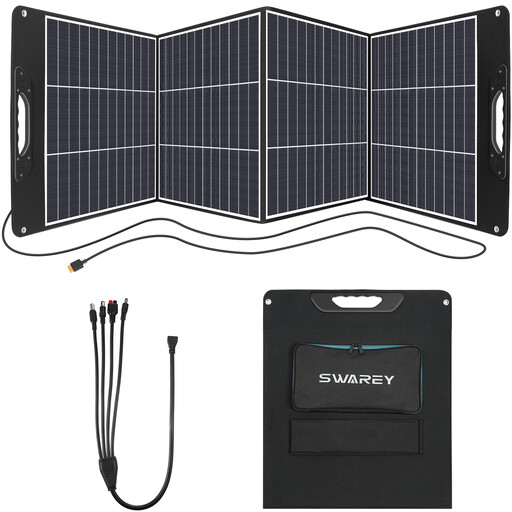
Why this product suits this type of buyer: The panel combines a foldable design with a stated weight of 5.5 kg, integrated support legs and several outputs for mobile devices and power stations.
The specifications list specific connections, including XT60, Anderson and DC adapters, as well as USB outputs. This makes it easier to check whether the connections will work with your equipment before you buy.
According to the product description: monocrystalline cells, a stated efficiency of 23 per cent, an 18-watt USB-C PD output and a 24-month warranty.
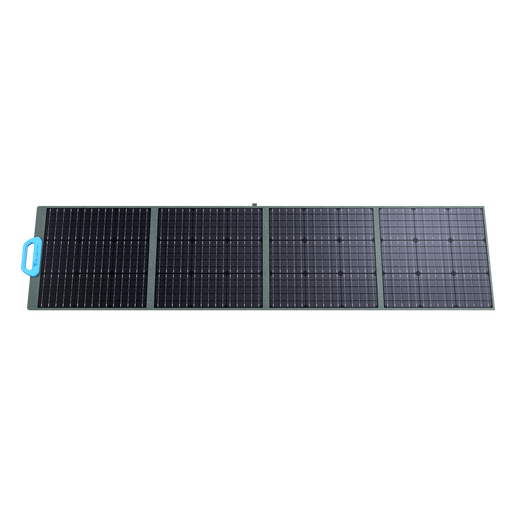
Why this product suits this type of buyer: This four-fold panel is designed for users who value MC4 compatibility, clearly specified electrical ratings and an integrated stand.
The product specifications list MC4 connectors, a rated output of 200 W and separate figures for operating voltage, open-circuit voltage and short-circuit voltage.
According to the product details: stated efficiency of up to 23.4 per cent, ETFE surface, weight of 7.3 kg and a 24-month warranty.
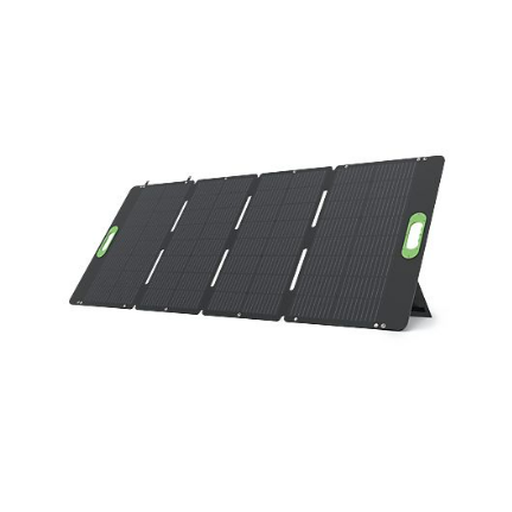
Why this product suits this type of buyer: This model is designed for camping, caravans, gardens and portable backup power. According to the product details, it has MC4 connectors and an integrated stand.
The technical specifications list rated voltage, rated current, open-circuit voltage and the IP rating. This helps buyers check more closely whether it will work with their 200W solar charger or power station.
According to the product description: 200 W output, stated cell efficiency of 23 per cent, IP67 rating, weight of 8.5 kg and an MC4-to-XT60 cable included.
We’ve put together a complete, regularly updated list of products that meet these strict selection criteria and fully comply with the safety regulations in force in the EU.
If you’re choosing a solar panel for a motorhome or caravan, also consider whether you’ll be setting it up temporarily or installing it permanently. Foldable panels are primarily designed for flexible use. A permanent installation has different requirements for mounting, wiring and electrical safety.
The amount of energy it actually generates depends on sunlight, the time of year, orientation, shade, temperature and the device it’s connected to. The 200-watt figure describes the rated output under test conditions; it is not a guarantee of how much electricity the panel will generate each day.
No. Before buying, check the power station’s permitted voltage and current range, as well as the connection type. MC4, XT60 or DC connections may require suitable cables or adapters. The panel’s specifications must not exceed the station’s input limits.
Its lifespan depends on the materials, how it’s transported, UV exposure, moisture and physical wear. Fold the panel only at the intended points, protect it from sharp objects and store it in a dry place. Warranty terms, such as 12 or 24 months, are subject to the relevant manufacturer’s conditions and do not represent a guaranteed overall lifespan.