
Lieferung heute & morgen

Qualitätsgarantie

Willkommens-Angebote freischalten: KOSTENLOSE Lieferung | Bis zu 80 % RABATT | Kostenlose 30-Tage-JoyPlus-Testphase
App herunterladen
A 20 cm induction frying pan is ideal for small portions, single eggs, omelettes, fish fillets or side dishes. Particularly in one- and two-person households, a small frying pan saves space and doesn’t need to be heated up as much as a larger model.
At first glance, the choice seems straightforward. In practice, however, unclear coating specifications, an unsuitable base area or conflicting care instructions often lead to the wrong purchase. The following criteria will help you select an induction-compatible pan that suits your everyday cooking needs.
The manufacturer’s measurement usually refers to the top rim of the pan. The actual magnetically effective base can be significantly smaller. With the BALLARINI Vipiteno, for example, the base diameter is 14.3 cm, while the top diameter is 20 cm. According to the product details, the Silit Belluna is designed for hob zones of around 14.5 cm in diameter.
For a small induction hob, this is usually fine. However, if you’re using a large induction zone, you should check whether the hob reliably detects the pan. A base that is too small or doesn’t sit fully flat can affect heat transfer.
A coated 20 cm frying pan can be equipped with PTFE, ceramic materials or other coating systems. These variants differ in terms of care, temperature recommendations and suitable kitchen utensils.
A PTFE coating, as specified for the Silit Belluna or the ZWILLING JOY PLUS, is designed for low-fat frying and delicate foods. Ceramic pans are often marketed with a mineral surface. However, this doesn’t automatically mean they are permanently scratch-resistant or suitable for high temperatures.
That’s why it’s important to look at the manufacturer’s specific coating details, rather than just the description “non-stick frying pan”.
Some models are explicitly suitable for cleaning in the dishwasher. According to the product descriptions, these include the BALLARINI Vipiteno, the ZWILLING JOY PLUS and the BALLARINI Murano. Nevertheless, for a longer lifespan, the manufacturers sometimes recommend hand washing with a soft sponge.
Other models, such as the PURECOOK aluminium pan with glass lid, are stated as not being dishwasher-safe. If you’re looking for a dishwasher-safe frying pan, you should therefore pay attention not only to the coating but also to the handle and lid materials.
An induction pan needs a magnetic base. The product description should explicitly mention induction. Ideally, it should also list other hob types such as gas, electric and ceramic, if you want to use the pan flexibly.
With an aluminium frying pan, it’s particularly important that it has a suitable induction base. Pure aluminium is not heated directly by an induction hob. The aluminium models in this selection are therefore described as having a corresponding base or bottom construction.
For eggs, pancakes, fish and vegetables, a coated surface is usually sufficient. When choosing, you should check the following details:
A pan should not be heated empty on a high setting for a long time. This can damage the coating and, depending on the hob, the pan itself.
A sturdy plastic or stainless steel handle is straightforward for daily use. A frying pan with lid model is also suitable for braising, slow cooking and keeping small portions warm. However, the lid increases the space required.
Removable handles can be an advantage for storage in a cookware set. However, they must be correctly locked into place before each use. For a single small frying pan, a compact, fixed handle is often the simpler solution.

Why this product fits the profile: This lightweight aluminium pan is described as suitable for induction as well as gas, electric and ceramic hobs, and is designed for small cooking tasks.
The details list both the hob types and the intended hob zone diameter of around 14.5 cm. The maximum oven temperature is also clearly stated.
Coated aluminium, lightweight, Silitan PTFE coating and, according to the manufacturer, a five-year guarantee on materials, workmanship and non-stick properties.
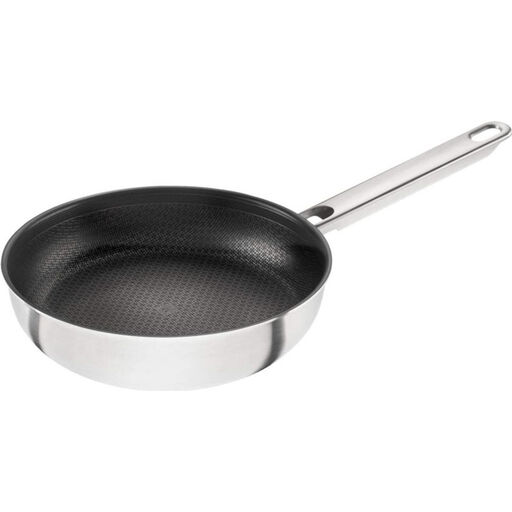
Why this product fits the profile: The three-layer construction of 18/10 stainless steel with an aluminium core is aimed at users who value material build and versatile use.
The details clearly distinguish between the stainless steel body, aluminium core and PTFE coating. The permitted oven temperature of up to 200 °C is also specified.
Induction-compatible, dishwasher-safe, with a wide pouring rim and a described Permaresist Ultra coating with a protective grid.
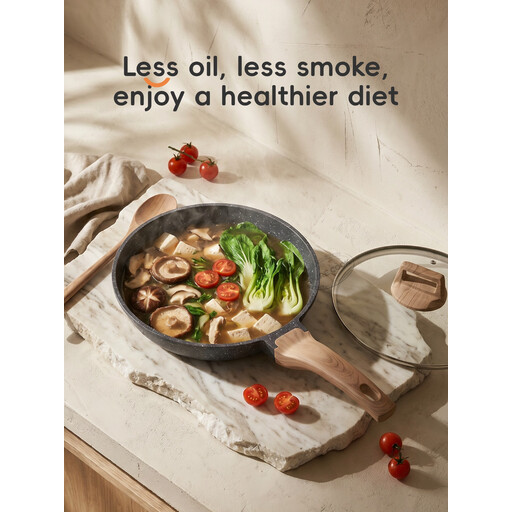
Why this product fits the profile: The glass lid expands the small pan to include braised, steamed and covered dishes.
The product details explicitly state the hob compatibility including induction, while also noting that only hand washing is intended.
Quick-heating aluminium, described non-stick surface, heat-insulating wooden handle and transparent tempered glass lid.
We’ve put together a complete, regularly updated list of products that fully meet these strict selection criteria and the safety regulations in force in the EU.
The key factor is the magnetic base diameter, not just the top rim. With many 20 cm models, the base is roughly between 14 and 15 cm. This size often suits a small induction zone. You should check the individual manufacturer’s details before buying.
There’s no one-size-fits-all answer. A ceramic pan and a PTFE-coated pan differ in material, care and temperature recommendations. For your choice, the specific details about the coating, heat, cleaning and use of kitchen utensils are more important than the description label alone.
The lifespan depends on heat, cleaning, storage and kitchen utensils. Frequent empty heating, strong temperature changes and abrasive sponges can wear down the surface more quickly. If you cook on low to medium heat and follow the care instructions, you’ll reduce typical stresses on the coating.