
Lieferung heute & morgen

Qualitätsgarantie

Willkommens-Angebote freischalten: KOSTENLOSE Lieferung | Bis zu 80 % RABATT | Kostenlose 30-Tage-JoyPlus-Testphase
App herunterladen
The search for a new 20cm ceramic induction pan can quickly become overwhelming. The market is filled with promises of durability and perfect non-stick properties. However, not every model delivers on its promise. Many buyers find that after just a few months, the coating degrades or the pan fails to deliver the expected performance on their induction hob.
This guide is designed to provide clarity. We will highlight the most common pitfalls when buying and explain which technical features truly matter, enabling you to make an informed decision.
Before you invest, you should be aware of the typical problems that often only become apparent after the purchase. Avoiding these mistakes will not only save you money but also a great deal of frustration in the kitchen.
To avoid the problems mentioned above, you should check three key aspects before buying. These define the quality, performance, and longevity of your new pan.
For a small induction pan, the quality of the base is critical. A good induction base must be ferromagnetic. Look for a thick, warp-resistant base that sits completely flat on the hob. Such a base ensures rapid and, most importantly, even heat distribution. This prevents food from burning in some spots while remaining raw in others. A solid base is also less prone to warping at high temperatures.
A durable ceramic-coated pan is distinguished by its composition. Some manufacturers reinforce their coatings with particles like diamond or titanium to increase abrasion and heat resistance. For health-conscious buyers, the labelling is crucial: explicitly look for products declared as PFOA-free, PTFE-free, and PFAS-free. This ensures that no unwanted chemicals are released when heated.
An oven-safe pan significantly expands your cooking options—from searing on the hob to finishing a dish in the oven. The maximum heat resistance is determined by the handle material. Stainless steel handles generally allow for high temperatures (often up to 250°C), while plastic or Bakelite handles are usually limited to lower temperatures. For a single-person household, this versatility can be particularly practical, as one pan can serve multiple functions.
Based on the criteria above, we have identified several products that are well-suited for different user profiles and requirements.
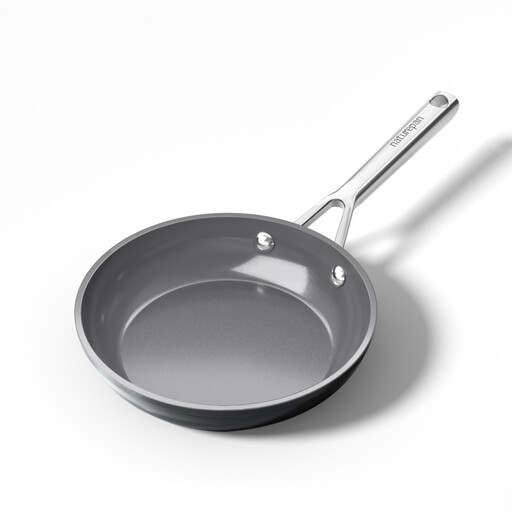
Why This Fits Their Persona: Ideal for users who prepare small, healthy meals daily and prioritise non-toxic materials and durability. Perfect for fried eggs, omelettes, or steamed vegetables.
The ceramic coating, reinforced with diamond and titanium particles, counteracts the problem of short-lived non-stick performance. It is explicitly declared as PTFE/PFOA/PFAS-free.
Highly versatile due to being oven-safe up to 260°C (according to the manufacturer). The optimised base ensures fast and even heat distribution on induction hobs.
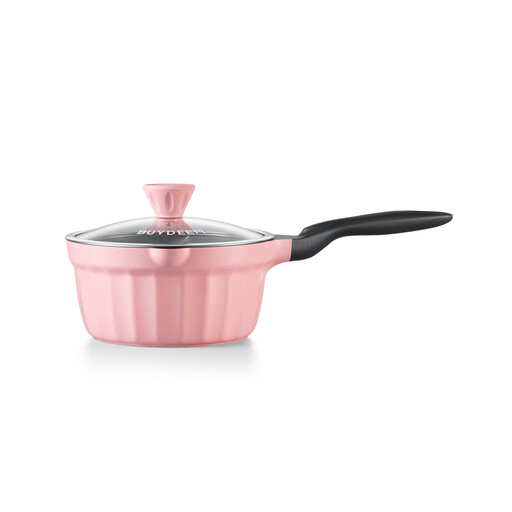
Why This Fits Their Persona: A versatile pot for small kitchens. With a 20cm diameter and high sides, it's suitable not only for frying but also for sauces, pasta, or heating milk.
The cast aluminium body ensures even heat distribution, avoiding the poor induction performance of thin bases. The Swiss ceramic coating is PFAS/PFOA-free, according to the manufacturer.
The integrated spout allows for drip-free pouring of liquids. The heat-insulated handle ensures safe handling during cooking.
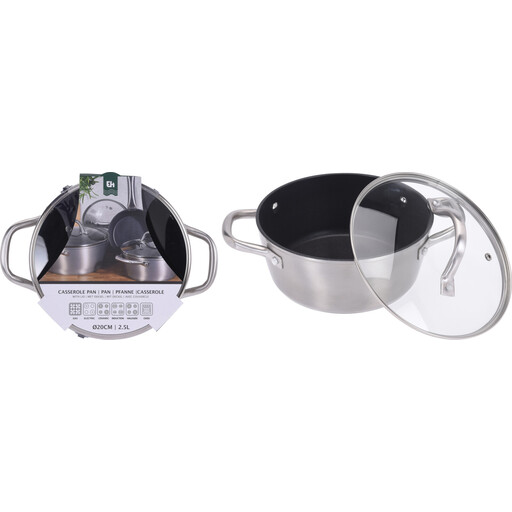
Why This Fits Their Persona: A multifunctional and budget-friendly solution. This 20cm pot is not just a 20cm frying pan, but is also suitable for stews, soups, and braised dishes.
As a versatile pot, it bypasses the need to buy a single-purpose product. The manufacturer states its suitability for most hob types, including induction, which ensures compatibility.
The lightweight aluminium provides good heat conduction. Its high-sided shape offers flexibility for various dishes, which is a great advantage for a starter kitchen setup.
We have compiled a complete, real-time list of products that fully satisfy these strict selection criteria and UK safety regulations.
1. How do I properly care for a ceramic-coated pan to maximise its lifespan? To preserve the non-stick properties, you should follow a few basic rules. Only use cooking utensils made of wood, silicone, or plastic. Avoid heating the pan empty on the highest setting. Although many pans are listed as dishwasher-safe, hand washing with a soft sponge and mild detergent is recommended, as aggressive cleaning agents can damage the coating.
2. How can I tell if my old pan is suitable for induction? The easiest method is the magnet test. Hold a standard magnet to the bottom of the pan. If the magnet sticks firmly, the base is ferromagnetic and therefore suitable for induction hobs. If it doesn't stick, or only very weakly, the pan will not work on an induction hob.
3. Is a 20cm pan large enough for a two-person household? A 20cm frying pan is ideal for preparing single-serving meals, like a large omelette or a piece of fish. For a two-person household, it works well for side dishes, sauces, or two fried eggs. However, for preparing main courses for two people, a 24cm or 28cm pan might be a more practical choice.