
Lieferung heute & morgen

Qualitätsgarantie

Willkommens-Angebote freischalten: KOSTENLOSE Lieferung | Bis zu 80 % RABATT | Kostenlose 30-Tage-JoyPlus-Testphase
App herunterladen
A 21V cordless impact wrench can save you a lot of time when changing tyres, carrying out repairs and tackling assembly work. However, a high torque figure on the packaging doesn’t automatically mean it’s the right tool for you. What matters is whether the power, battery capacity, drive and accessories suit the work you have planned.
Figures such as 800, 1,000 or 1,800 Nm often refer to a maximum value specified by the manufacturer, usually for loosening. The actual result depends on several factors, including bolt size, rust, battery charge, material and the impact mechanism.
A cordless impact wrench shouldn’t be treated as a substitute for a torque wrench when tightening wheel bolts. After using the impact wrench to fit them, check the torque against the vehicle manufacturer’s specifications with a suitable torque wrench.
The 21V rating describes the impact wrench battery’s nominal voltage. Battery capacity, measured in ampere-hours, also determines runtime. With similar use, a 4.0 Ah battery can run for longer than one with a lower capacity. Two batteries are particularly useful in a workshop, on a building site or for mobile tyre fitting, as one can charge while the other is in use.
Also check whether the battery and charger are included. A seemingly cheap cordless impact wrench without a compatible power supply can increase the actual cost of buying the tool.
For many jobs, a 1/2-inch impact wrench with a suitable impact socket is the standard choice. Ordinary sockets aren’t necessarily designed to withstand the repeated impacts of a powered impact wrench. Sockets specifically labelled as impact sockets are a better choice, for example those made from chrome vanadium steel.
Before buying, check:
A high-torque cordless impact wrench is generally suitable for loosening stubborn fasteners. For more delicate jobs, however, multiple speed settings are more useful than a single maximum torque figure. Three or four speed settings make it easier to match the power to the bolt and material.
Speed is measured in revolutions per minute, while the impact rate is usually measured in impacts per minute. A variable trigger lets you start slowly and then increase the power. This can help reduce the risk of cross-threading or overtightening when starting, but it doesn’t replace checking the tightening torque.
A brushless impact wrench has no conventional carbon brushes in its motor, so there’s no brush component to wear out. Manufacturers often highlight lower heat build-up and more efficient power transfer as design features. The tool’s actual lifespan will still depend on the load, maintenance, dust, moisture and charging habits.
For building and assembly work, a non-slip handle, balanced weight distribution and LED lighting for dark work areas are also useful. A compact body can make it easier to work in a wheel arch or engine bay.
Lithium-ion batteries should be charged using the designated charger and protected from extreme heat, moisture and physical damage. Remove the battery before changing accessories or cleaning the tool. Don’t use the impact wrench in areas where there’s a risk of explosion due to flammable liquids, gases or dust.
When using an impact wrench for changing tyres, use the tool to loosen and initially fit the wheel bolts, then check them with a torque wrench. For lorries and commercial vehicles, also take account of the vehicle specifications, thread size and required torque.
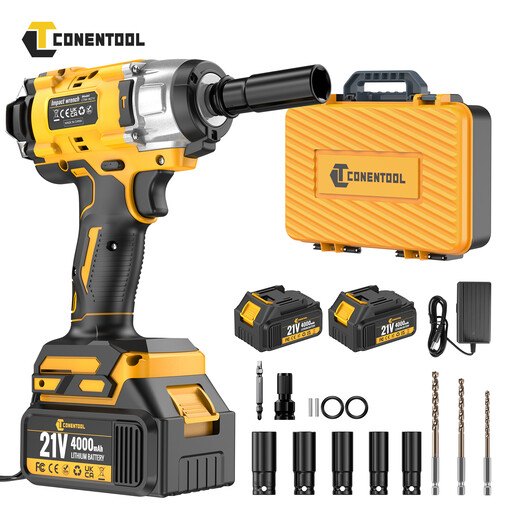
Why this product suits this profile: This set is aimed at DIYers looking for a cordless starter kit for vehicle maintenance and assembly work. According to the manufacturer, it delivers up to 800 Nm of maximum torque, has three speed settings and comes with a 21V 4.0 Ah battery.
The three settings and variable trigger help you start work with greater control. The five included sockets cover several common sizes.
Brushless motor, 1/2-inch drive, LED and two batteries, according to the product description.
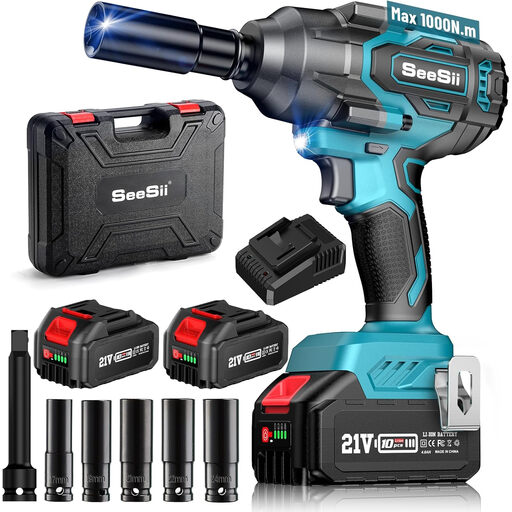
Why this product suits this profile: This model is designed for users who want two batteries, a comprehensive set and multiple settings for regular jobs. According to the manufacturer, it has a maximum loosening torque of 1,000 Nm.
The product specifications distinguish between loosening and tightening torque. Two 4.0 Ah batteries help reduce downtime during repeat jobs.
Three speed settings, a fast charger according to the product details, plus five sockets and an extension.
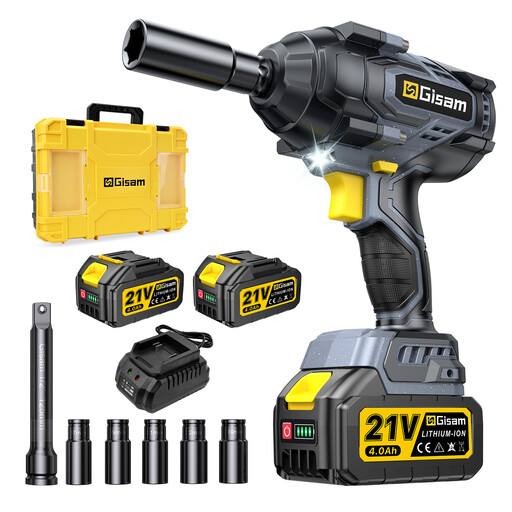
Why this product suits this profile: According to the manufacturer’s description, this set is designed for cars, lorries, tyre work and mobile use. The four settings and two 4.0 Ah batteries are well suited to frequent work cycles.
The four speed settings give you more choice for different types of fastening. A battery charge indicator helps you plan your work.
Up to 1,800 Nm, 4,000 rpm, two batteries and five sockets, according to the manufacturer.
For occasional car tyre changes, a set with a 1/2-inch drive, several speed settings and at least one suitable battery is usually enough. Workshops and tyre-fitting businesses are more likely to benefit from two batteries, readily available replacements and a sturdy carry case.
When using the tool on a lorry, check that its stated torque range matches the vehicle’s actual requirements. A high advertised figure alone doesn’t guarantee that it can loosen every lorry wheel bolt. For scaffolding, metal assembly or heavy-duty fastening, you should also consider the weight, handle design, overload protection and availability of suitable sockets.
We’ve put together a complete, regularly updated list of products that meet these strict selection criteria and fully comply with the safety regulations in force in the EU.
Yes, as long as the drive, sockets and torque range are suitable for the job. An impact wrench loosens wheel bolts and starts them off when refitting. Always tighten them fully to the vehicle manufacturer’s specifications using a torque wrench.
Runtime depends on battery capacity, bolt size, workload and charge level. A 4.0 Ah battery generally offers more capacity than a smaller one. Two batteries let you swap between them, but they don’t guarantee a precise amount of working time.
A brushless motor avoids wear to carbon brushes. However, cooling, safety features, battery availability, maintenance and following the manufacturer’s instructions are also important for continuous use. If you’ll be using the tool heavily every day, check these points particularly carefully before buying.