
Lieferung heute & morgen

Qualitätsgarantie

Willkommens-Angebote freischalten: KOSTENLOSE Lieferung | Bis zu 80 % RABATT | Kostenlose 30-Tage-JoyPlus-Testphase
App herunterladen
A 22 kW Type 2 wallbox can make charging an electric car or plug-in hybrid considerably more flexible. However, the stated power rating alone does not determine how quickly your vehicle will actually charge. Key factors include the car’s on-board charger, the household connection, the installation and the charging cable used.
Before you buy, it is worth taking a close look at the technical specifications. Many products appear similar at first glance, but differ significantly in terms of number of phases, safety features, cable length, connection type and operation.
The rating describes the maximum possible output of the EVSE charging station. If your vehicle only supports 11 kW AC charging, it will charge at a maximum of 11 kW even when connected to a 22 kW wallbox. For many plug-in hybrids, the AC charging power is even lower.
Before purchasing, you should check the maximum charging capacity of your vehicle model in the owner’s manual or data sheet. A 22 kW solution is mainly worthwhile if your car has a compatible three-phase on-board charger, or if you plan to use the wallbox with a different vehicle in the future.
For 22 kW, you typically need 32 A at 400 V and three phases. A product labelled as 22 kW should therefore always be considered alongside the specifications for input voltage, number of phases and maximum current.
With a 32 A 3-phase wallbox, a qualified electrician must check whether the cable, fuse protection, residual current device and household connection are suitable. For a fixed installation, you should also clarify the requirements of your local network operator.
An IP rating is not a free pass for any outdoor environment. IP54, IP65 and IP66 describe different levels of protection against dust and water. Even a device with a higher protection rating should not be left permanently in flooded areas or cleaned with a pressure washer.
Also important are clear specifications regarding overcurrent, overheat, overvoltage, earthing and residual current protection. Some models mention a DC residual current protection of DC 6 mA or a Type-B protection. Which additional protection is needed in your home installation must be decided based on the instructions and your local electrical setup.
In Germany and Europe, Type 2 according to IEC 62196-2 is common for many electric cars and plug-in hybrids. This applies to numerous models from Tesla, Audi, BMW, Mercedes-Benz, Volkswagen, Hyundai and Kia, among others. Nevertheless, you should check your own vehicle’s charging port.
A Type 2 charger is not compatible with every connector system. Vehicles with Type 1, CCS1 or CHAdeMO require a different solution or a suitable adapter, provided the manufacturer approves it.
A stationary wallbox is permanently mounted on the wall and is suitable for a garage, carport or company car park. A mobile wallbox, on the other hand, can be taken with you and used at suitable connections depending on the model. The power source is crucial here: a Schuko socket is not designed for a 32 A continuous load.
With mobile 22 kW devices, you should check whether a suitable CEE connection is available and what current setting can be selected. Models with adjustable steps such as 8, 10, 13, 16, 20, 25 and 32 A offer more flexibility. The setting should be made before starting the charging process.
A Type 2 charging cable 22 kW with a 5 m length is often sufficient for a parking space directly in front of the wallbox. 7 m offers more flexibility at public charging points or in a garage. 10 m can be practical for awkward vehicle positions, but requires more storage space and should be routed carefully.
For households with a heat pump, instantaneous water heater or multiple vehicles, a wallbox with load management can be of interest. Dynamic load management distributes the available power between household consumption and the vehicle. The specific function, any meter that may be needed, and compatibility with your home installation must be checked in advance.
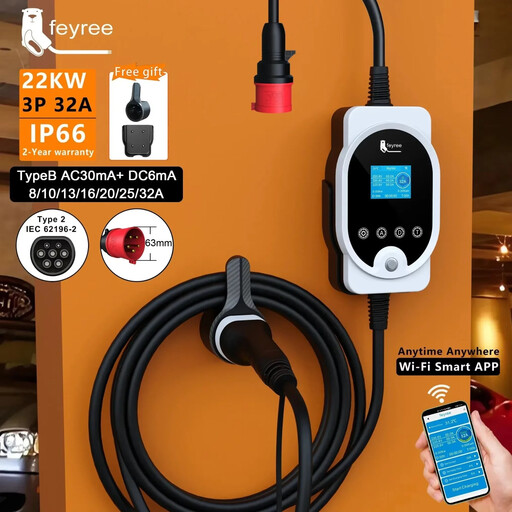
Why this product suits the profile: The mobile design is ideal for users who want to charge at home and at suitable connections on the go. The TUYA app enables current adjustment, scheduling and status monitoring, among other features.
The adjustable current helps you match the charging power to your vehicle and connection. However, the IP66 rating does not replace a professional inspection of the circuit being used.
32 A, three-phase operation, current selection from 8 to 32 A, app control and emergency stop button.

Why this product suits the profile: The separate charging cable is designed for owners of a vehicle with a Type 2 connector who charge at public stations or a wallbox with a Type 2 socket.
The product specifications explicitly mention Type 2 and CCS2, and exclude J1772, CCS1 and CHAdeMO. This allows you to check the connector compatibility before buying.
10 m length, 32 A, three-phase design, IP54 and, according to the product information, TÜV Rheinland certification.
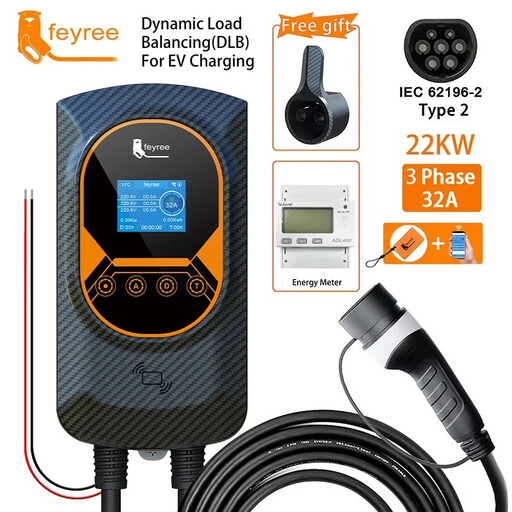
Why this product suits the profile: This solution is aimed at households with varying electrical loads, as well as users who want to monitor and schedule charging sessions via an app.
The stated dynamic load management addresses the risk of several large appliances drawing on the available connection capacity at the same time.
Three-phase operation, 5 m cable, IP66, Wi-Fi app, LCD display, RFID function and adjustable current up to 32 A.
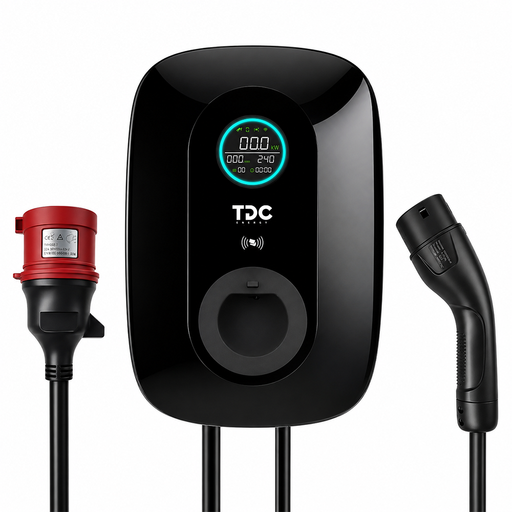
Why this product suits the profile: This wall-mounted charging station combines a 5 m cable, display, RFID cards and app control. This is practical for shared parking spaces or smaller company car parks.
RFID enables user-specific access control, while the technical specifications transparently list input, phases, protection functions and operating temperature.
22 kW at 32 A and 400 V, 3-inch display, app and RFID access, emergency stop, and IP54 or IP65 depending on how the connector is stored.
We have put together a complete, regularly updated list of products that fully meet these strict selection criteria and the safety regulations in force in the EU.
An 11 kW and 22 kW charging station differ mainly in current rating and installation requirements. 11 kW typically corresponds to 16 A three-phase, while 22 kW usually requires 32 A three-phase. The higher rated power can be worthwhile if your vehicle supports it and the electrical infrastructure is adequately sized.
For many private households, an 11 kW wallbox is sufficient. A 22 kW variant, on the other hand, offers more headroom, but may require additional coordination and a more powerful installation. What matters is not the number on the casing, but the combination of vehicle, connection and desired charging time.
No. The vehicle must have a Type 2 connector and a compatible AC on-board charger. If the car only supports 11 kW, for example, it will limit the charging power itself. A plug-in hybrid may be even lower.
For a fixed installation, a qualified electrician is required. They will check the cable cross-section, protective devices, earthing and mains connection. Before installation, you should also clarify the requirements of your local network operator.
Electricity costs depend on energy consumption, tariff and charging time. A Wi-Fi app control can document schedules and charging sessions. Charging during cheaper tariff periods is only worthwhile if your electricity tariff offers variable rates. In the long term, an integrated meter or a traceable charging log helps with consumption monitoring.