
Lieferung heute & morgen

Qualitätsgarantie

Willkommens-Angebote freischalten: KOSTENLOSE Lieferung | Bis zu 80 % RABATT | Kostenlose 30-Tage-JoyPlus-Testphase
App herunterladen
Opting for your own 22kW wallbox is a pivotal step towards charging your electric vehicle quickly and efficiently at home. However, the market can be overwhelming, filled with technical jargon and lofty promises. Before you invest, it's crucial to understand the common pitfalls that can lead to unnecessary costs or functional limitations. This guide will help you separate the wheat from the chaff and make an informed decision.
Many buyers focus solely on the maximum charging power. Yet, the real hidden costs and disappointments often lie in the details. Pay close attention to these three points:
To make the right choice, you should focus on the technical facts that determine daily usability and safety.
A 22kW wallbox theoretically offers double the charging speed of an 11kW station. However, this requires that both your home's power supply is 3-phase and your vehicle's on-board charger can accept this power. Therefore, always check your EV's specifications. All models presented here use the Type 2 22kW EV charger connector, which is standardised in Europe and compatible with almost all common electric vehicles. A key advantage is the ability to flexibly adjust the charging current (e.g., to 16A for 11kW) if the on-site conditions or the vehicle do not permit 22kW.
Safety is non-negotiable. Look for a CE marking, which confirms compliance with EU standards. An integrated RCD (ideally Type B: AC 30mA + DC 6mA) is an essential feature that protects against dangerous fault currents and reduces installation costs. For outdoor installation, such as in a carport, a high protection rating like IP65 or higher is necessary. This ensures the electronics are protected against dust and water jets.
A smart wallbox justifies its name with features that save you money and increase convenience. A good wallbox with app control allows for:
An additional wallbox with a display directly on the unit offers the advantage of being able to read important information such as charging power, duration, and status instantly, even without a smartphone.
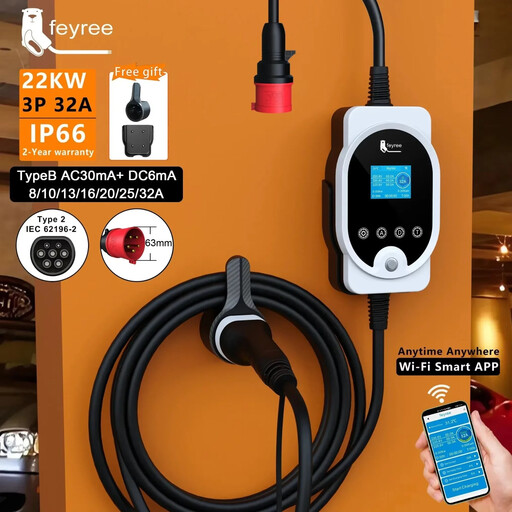
Why it's a good fit: This model combines full 22kW power with the flexibility of a portable charger. It's ideal for users looking for a cost-effective solution that can be used both at home and on the go with a CEE socket, without sacrificing smart features.
It integrates a Type B RCD (AC 30mA + DC 6mA), thus avoiding expensive retrofits. Control via the Tuya Smart App enables scheduled charging and flexible power adjustment.
Portable usability; comprehensive safety features (IP66); full app control for cost optimisation.
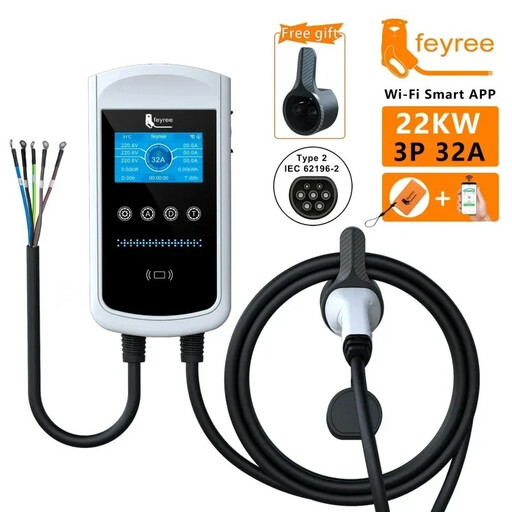
Why it's a good fit: For users who want maximum control and transparency. The large 4.3-inch display shows all charging data in real-time, while the app allows for detailed management of charging history and error logs. Ideal for data-driven EV drivers.
The app control is particularly well-developed here, offering detailed logs for the last 500 charging sessions. The integrated Type B protection and CE certification ensure safety and compliance.
Large 4.3-inch colour display; detailed charging and error logs; flexible current adjustment (8A-32A) via app and on the device.
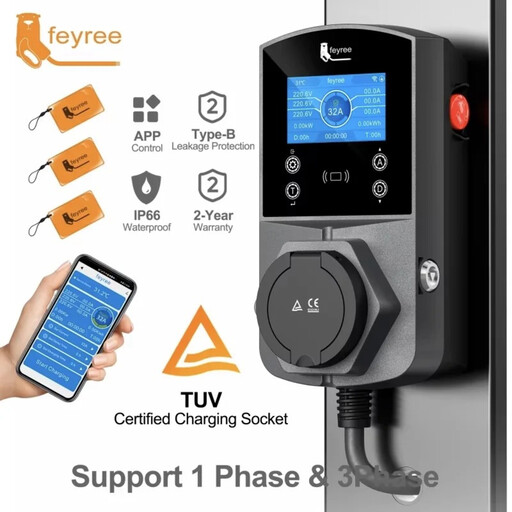
Why it's a good fit: This wallbox with a Type 2 socket instead of a tethered cable offers maximum flexibility. You can use charging cables of different lengths or types (e.g., Type 2 to Type 1). The electronic plug lock ensures security during the charging process.
It offers full app control for smart charging and cost management. The integrated Type B RCD and IP66 rating ensure a high level of safety with no hidden extra costs.
Flexibility through a Type 2 socket; electronic plug lock for enhanced security; robust, weatherproof design (IP66).
We have compiled a complete, up-to-date list of products that fully meet these strict selection criteria and German safety regulations.
Yes. In Germany, charging equipment with a power rating of more than 11 kW (which includes a 22kW wallbox) must be approved by the responsible grid operator before installation. The installation itself may only be carried out by a qualified electrician, who will typically also handle the application process for you.
Yes, that is possible without any issues. The wallbox and the vehicle communicate with each other to determine the maximum possible charging power. If your car can only accept 11 kW, the 22kW wallbox will automatically throttle the charging process to 11 kW. This means you are also future-proofed for vehicles with higher charging capacities.
Installation costs vary widely and depend on the on-site conditions. Factors include the distance from the fuse box to the wallbox, any necessary wall penetrations, and the condition of your home's electrical system. As a general rule, you can expect costs between €500 and €2,000 for a professional installation by an electrician. It is best to get several quotes for this.