
Lieferung heute & morgen

Qualitätsgarantie

Willkommens-Angebote freischalten: KOSTENLOSE Lieferung | Bis zu 80 % RABATT | Kostenlose 30-Tage-JoyPlus-Testphase
App herunterladen
A 230 V LED recessed spotlight 6-pack is ideal for a range of renovation projects. You can space the lights evenly throughout your bathroom, kitchen, living room or hallway. However, not every model will fit every ceiling. It’s not just the wattage and design that matter: recess depth, ceiling cut-out, IP rating and dimmer compatibility are all key considerations.
A light’s external dimensions don’t tell you whether it will fit the existing opening. For example, a model with a diameter of 145 mm may require a ceiling cut-out of 115 to 135 mm. Other flat LED spotlights are designed for openings of 90 to 100 mm or 145 to 160 mm.
Before you buy, measure:
When renovating, you can’t simply use the cover to make an oversized cut-out fit.
The IP44 rating protects against solid objects larger than 1 mm and water splashes from different directions. It’s therefore relevant for many indoor spaces and certain areas of the bathroom, but it doesn’t protect against direct jets of water or immersion.
For wetter environments, a model with IP65 may be more suitable. You’ll still need to take the specific bathroom installation zone and applicable installation requirements into account. Smart models with IP20, on the other hand, are intended for dry indoor spaces only.
Wattage describes power consumption, not brightness. Lumens are a more useful way to compare brightness. A 9 W model with 690 or 720 lumens won’t necessarily be as bright as a 10 W model with 1,050 lumens.
Light distribution also matters. A wide beam angle can be useful for even general lighting, while more focused LED ceiling spotlights can draw attention to specific areas.
Many 230 V LED recessed lights connect directly to a 220–240 V AC supply, so there’s no need for a separate transformer. This makes planning easier, but it doesn’t mean installation should be carried out without electrical expertise.
Switch off the power at the fuse box before installation. A qualified electrician should carry out the connection in accordance with applicable regulations. Models rated for 12 to 24 V must not be connected directly to the mains.
Ultra-flat recessed spotlights with a recess depth of around 25.5 mm are suitable for ceilings with limited cavity space. You’ll still need to check that there’s enough room for the cables, connector and light fitting.
Aluminium housings can help dissipate heat. PBT plastic and polycarbonate are also used in various models. Figures such as an average lifespan of 25,000 or 30,000 hours are manufacturer estimates and depend on factors including ambient temperature, switching cycles and installation.
With 3CCT recessed spotlights, you can usually select the colour temperature using a switch on the light fitting:
A 3CCT light isn’t automatically dimmable. For dimmable LED ceiling spotlights, you’ll also need to check whether a compatible trailing-edge or leading-edge dimmer is required. Not every combination will prevent flickering or buzzing.
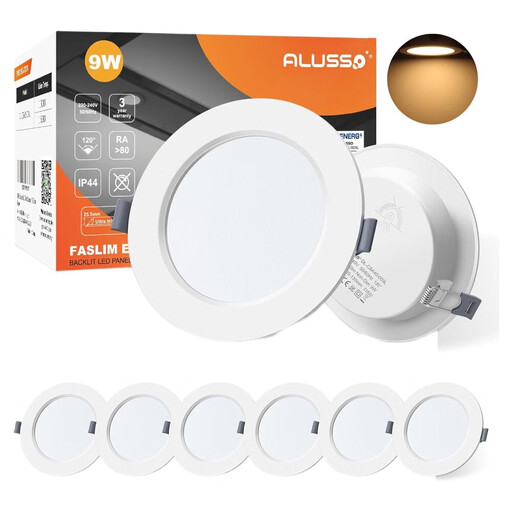
Why this product suits this profile: This set includes six warm white lights at 3000 K, each delivering 690 lumens, with a direct connection to 220–240 V. The recess depth is 25.5 mm.
The required ceiling cut-out of 115–135 mm and the recess depth are clearly stated. According to the product details, the lights aren’t dimmable, so you won’t risk planning to use them with a dimmer.
230 V direct connection, 25.5 mm recess depth and IP44 protection for suitable indoor areas.
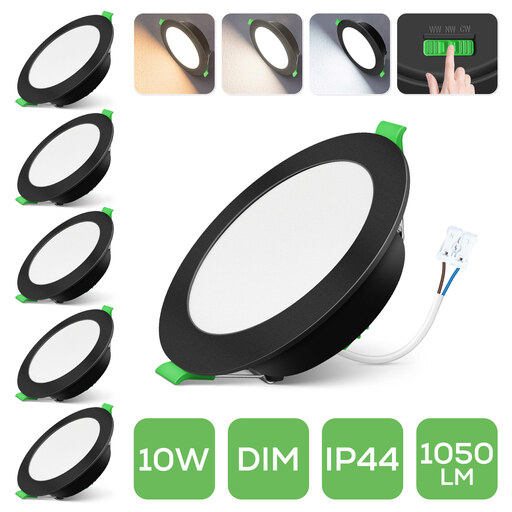
Why this product suits this profile: This model combines 3CCT settings of 3000, 4000 and 6500 K with a stated dimming range of 10 to 100 per cent when used with a compatible dimmer.
The required opening of 90–100 mm is smaller than that of many large ceiling lights. Dimming is also explicitly conditional on using a compatible dimmer.
1,050 lumens per light, an aluminium and polycarbonate construction, and a recess depth of 34 mm.
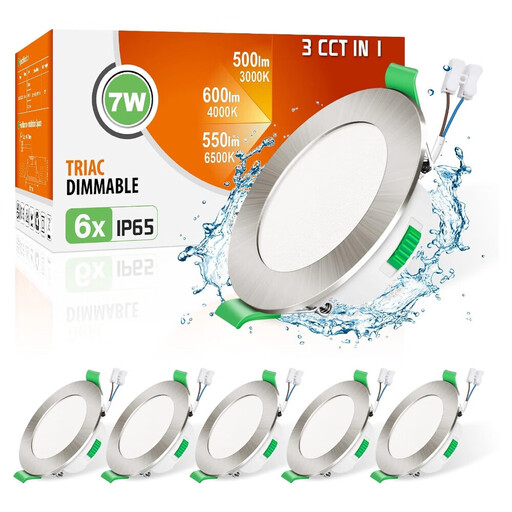
Why this product suits this profile: With IP65, 3CCT and a direct 230 V connection, this set is worth considering if you want to combine moisture protection, adjustable colour temperature and frequent use.
The IP65 rating is clearly specified. The required ceiling cut-out of 67–75 mm and installation by a qualified professional are also stated.
Dimmable from 10 to 100 per cent with a compatible trailing-edge dimmer, 3CCT and a recess depth of 29 mm.
We’ve put together a complete, regularly updated list of products that meet these strict selection criteria and comply fully with the safety regulations in force in the EU.
A direct 230 V connection involves work on the electrical installation. The power supply must be switched off before installation and secured against being switched back on. A qualified electrician should carry out the connection in accordance with the applicable German installation regulations.
Depending on the model, the product details for the options listed give an average lifespan of 25,000 to 30,000 hours. This is a manufacturer estimate, not a guarantee for every installation. Heat, frequent switching, moisture and unsuitable installation can all affect the actual lifespan.
With six lights rated at 9 W each, the maximum total connected load is 54 W. The cost depends on how many hours you use the lights each day and your electricity tariff. The calculation is:
Power in kilowatts × operating hours × electricity price per kilowatt-hour = running costs
With dimmable models, reducing the brightness can lower power consumption. However, the actual figure depends on the light source and the dimmer you use.