
Lieferung heute & morgen

Qualitätsgarantie

Willkommens-Angebote freischalten: KOSTENLOSE Lieferung | Bis zu 80 % RABATT | Kostenlose 30-Tage-JoyPlus-Testphase
App herunterladen
230 V LED recessed spotlights are ideal for renovations, new builds, and replacing older halogen lights. They connect directly to the household mains at 220–240 V and, with suitable models, do not require a separate transformer. Before buying, however, wattage and design are not the only factors that matter. Cut-out diameter, installation depth, IP rating, and dimmer compatibility determine whether the LED recessed spotlight will actually fit the existing ceiling and can be used safely.
A shallow installation depth is practical for low ceilings or suspended structures. Nevertheless, there must be sufficient space behind the light for connection cables, terminals, and heat dissipation. A model with a light fitting depth of 25.5 mm may be suitable for a particular ceiling, but the required connection space above it must still be checked.
The ceiling cut-out is also critical. Depending on the model, specifications may include 67–75 mm, 90–100 mm, 95–110 mm, or 145–160 mm, for example. An oversized cut-out cannot be reliably compensated for with a smaller spotlight.
An IP44 LED spotlight is protected against solid foreign objects measuring 1 mm or more and against splashing water from various directions. This may be suitable for many bathroom areas, kitchens, and covered balconies. However, IP44 does not mean that the light is suitable for direct jets of water, consistently high humidity, or immersion.
An IP65 LED spotlight additionally provides a higher level of protection against dust and water jets. Even so, the installation location, mounting conditions, and local electrical regulations must be taken into account. Special protection zones apply to areas immediately surrounding showers or bathtubs. Installation in these areas should be carried out by a qualified electrician.
With dimmable LED recessed spotlights, performance depends on the dimmer being used. The product specifications for the models presented here state compatibility with phase-cut, or trailing-edge, dimmers. An older halogen dimmer may cause flickering, buzzing, or a restricted dimming range.
Before buying, check the following:
An LED spotlight without a transformer is connected directly to a 220–240 V AC supply. This reduces the number of additional components, but it does not eliminate the need for professional wiring. Before installation, the circuit must be switched off at the circuit breaker and secured against being switched on again.
For these products, the specifications “230 V” and “220–240 V AC” describe the intended mains voltage range. Terminals, cable cross-section, and installation must comply with the applicable German regulations.
Measure the existing ceiling cut-out at several points. For replacement projects, the outer diameter and the position of the retaining springs are also relevant. An overview of the sizes mentioned:
Depending on the design, installation depth ranges from approximately 25.5 to 34 mm. Before buying, also check whether insulation material or other components could obstruct heat dissipation.
The lumen rating describes luminous flux, not necessarily the perceived brightness in a room. According to the product specifications, a 7 W model can deliver up to 600 lm, while a 10 W model is rated at 1050 lm. Planning should also take into account the number of spotlights, the size of the room, and the beam angle of the light.
With a 3CCT LED ceiling spotlight, the colour temperature can usually be selected using a switch on the light fitting:
Set the desired colour temperature before installation if the switch will no longer be accessible after mounting. A higher Kelvin value does not automatically mean greater brightness.
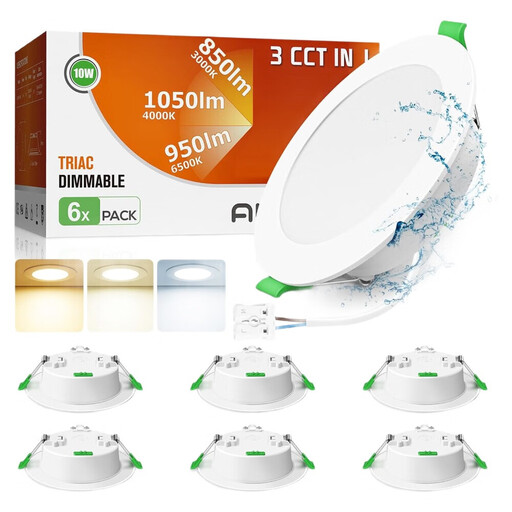
Why This Fits Their Persona: This six-piece set is appealing to renovators who want to equip several rooms or a continuous ceiling area. The choice between warm white, neutral white, and cool white is made via 3000, 4000, or 6500 K.
The manufacturer specifies a required ceiling cut-out of 90–100 mm and a depth of 34 mm. This allows the installation dimensions to be checked precisely before ordering.
According to the product specifications: 1050 lm per light, dimmable from 10 to 100 percent with a compatible dimmer, direct 220–240 V connection, and IP44 protection.
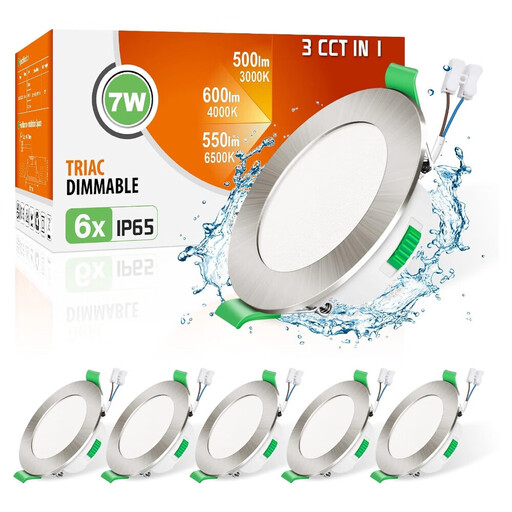
Why This Fits Their Persona: This model is suited to buyers who prioritise a higher protection rating and compact design for bathrooms, kitchens, or covered outdoor areas.
The IP65 rating is clearly specified and is not presented as blanket suitability for every wet zone. The 67–75 mm cut-out prevents buyers from ordering based solely on the housing size.
According to the product specifications: 29 mm installation depth, 500/550/600 lm, 3CCT selection, dimmable from 10 to 100 percent, and direct 230 V connection.
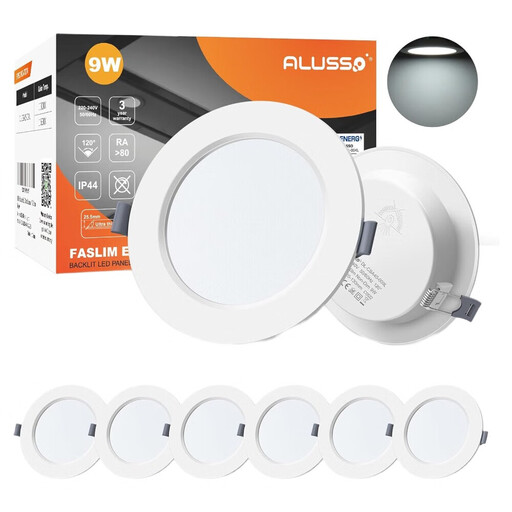
Why This Fits Their Persona: For rooms with limited ceiling height, such as bathrooms, hallways, or living rooms, the shallow installation depth is the key advantage. The fixed cool-white colour temperature suits users who do not require adjustable CCT.
This model is explicitly non-dimmable. That helps prevent a common purchasing mistake when brightness adjustment is not required.
According to the product specifications: 25.5 mm installation depth, 115–135 mm cut-out, 720 lm per spotlight, IP44 protection, and direct 220–240 V connection without a transformer.
For kitchens and living rooms, LED recessed lights with a warm-white or neutral-white setting are often a practical choice. Warm white can create a discreet, comfortable lighting effect in bedrooms and hallways. In bathrooms, the IP rating should be matched to the installation conditions above all else, alongside the chosen light colour.
Our current selection includes further products for different installation locations, protection ratings, and ceiling-lighting requirements.
A direct 230 V connection is technically possible without a transformer, but it involves working with mains voltage. In Germany, the connection, protective conductor testing, and commissioning should be carried out by a qualified electrician. Tenants should also observe any landlord and installation requirements that apply to the property.
The products mentioned are rated for an average service life of 25,000 to 30,000 operating hours, depending on the model. These figures come from the respective product specifications and do not guarantee an identical service life in every household. Heat, frequent switching, inadequate ventilation, and moisture can affect longevity.
Running costs depend on power consumption, daily usage, and the electricity price. At the same operating time, a 7 W spotlight theoretically uses less electrical power than a 50 W halogen light. For a fair comparison, consider the total installed wattage of all spotlights and the energy efficiency class of the specific model.