
Lieferung heute & morgen

Qualitätsgarantie

Willkommens-Angebote freischalten: KOSTENLOSE Lieferung | Bis zu 80 % RABATT | Kostenlose 30-Tage-JoyPlus-Testphase
App herunterladen
If you’re looking for 230 V LED recessed spotlights for your bathroom, kitchen, living room or bedroom, you’ll find plenty of sets with similar product images but very different technical specifications. Wattage and design aren’t the only things that matter. The wrong cut-out diameter, an installation depth that’s too great or an unsuitable IP rating can make installation more difficult and lead to extra costs.
This buying guide explains which details really matter when choosing LED ceiling spotlights, and which options suit different homes.
The visible trim of a recessed spotlight doesn’t necessarily match the size of the existing ceiling opening. What matters is the ceiling cut-out: the diameter of the hole the spotlight fits into.
For example:
So make sure you measure the existing opening accurately before you buy. If it’s too large, the side springs may not hold securely. If it’s too small, the ceiling will need to be adjusted.
For low ceilings or limited cavity space, installation depth is an important factor. The reference models, for example, range from 25.5 mm to 34 mm. You’ll also need to allow space for cables and connectors, as well as heat dissipation.
An LED recessed spotlight without a transformer connects directly to AC 220–240 V. This makes planning simpler, but it doesn’t remove the need for a safe, professional electrical installation. Before carrying out any work on the ceiling, switch off the power at the circuit breaker. A qualified electrician should make the connection in line with current regulations.
An IP44 LED recessed spotlight is protected against solid objects larger than 1 mm and splashing water from any direction. This doesn’t mean it’s suitable for a direct jet of water, inside a shower or for immersion.
When choosing a bathroom recessed spotlight, you should also consider the installation zone, distance from water sources and local electrical regulations. IP65 offers greater protection against dust and water, but it must still be suitable for the specific installation location.
Light colour is measured in Kelvin:
With 3CCT LED ceiling lights, you can select the colour temperature using a switch on the light fitting. This is useful if you think you may use the room differently in future. Bear in mind that 3CCT doesn’t automatically mean you can change the light colour using a wall switch or remote control. With the models mentioned here, you select the setting before or during installation.
Wattage tells you how much electricity a light uses, not how bright it is. For that, you need to look at the luminous flux, measured in lumens. The models available range, for example, from 430 lm at 6 W to 1,200 lm at 15 W per spotlight.
When choosing a 6-piece LED spotlight set, also check:
Claims such as “replaces 72 W halogen” are manufacturer comparisons. They shouldn’t be taken to mean that the light distribution will be identical.
Not every LED ceiling spotlight is dimmable. If a product is specifically described as dimmable LED recessed spotlights, you’ll also need to check that your trailing-edge or leading-edge dimmer is compatible. Otherwise, the lights may flicker or hum, or offer a limited dimming range.
According to the product specifications, some models can be adjusted from 10 to 100 per cent. Non-dimmable versions are a better choice for installations where a constant brightness is all you need.
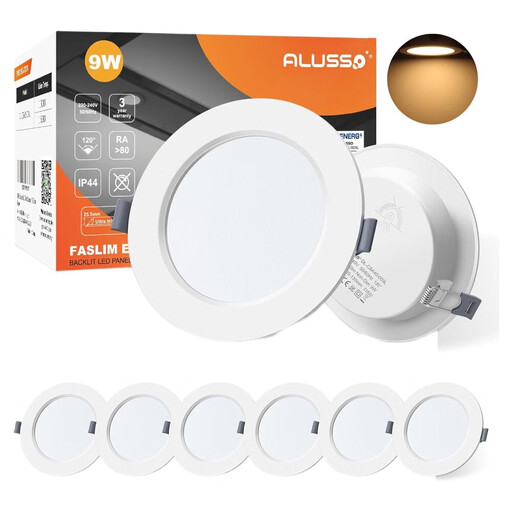
Why it suits this profile: This set includes six warm-white spotlights, with a direct 220–240 V connection and an installation depth of 25.5 mm. It’s suitable for renovations where ceiling space is limited and the cut-out measures 115 to 135 mm.
The cut-out size, installation depth and connection details are clearly stated. However, don’t mistake the IP44 rating for protection against direct water jets.
9 W, 690 lm per spotlight according to the product specifications, 3000 K and a direct 230 V connection without a separate transformer.
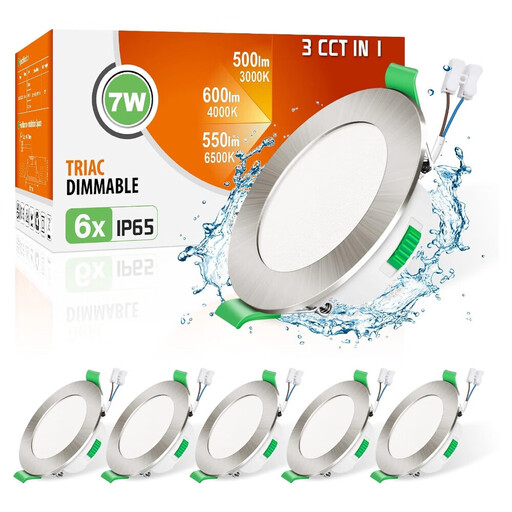
Why it suits this profile: This model combines a shallow 29 mm installation depth with IP65 protection, three selectable colour temperatures and dimming. It fits small ceiling cut-outs measuring 67 to 75 mm.
IP65 offers greater protection against dust and water than IP44. For dimming, you’ll still need to check compatibility with your existing dimmer.
7 W per light, 3000/4000/6500 K, a dimming range of 10 to 100 per cent according to the product specifications, and a direct 230 V connection.
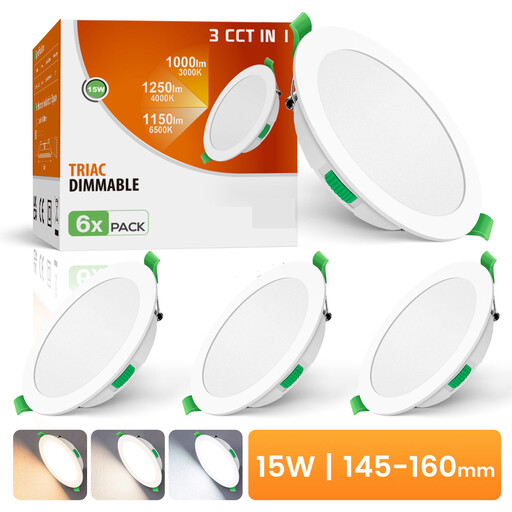
Why it suits this profile: This set is designed for rooms where each light needs to produce a higher luminous flux. It offers 1200 lm, a 3CCT setting, dimming and an installation depth of 32 mm.
The product specifications clearly state the cut-out size, luminous flux, colour temperatures and IP44 rating. Check that the larger 145 to 160 mm cut-out will fit your ceiling before ordering.
15 W, 1200 lm, 3000/4000/6500 K, a 120-degree beam angle and dimming with compatible phase-control dimmers.
We’ve put together a complete, regularly updated list of products that meet these strict selection criteria and fully comply with the safety regulations in force in the EU.
Before buying and installing, make sure you’ve checked the following:
Models with an integrated connection for AC 220–240 V are designed for direct connection to the mains, according to the product specifications, and don’t need a separate transformer. Mains connections must only be made with the power switched off and in accordance with current safety and electrical regulations. A qualified electrician should carry out the installation.
Several of the models mentioned are rated for an average lifespan of 25,000 to over 30,000 hours. This is a manufacturer’s estimate and depends, among other things, on the ambient temperature, ventilation, mains conditions and correct installation. Make sure heat can dissipate properly, and don’t let insulation or an unsuitable ceiling opening restrict airflow around the light.
Consumption depends on the wattage of each light. A 6-piece set with 9 W spotlights uses 54 W at full power, while a set with 15 W spotlights uses 90 W. With dimmable models, actual consumption may be lower depending on the brightness setting and how long the lights are on. So, to work out your running costs, consider the wattage, how long you use the lights and your electricity tariff together.