
Lieferung heute & morgen

Qualitätsgarantie

Willkommens-Angebote freischalten: KOSTENLOSE Lieferung | Bis zu 80 % RABATT | Kostenlose 30-Tage-JoyPlus-Testphase
App herunterladen
If you are looking for several 230 V LED recessed spotlights for the bathroom, kitchen, hallway or living room, you should consider more than wattage and product images. Key factors include installation depth, ceiling cut-out size, moisture protection and the desired light colour. An inexpensive set may be unsuitable if the existing ceiling cut-out does not match or the light is not compatible with a dimmer.
This buying guide from the Joybuy Product Recommendation Officer provides an objective overview of the most important criteria and presents a selection of suitable models for different living environments.
LED recessed spotlights designed for direct connection to 220–240 V AC generally do not require a separate transformer. This simplifies planning, but it does not automatically make installation a suitable DIY task. Before working on an electrical installation, the circuit must be switched off and secured against being switched on again. In Germany, the connection should be carried out by a qualified electrician in accordance with applicable regulations.
Also check whether the delivery includes a connection cable, terminal block or driver. These details have a direct impact on the actual installation effort.
IP44 means protection against solid foreign objects measuring 1 millimetre or more, as well as splash water from various directions. This can be suitable for many LED recessed lights for bathrooms or kitchen areas, provided the installation zone and the instructions permit it. However, IP44 does not protect against direct water jets, continuous exposure to water or immersion.
For damp rooms, you must also consider the specified protection zones, the distance from water sources and professional installation. When looking for a suitable LED damp-room light, you can find further models for different applications.
An LED ceiling spotlight with 6500 K produces a very cool white light. It appears bright and functional, but may feel less inviting in a bedroom or living room than 3000 K. Cool white light can, however, be useful for work surfaces, utility rooms or certain bathroom areas.
Models with a 3CCT function generally offer 3000 K, 4000 K and 6500 K. Check whether the colour temperature is selected via a switch before installation or can be adjusted later using a control system.
Before buying, measure the existing cut-out in the ceiling or mounting surface. Product specifications distinguish between the outer diameter and the required installation diameter. For example, some slim spots require a cut-out of 95–110 mm, while other models require 145–160 mm.
Installation depth is particularly important for suspended ceilings or shallow cavities. Models with an installation depth of around 25.5 mm are among the slimmer options. There must also be sufficient space behind the light for cables and connections.
Wattage indicates energy consumption, not brightness in itself. For comparisons, luminous flux in lumens is more meaningful. A 6 W model delivering 430 lm will illuminate differently from a 10 W model delivering 1050 lm. The required brightness depends on room size, ceiling height, beam angle and the number of lights installed.
With a 6-piece LED recessed spotlight set, distinguish between the stated luminous flux per light and that of the complete set. Even, well-planned positioning is generally more important than a single particularly bright light.
Not every LED recessed spotlight is dimmable. If a light is labelled “dimmable”, the correct type of dimmer must also be used. The model may, for example, be designed for a trailing-edge dimmer. An incompatible dimmer can cause flickering, buzzing or a restricted dimming range.
Non-dimmable models should explicitly not be connected to a dimmer. For flexible lighting plans, dimmable LED recessed spotlights with clearly stated compatibility are the better choice.
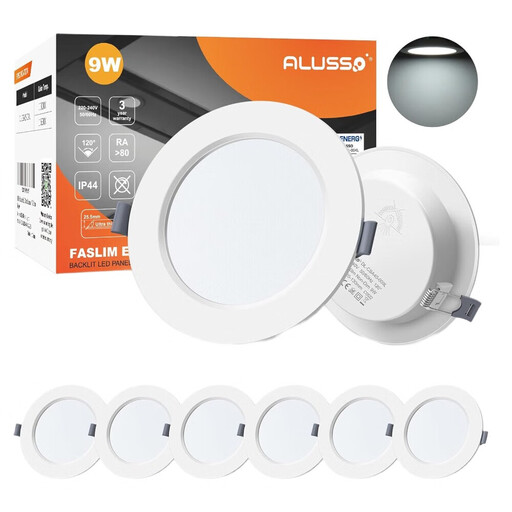
Why This Fits Their Persona: This set is suited to renovators who need several matching recessed lights for indoor spaces with limited installation depth. The light colour is 6500 K.
The specifications state a ceiling cut-out of 115–135 mm, an installation depth of 25.5 mm and IP44 protection. This allows the dimensions to be checked carefully before purchase.
9 W, 720 lm per light, direct connection to 220–240 V and a stated service life of more than 30,000 hours. Not dimmable.
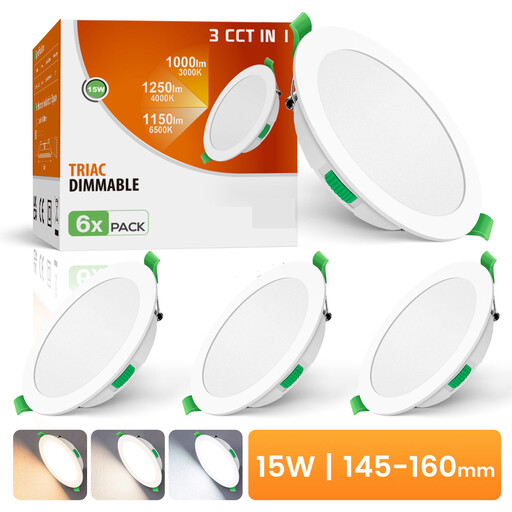
Why This Fits Their Persona: Ideal for households that want to switch between warm white, neutral white and cool white light—for example, between the living room, kitchen and bathroom.
The 3CCT selection of 3000 K, 4000 K and 6500 K reduces the risk of being stuck with an unsuitable light colour. The dimming range is specified as 10–100%.
1200 lm per light, IP44 protection, direct 230 V connection and a required ceiling cut-out of 145–160 mm. A compatible phase-control dimmer is required.
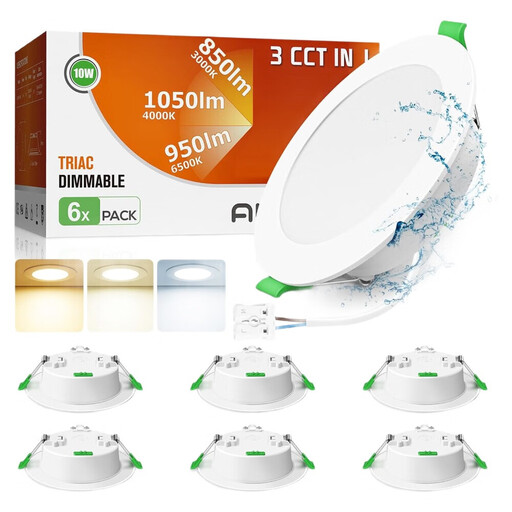
Why This Fits Their Persona: The combination of high stated luminous flux, selectable colour temperature and dimming makes this a good fit for users planning adaptable general lighting in the kitchen, bathroom or hallway.
The technical specifications explicitly state a cut-out of 90–100 mm and the required dimmer compatibility. This helps prevent installation and control issues before work begins.
1050 lm per light, selectable 3000/4000/6500 K, dimmable from 10–100% and a construction height of 34 mm. IP44 is suitable only for areas exposed to splashing water.
We have compiled an up-to-date selection of products that take these criteria and the relevant safety requirements for use in Germany into account.
Direct connection to 230 V involves a risk of electric shock and fire. Switch off the circuit before carrying out any work. In Germany, the electrical connection should be performed by a qualified electrician and matched to the existing installation. Bathrooms are subject to additional requirements, particularly regarding protection zones and cable routing.
Product specifications often state an average service life, such as 25,000 or 30,000 hours. This figure is not a binding guarantee for every installation environment. Heat generation, operating time, power quality and compliance with the installation instructions all affect the actual service life. Adequate ventilation and a correctly sized installation opening are therefore important.
Running costs depend on power rating, operating time and the electricity tariff. The simple calculation is: Wattage ÷ 1000 × operating hours × electricity price. For example, a 10 W spotlight operated for 1,000 hours consumes 10 kWh. With a six-light set, add the wattage of each individual light when all of them are switched on at the same time.