
Lieferung heute & morgen

Qualitätsgarantie

Willkommens-Angebote freischalten: KOSTENLOSE Lieferung | Bis zu 80 % RABATT | Kostenlose 30-Tage-JoyPlus-Testphase
App herunterladen
230 V LED recessed spotlights can be connected directly to the household AC mains. Many models do not require an additional transformer. However, LED recessed spotlights vary considerably in terms of installation depth, ceiling cut-out, brightness, colour temperature and suitability for damp areas.
Anyone simply searching by wattage or for a low-cost set may overlook important details. Three common purchasing problems occur particularly often:
Before buying, measure the existing ceiling opening. The key measurement is not just the external diameter of the visible light, but above all the specified cut-out diameter.
Installation depth is equally important. In suspended ceilings or renovations where cavity space is limited, 25.5 to 34 mm can make a significant difference. Despite their slim design, LED ceiling spotlights may come into contact with cables, profiles or insulation material. The connection cable and the necessary clearance for heat dissipation must also be taken into account.
For a 230 V LED recessed spotlight, the technical specifications should state an input range of 220–240 V AC or explicitly specify 230 V AC. These models are generally connected without an external transformer.
Not every product with a similar appearance is suitable for direct mains connection. A 12–24 V spotlight requires a suitable transformer. The 12–24 V, 4 W light available in the range must therefore not be connected directly to 230 V. A qualified electrician must be involved when carrying out work on the mains connection. Before installation or maintenance, the relevant circuit must be switched off and secured against being switched on again.
Wattage describes power consumption, not brightness alone. Luminous flux, measured in lumens (lm), is the important factor here. A model with 430 lm is suitable for a different lighting plan than a spotlight with 1,050 lm.
Colour temperature also affects the atmosphere of a room:
With 3CCT LED recessed spotlights, the colour temperature can be selected on the light fitting. The setting should be chosen before installation if the switch will no longer be accessible afterwards.
A light is not automatically dimmable. With dimmable LED recessed spotlights, the dimmer type must be compatible with the light. According to the product specifications, the 10 W model in the selection can be adjusted from 10 to 100 per cent and requires a compatible trailing-edge dimmer. A non-dimmable light must not be connected to an external dimmer.
IP44 means protection against solid foreign objects measuring 1 mm or more, as well as protection against splashing water. This protection rating may be suitable for certain areas in bathrooms or kitchens, provided the installation location, installation zone and local requirements are taken into account. However, an IP44 LED recessed spotlight must not be installed where direct water jets or immersion are possible.
IP65 additionally provides complete protection against dust and protection against water jets from any direction. An IP65 LED recessed spotlight may therefore be more suitable for environments with higher levels of moisture. Nevertheless, the protection rating of the complete installation, including connection points and any components used, must also be considered. A qualified electrician should assess whether a light is suitable for a specific area of the bathroom.

Why this product suits this profile: This set of six spotlights is ideal for buyers who need several lights with a shallow installation depth for indoor spaces. The specified cut-out is 95–110 mm, while the installation depth is 25.5 mm.
The details on the ceiling cut-out, installation depth and 230 V connection make it easier to check compatibility before buying. According to the product data, the light is not dimmable.
6 W, 430 lm, 6,500 K, IP44 and direct connection to 220–240 V AC.
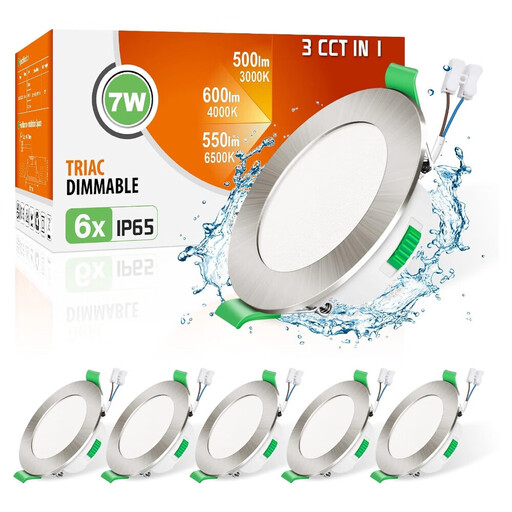
Why this product suits this profile: This model combines a 29 mm installation depth with IP65, three selectable colour temperatures and dimmability. It is therefore suitable for users who want to take several technical parameters into account when planning their lighting.
IP65 helps prevent confusion with models that only offer splash protection. The 67–75 mm cut-out must be checked precisely before ordering.
3CCT with 3,000, 4,000 and 6,500 K, dimming range of 10–100 per cent and a stated three-year guarantee.
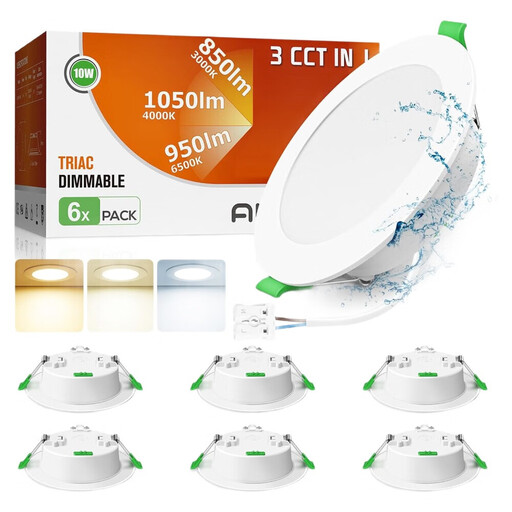
Why this product suits this profile: The combination of 1,050 lm, a 3CCT selection and dimmability is ideal for rooms that need different levels of lighting depending on the time of day or how they are being used.
Dimming requires a compatible trailing-edge dimmer. This highlights the need to ensure that the light and the existing control system work together.
90–100 mm cut-out, 34 mm installation depth, 3,000/4,000/6,500 K and 10–100 per cent dimming range.
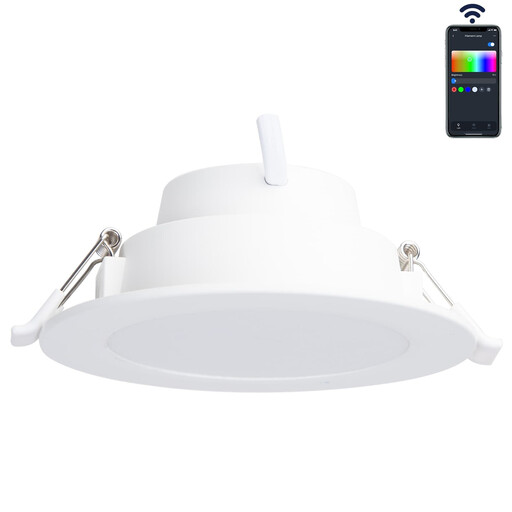
Why this product suits this profile: This light is designed for users who want to manage colour changes, colour temperature and dimming via an app or voice control.
The IP20 protection rating is clearly stated. This model is intended for dry indoor spaces and is not suitable for bathrooms or other damp areas.
RGB+CCT, 2,700–6,500 K, 780 lm, Bluetooth Mesh and app-based dimming.
We have put together a complete, regularly updated list of products that fully meet these strict selection criteria and the safety regulations applicable in the EU.
Connecting directly to 230 V involves work on an electrical installation. Installation and testing should be carried out by a qualified electrician in accordance with the applicable regulations. The voltage, connection terminals, installation clearance and ceiling structure must be checked beforehand.
Depending on the version, the product specifications for the models featured state around 25,000 to 30,000 operating hours. This is a guideline and depends, among other things, on the ambient temperature, heat dissipation, switching cycles and correct installation. A covered housing can impair heat dissipation.
The cost depends on the power rating, operating time and electricity tariff. For example, six lights rated at 6 W each have a total power consumption of 36 W. With three hours of daily use, this corresponds to 0.108 kWh per day. For a realistic calculation, multiply this consumption by your own electricity price per kilowatt-hour. The decisive factor is therefore the actual wattage per spotlight, not just the advertised halogen-equivalent output.