
Lieferung heute & morgen

Qualitätsgarantie

Willkommens-Angebote freischalten: KOSTENLOSE Lieferung | Bis zu 80 % RABATT | Kostenlose 30-Tage-JoyPlus-Testphase
App herunterladen
If you're looking for 230 V LED recessed downlights, you probably want to avoid an extra transformer, need a shallow installation depth, and wish to create the right lighting atmosphere. In practice, however, buying mistakes often arise not from the LED technology itself, but from unsuitable installation dimensions, misjudged splash-water protection, or incompatible dimmers.
This buying guide from the Joybuy Product Recommendation Officer will help you assess technical specifications objectively and select suitable models for bathrooms, kitchens, hallways, bedrooms and living areas.
The outer diameter of a light fitting is not automatically the measurement for the ceiling cut-out. At least three specifications are crucial:
An ultra-flat recessed light may be suitable for low ceilings, but it still requires a specific opening. Before buying, measure the existing hole precisely. When renovating with pre-existing cut-outs, this measurement is often more important than the wattage.
An IP44 recessed downlight is protected against solid foreign objects and splashing water from various directions. However, this protection rating does not mean the light is suitable for direct water jets, continuous spraying, or immersion.
For LED lighting in the bathroom, you should also consider the installation situation. Areas with direct contact with water have special requirements for electrical installation and protection zones. Connection to 230 V should therefore be carried out by a qualified electrician in accordance with current regulations.
With dimmable LED recessed spots, the dimmer must match the light fitting. Some models, for example, require a leading-edge or trailing-edge dimmer. An unsuitable device can cause flickering, humming, or a limited dimming range.
The description "dimmable from 10 to 100 per cent" only indicates the intended range under suitable technical conditions. Check your existing wall dimmer for LED compatibility before installation.
A 230 V direct LED spot is typically connected to 220–240 V AC and does not require a separate transformer. This can simplify planning, but does not replace professional installation. Before working on the ceiling, switch off the circuit at the fuse box and secure it against being switched back on.
Wattage describes energy consumption, not directly the brightness. For comparison, luminous flux in lumens is more meaningful. A model with 10 W and 1,050 lm, for example, delivers a different amount of light than a 6 W model with 430 lm.
Colour temperature is given in Kelvin:
A 3CCT LED spot with 3,000 K, 4,000 K and 6,500 K allows you to select the colour directly on the light housing. This is handy when you want to decide on the room's atmosphere after installation. However, this selection does not replace separate lighting planning for larger rooms.
With flat LED ceiling spots and ultra-flat recessed lights, the available ceiling height is crucial. Models with 25.5 mm or 32–34 mm installation depth can be suitable for suspended ceilings with limited cavity space. At the same time, adequate heat dissipation must be ensured.
Aluminium can help with heat dissipation. Polycarbonate or flame-retardant PBT are often used for covers and housings. The key comparable specifications are the stated dimensions, luminous flux, protection rating, colour temperature, and dimmer compatibility.

Why this product fits the profile: This set of six lights is ideal for users who want to equip multiple ceiling points at once and need a shallow installation depth. The lights are designed for 95–110 mm cut-outs.
The specifications clearly state the installation depth, cut-out size and IP44 rating. The model is also marked as non-dimmable, preventing an unintended combination with a dimmer.
25.5 mm installation depth, 430 lm per light, 230 V direct connection and IP44 protection rating.
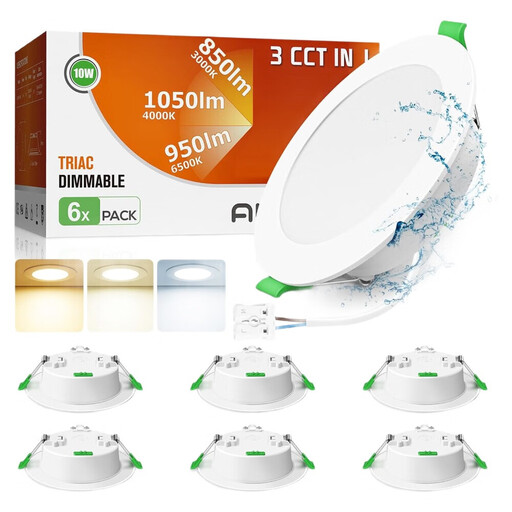
Why this product fits the profile: The combination of selectable light colour and dimming function offers more adjustment options for rooms used in different ways, such as kitchens, bathrooms and living areas.
The three colour temperatures are selectable on the housing. The dimming function is designed for use with a compatible trailing-edge dimmer and should not be combined with just any dimmer.
10 W, 1050 lm per light, 3CCT with 3000/4000/6500 K, dimmable from 10 to 100 per cent and 34 mm installation depth.
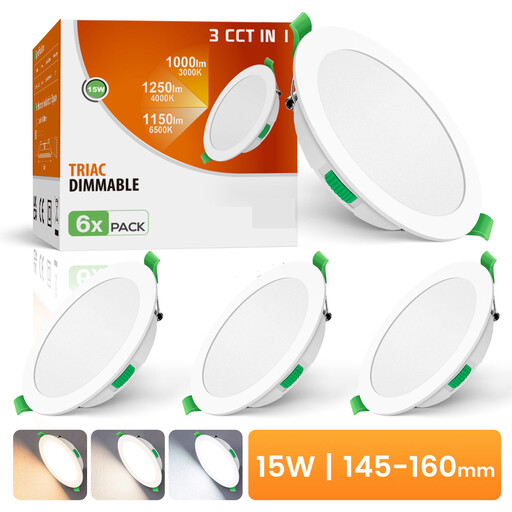
Why this product fits the profile: This model is aimed at users with larger cut-outs and higher light requirements, for example during a comprehensive renovation of a living area, hallway or bathroom.
The required ceiling cut-out of 145–160 mm is clearly stated. This allows you to check in advance whether the light will fit into your existing structure. IP44 is understood as splash-water protection, not protection against direct water jets.
15 W, 1200 lm, 120-degree beam angle, three light colours and dimming function from 10 to 100 per cent.
We have compiled a complete, regularly updated list of products that fully meet these strict selection criteria and the safety regulations in force in the EU.
Before ordering or installing, tick off these points:
Models explicitly marked for 220–240 V or 230 V connection are designed for direct connection without a separate transformer. However, the electrical installation should still be carried out by a qualified professional in accordance with regulations.
IP44 models can be intended for damp indoor spaces such as bathrooms or kitchens. The specific position within the bathroom is crucial. Direct water jets, continuous spraying and immersion are not covered by IP44 protection.
For the models mentioned, around 25,000 to 30,000 operating hours are stated, depending on the product. This figure is a manufacturer's specification and depends on factors such as ambient temperature, ventilation, mains conditions and daily usage duration.